
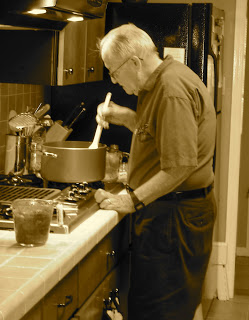
As my father-in-law and I prepare supper together, I joke that we should have our own television cooking program. He is an avid fan of Rachel Ray, the speed queen of cooking, and Paula Dean, the maven of butter and sugar. As he chops the celery, he asks, “What should we call our show?” I say, “Cooking with Dad.” He smiles. I can tell that he gets satisfaction from helping to cook. Even more than that, he likes being called “Dad.”
After he was 70 years old and had retired as a mechanical engineer, my father-in-law worked at a fast food restaurant. For more than 10 years, he would get up each morning at 4:00 a.m. to open the restaurant and prepare the grills for the breakfast crowd. The franchised restaurant chain hired all part-time employees, with the exception of the store manager. Most of these employees were teenagers struggling with the adjustment of becoming adults. They relied on this grandfatherly person for his advice and his good humor. And, they called him “Dad.”
It has been difficult for me to call my father-in-law “Dad.” It somehow does not feel fair to my biological father. My Dad established a relationship with me even before I was born, and continues that bond even after his death.
My father-in-law is now in his late 80’s and I feel the increasing weight of becoming responsible for his well-being. He can walk only a few yards before he becomes short of breath. He insists this is from allergy, not the heart disease the doctor mentioned. As he pitches his body forward in an unbalanced stride, I find myself playing a more “Mother Hen” role than acting like a daughter to him. “Don’t forget your cane!” I say as we leave the house together. “Watch out for that bump on the sidewalk.” He makes a sour face because he does not want to admit he is vulnerable to broken bones. He is struggling with the adjustment to old age. He still wants to be the protective one, not the protected.
But when we cook together at the end of each day, the relationship is transformed. Mimicking my own mother’s voice, I lay out the jobs that need to be accomplished and divide the tasks between the two of us. “You chop the celery and I’ll peel the potatoes,” I say. He can enjoy re-experiencing the roll of protector. “Don’t forget to put on the oven mitts. The pan is hot, you know,” he warns. Together we work to prepare the family meal. It is not just the food that will sustain us and comfort us; it is the sharing of the care giving.

 My Turn