
At the prompt of a friend I am writing to the same title as a recent guest blog in Scientific American.
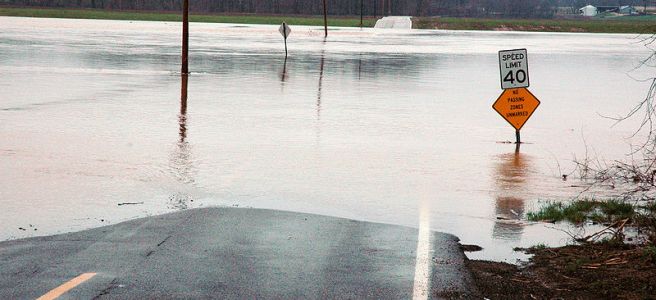
As I drove around the curve of the winding country road, I saw in the distance that the long stretch of pavement ahead seemed to be flooded. There had been no other cars pass me on the road that afternoon. That didn’t seem unusual this far away from the city. I was exploring new territory with no particular destination in mind. I continued to drive along the narrow road, wondering if the spot that appeared to be wet was a mirage created by the heat. It was a steamy afternoon, and I was enjoying the ride, besides there seemed to be no easy way for me to turn the car around, so I kept driving forward. As I got closer, I could see a body of water on either side of the road; closer still I could see that the water had overflowed its banks and was covering the road. The water appeared to be calm, a mirror of the sky above. Now when I looked ahead I could not see a point where the road reemerged. It was as if the road had disappeared beneath the water. Had I missed a sign that said, “boat ramp?” Irrationally I kept driving, wondering if my car would hydroplane, float or sink.
As I awoke from the dream, I sobbed uncontrollably.
I was raised to believe that anger and sadness were out of place. Anger was more than inappropriate; it was dangerous for me and for those around me. It had the power to displace me. “Go to your room and stay there until you calm down,” my mother would say.
I remember an illustration in one of my children’s books of a child kicking a tree and longed to do the same, but I knew that I would begin a hematoma in my foot that would require ice and perhaps even a trip to the Emergency Room of the hospital. Eventually I constructed a wall to hold the anger in and channel it away. When I went into therapy as an adult, the therapist asked, “Aren’t you angry?”
I could only reply, “What good would that do?”
The anger didn’t all flow down stream; some came out in short spurts of sniping sarcasm. The tears I shed were mostly in movie theaters. The barrier walls were strong enough to contain my emotions even though the levees made them run faster and rise higher. I could see the evidence as the blood pressure cuff squeezed tight and then released around my wrist.
I reinforced the embankment of defenses to control my anger and my sadness. I reasoned that displaying either would only make the ones I loved fearful and sad too and I certainly did not want that. “Smile and the world smiles with you, cry and you cry alone,” was the refrain. It didn’t make me feel any happier or any less alone.
Being in control is an illusion, I learned. The climate around me was changing and the old ways of coping were inappropriate for the conditions of my life now.
In the same way that the levee works well when the water volume is moderately increased, and not so well when there is a torrential flood, I started having recurring dreams about water after four of my cousins and both of my parents died within the space of two years. I was living on an internal flood plain and I didn’t know it consciously. If I remove the containment walls and let the water spread wide, will I find myself on fertile ground?

 My Turn
I really like the metaphor, cuz.If you let down the walls you'll be either on fertile ground or swimming.Either would be good.
LikeLike
Linda, I really like this piece. It is beautifully written, revealing, and full of wisdom. And, yes, I believe you'll find yourself on fertile ground. More power to you!
LikeLike
Very nice! I'm following your blog. I do believe I can learn from you, you write so very well.
LikeLike