
Squatting on the ground, my eyes stared at the hole in the sand; I watched ants slide one at a time down the slope and into the waiting grasp of the antlion. I couldn’t see the antlion and neither could the ant. As soon as the ant began to lose it’s footing, however, it seemed to know that it was in trouble. Sometimes an ant would make a brave attempt to climb back up and escape to freedom. When this happened, a sand-pebble barrage would shoot from the hole in the middle of the funnel, knocking the ant off balance and rolling it down hill once again. I routed for each ant, but very few made it out to freedom.
Author: Linda Wright
The Power of Positive Choices
Recently I saw a quote from Norman Vincent Peale posted on Facebook. “Live your life and forget your age.” I felt as if I had been hit with a jolt of indignation. Forget my age? I like my age! I can’t really take credit for it, but it came as an unexpected surprise when I celebrated my 62nd birthday. That’s not something I want to forget because, with a bleeding disorder there were lots of medical professionals along the way who predicted a substantially shorter life span for me. When I was twelve years old and too big to crawl under the desk, I did not morn that my body had grown. Why now would I want to feel sorry that at the age of 62 there are things I cannot do that were easy when I was younger?
However, that wasn’t the only reason why the quote set off a spark of anger.
When I was a child, one of my cousins would send me a subscription to Guide Posts each year. The magazine in the 1950’s was filled with anecdotes about the power of positive thinking. They offered an easy fix for all ills. Just pretend that there is nothing wrong and it will go away. My cousin hinted that the magazine was what a little girl with a severe bleeding disorder needed to be healed.
Now I like chocolate, it makes me forget my troubles, but I know it doesn’t make them go away. I also know that the only thing I can change is my attitude. Most of the time I am an optimist, but when I have negative thoughts I don’t want to sit in judgment by someone who thinks I am undermining my health.
What is healthy is to acknowledge that my bleeding disorder (like my age, my eye color, the gap between my two front teeth) is a part of me.
If my cousin thought that I lacked positive thinking, then he really didn’t know me. Yet, even as a child, I understood that positive thinking was not enough to make my body suddenly produce fibrinogen.
What angered me was that the underlying message seemed to be that if you were sick you didn’t have enough faith. I didn’t believe that having a bleeding disorder was my fault. It was not only foolish to pretend that having a bleeding disorder had no effect on my life; it was dangerous, both physically and emotionally.
After church one Sunday I saw a friend of mine who had undergone chemotherapy treatment for cancer and was now in remission.
I said, It’s wonderful to see you looking so well!
Her husband beamed and said with pride, “Yes, if you have the right attitude you can beat cancer.”
Without thinking, I responded, “Sounds like blaming the victim to me.
My friend’s face relaxed into a warm smile and nodded as her husband looked confused.
I believe she understood that if her positive thoughts could cure the cancer, then her negative thoughts might have caused it to occur in the first place.
So excuse me if when I look in the mirror I see a 62 year-old woman. Some days I like the way I look, some days I don’t, but I believe I would be foolish to wish that I wasn’t my age.
I Did It My Way
When we are motivated by goals that have deep meaning, by dreams that need completion, by pure love that needs expressing, then we truly live life.
Con Artist
“My mudda didn’t give me anythin’ to eat.”
“Well that’s too bad,” Gram said noticing the milk mustache on his face. “I’ll scramble you an egg.”
Patrick put down the fork and burped when he had finished the last bite. He slid off the chair until his feet touched the floor.
“Bye,” he said shutting the door.
Holding onto the stair railing he walked up to the third floor apartment and knocked on the door.
“Daisy, my mudda didn’t feed me any breakfast.”
“What a shame,” she said noticing the yellow egg yolk stain on his shirt.
“Got any toast?”
“Sure come on in.”
Patrick finished the toast and slid off the chair. When he closed the door he said, “See ya tomorrow.”
You Say Tomato
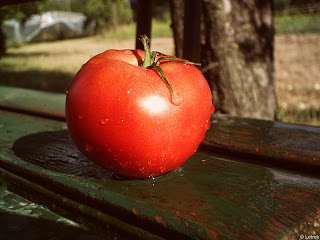
Uncle Bill picked a ripe tomato from the garden and rinsed the dust off under the garden hose. Then he sat down at the picnic table and surveyed our backyard. From the look of satisfaction on his face, Uncle Bill was getting great enjoyment from that fresh tomato. To my surprise, he took a large bite out of it, the way I would have bitten into an apple. I shivered, thinking about the acidity.
“Do you want some salt?” I asked.
“Nope, I like it just the way it is.”
I slid into the bench across from him and watched him closely, waiting for the tomato juice to dribble down his chin. It was so hot that afternoon, neither of us felt like talking anyway. We listened to the cicadas announcing the temperature with their clicking.
Languidly Uncle Bill took a second bite of the tomato, and then he took another. His short-sleeved shirt was spotlessly clean. By the time he finished that tomato, not one drop of juice had escaped his lips or stained his clothes. It seemed like a magic trick to me.
I was sure that my mother would have preferred to be outdoors like her brother Bill and me, but instead she was brewing tea for Auntie Anne. Two bone china cups and saucers would be on the table with a sugar bowl and a pitcher of milk. Auntie Anne would be chattering away like the cicadas while my mother listened and nodded politely.
Uncle Bill and his wife, Anne, were visiting us for a week. They lived in Toronto. Auntie Anne had grown up in England. She pronounced her words differently than we did. Mom said she was a “war bride.” I didn’t know what that meant.
“I can’t imagine what he sees in Anne,” my mother said after they had left. To my mother, Anne was an annoyance. When Auntie Anne unpacked her suitcase it contained several dresses, pointy-toed shoes and a hat decorated with artificial flowers. Mother thought Anne was superficial and vain. Anne’s appearance, religious beliefs and values were different from ours. “She’s not like us,” mother would say. For her brother’s sake, my mother kept this opinion to herself.
In February of 1964, Uncle Bill went out to shovel snow after dinner and died suddenly of a heart attack. He was 52 years old.
Five months later, Anne traveled alone to our house for a visit. Anne unpacked the hats and sundresses from her suitcase as usual. After supper she asked my father to bring out a deck of cards so we could play Bridge. Anne had met Bill, playing Bridge at the USO. Mom found it hard to imagine that her brother would have enjoyed such a pastime. It seemed foreign.
We were used to card games that were less complicated. We were in the habit of laughing and joking during a card game, not keeping track of what had been dealt and played.
None of us played Bridge; Anne said that didn’t matter. Patiently she instructed us in how to rotate shuffling the deck, passing it to another person to deal. She explained how to bid, name trumps, and lay out the dummy hand. Auntie Anne took Bridge seriously and in spite of our lack of interest, she insisted that we play each night together.
After that visit on her own, she would come and stay with us once each year. Since we only played Bridge when she was visiting, we needed a refresher each time. She tolerated our lackadaisical attitudes the way my mother had kept silent about her vanity. It seemed to me that Uncle Bill still had a hand to play and hearts were trump.