Motherless Child

When Daisy and her husband moved into their new house, Evelyn was one of the first neighbors to befriend Daisy. Evelyn had a four-year-old daughter, Susan. She was a flirtatious child whose blonde hair hung in shiny ringlets. Evelyn herself had a vivacious personality; she laughed easily and talked incessantly. Often Evelyn and Susan were dressed in identical mother-daughter outfits, doubling the smiles they received when they entered a room together. Their matching red polka dot dresses got the most attention.


In a few years, Evelyn had a son, Albert. He was an attractive child with large brown eyes and sandy brown hair. He looked just like his father. Now the mother of two, Evelyn’s behavior set people to talking. The neighborhood gossiped about how the city bus driver visited her on his lunch break leaving with a broad smile and liquor on his breath an hour later. The next son Evelyn gave birth to had no resemblance to Evelyn’s husband. The child had an olive complexion and course dark brown hair. A fourth pregnancy ended abruptly when Evelyn’s husband shoved her down the stairs. Ruth was born prematurely, her retinas damaged by the oxygen in the incubator.


One morning, a few weeks after Ruth was released from the neonatal intensive care ward of the maternity hospital, there was a knock on Daisy’s back door. The staccato knock was hard and it sounded frantic. When Daisy opened the door, Evelyn handed her the baby, “I’ve got to take Susan to the doctor. Will you care for Ruth while I am gone?”


“Of course,” Daisy said, cradling the infant in her arms. She was easy to ignore because she rarely cried. Blind and passive to the world around her, she appeared like a fledgling with her eye lids closed. She clung to the body that supported her and would feed her.


“She looks a little like her Daddy,” Daisy thought as she uncurled the tiny pale fingers. It was distressing to see her tiny fists pressed deeply into the sockets of her sightless eyes. Daisy wouldn’t ignore her though; she would hold her and coo soothing sounds, feed her the warmed bottled milk and change the soiled diapers.


Later that afternoon there was another knock on the back door. This one was soft and tentative. If Daisy hadn’t been in the kitchen at the time, she might not have heard it. The Glenwood Elementary school bell had rung several minutes earlier. Daisy’s daughter was already home and looking for an after-school snack.


The soft little knock on the back door in the middle of the afternoon was Albert, Ruth’s older brother. “Are you here to pick up your sister?” Daisy asked. The seven-year-old shook his head as tears began to dribble down his cheeks.
“Something’s very wrong in my house,” Albert said trying to hold back his sobs. “There is stuff everywhere.” Then he added, “There is a piece of paper hanging from the light over the kitchen table but I can’t read what it says.”


“Wait here with us until your father gets home from work,” Daisy instructed him.


An hour later it was Albert’s father who knocked on the back door. He had come home to find the house torn apart. Chairs were turned upside down and books thrown across the living room floor. The note said, “Ruth is at Daisy’s house.”
Evelyn must have been planning her escape for weeks. She had fled with the two children who did not resemble her husband. She had sold what she could: china, silverware, and antiques. What she could not sell she destroyed. Broken glass and slashed cushions were thrown or tossed at random. Her second-grade son could not read the note; yet he knew what the message must say. His mother had left him.
Dream a Little Dream of Me

When my father celebrated his 90th birthday, someone asked him the secret to a long life. After a short pause, he replied with a cliché, “Don’t worry about the small stuff.” He stopped a minute and winked, finishing the punch line, “And, you know, it’s all small stuff.”

In my opinion, my father was fascinated by anything small. Small things captured his curiosity. One summer he collected little bits of lichen, identifying each species. He constructed shadow boxes for each sample and hand-wrote the labels with the common name as well as the Latin name. Cladonia rangiferina, also known as Reindeer Moss, was like the manna from heaven, Dad told me. It could turn air, light and moisture into food.

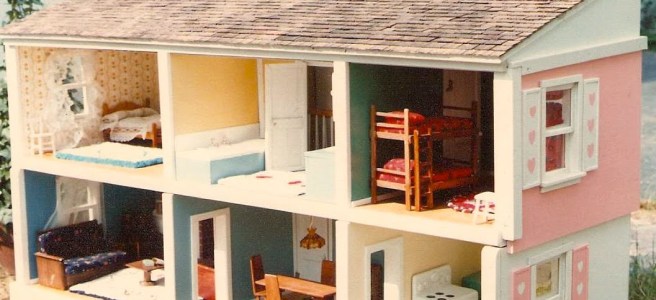
Far from worrying about small stuff, he was intrigued by it. He constructed a dollhouse for me. For each room he meticulously crafted wooden furniture: stoves and refrigerators in the kitchen, bunk beds and swinging cribs for the children’s bedrooms, cabinets and bookcases for the living room. For the bookcase he made and hand painted books out of slivers, scribbling titles on the tiny spines. Dad had as much fun designing and building that little house as the children who played with it.

My friends and I played with that dollhouse for years, imagining the dwarfs who lived inside. We made small rugs, bedspreads and curtains for the windows. The boys insisted that they were not playing but simply rearranging the furniture. However, they were as transfixed by the house as the girls.

In the past few weeks I have watched as the fireflies wink and sparkle between the trees after sundown. It seems to me that by paying homage to the small stuff in life I can let go of worrying about it.

Blood Light

“So,” said the man sitting in the reclining chair in front of me, “are you here for chemotherapy too?”

“No,” I replied as the nurse began taking my vital signs and laying the medical supplies on the tray table beside my recliner, “I’m here for blood products.” I settled back for the reactions I expected to follow.

“You see I have a bleeding disorder and my blood does not clot.” I explained.

“Oh,” he said and then, much to my surprise, he added, “So, you couldn’t have been in the Peace Corps in Bolivia like I was… too many vampires there.”

I assumed he meant vampire bats. He got me to thinking though. It certainly would be a turn about to have some creature gaining sustenance from my blood. What would my blood taste like to a vampire bat? Certainly not full bodied and probably not very satisfying.

I am usually on the receiving end. When I was a child it was fibrinogen concentrate that hung in clear glass bottles. The glass bottles clinked against the metal polls. The concentrated fibrinogen was dehydrated and readily available in the maternity ward. It was a fine powder that had the look and qualities of unflavored gelatin. It had to be reconstituted with saline before it could run through the tubing and into my veins. A nurse would stand by my bed tipping the bottle back and forth until all the thick gooey lumps were dissolved.

As a child the blood and food, mixed science with myth and created a recipe for confusion. By the early 1960’s a scientific study concluded that eating peanuts would cure Hemophilia. My Dad went out to the store and carried home a burlap sack of unshelled peanuts that stood nearly four feet high. Later the study was refuted as false, but I finished eating my bag anyway.

There seemed to be no visible improvement in my blood’s ability to clot, however, there seemed to be no negative side effects from the experiment. The same cannot be said of blood.

By the time I was twenty years old fibrinogen concentrate had been taken off the market and was no longer approved by the FDA. The glass bottles had been replaced by plastic sacks and the blood product I used was frozen. It takes time to thaw it. The liquid looks yellow, sometimes almost orange and occasionally green. Often I wonder what the blood donor had to eat just before going to the Blood Bank.

For most of my life, I have cautiously used blood products. I did not live my life in fear but I was prudent.

Since blood transfusions have been used, those of us with bleeding disorders have been the first to get blood born viruses, like hepatitis and HIV. We will be among the first to be infected with prion diseases like CJD and mad cow disease. The Centers for Disease Control and Prevention (CDC) have reported that West Nile virus can be transmitted via blood transfusions.

So if I thought I might encounter a vampire, perhaps I should wear a warning notice on their neck.

One in a million

When I was a few months old, my parents recognized that there was something amiss with their first born-child. I had unexplainable black and blue marks after routine immunizations. As I began to toddle around, it became even more apparent that I was particularly susceptible to bruising.

It was not until I was two years old that my condition was properly diagnosed as congenital afibrinogenemia. That would have been about 1951, and at that time there were only two or three other cases of afibrinogenemia that had been identified. Dr. William Dameshek a hematologist in Boston, was the doctor who correctly identified my bleeding disorder. I was very lucky to have been under his care until 1966 when he retired from Tufts New England Medical School.

Among other things, this is a blog about my experience as a person with a severe bleeding disorder. This is not unique, but it is rare. I am, as my friend Amy puts it, “one in a million.”

Deck the Halls


When I was a child, my grandmother sent me a freshly cut evergreen tree from her farm in Nova Scotia, Canada each December. It would come wrapped in brown paper and tied with string. It was very small and by the time I was eight years old, I was taller than the tree. The tree smelled wonderful and we decorated it with ornaments that we made ourselves. My friends and I would string popcorn and make chains of paper loops.

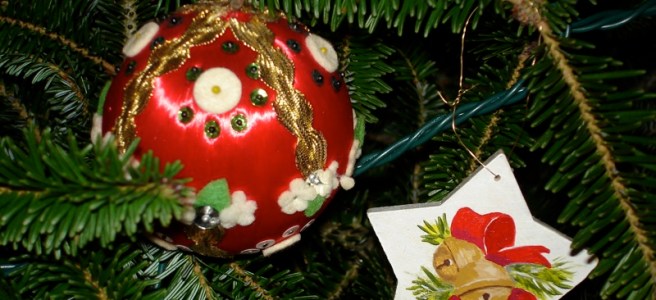
By the time I was a teenager, I was having a lot of injuries to my ankles. During those years I was at home most days. Repeated bleeds into my ankle joints made it impossible for me to climb the steep steps in my high school. While my peers were going to dances and sports events, I spent a lot of my free time doing craft projects. Each autumn, I designed and constructed holiday decorations with a new color scheme for our tree. It gave me great joy to create them. There was the Christmas of the red silk and gold felt, the year of sugarplum purple with white sparkles, and the royal blue metallic silver combination.

I carried the tradition of making tree decorations into my adult life. The freshly cut evergreen tree that is in my living room this year came from a local nursery. It is covered with decorations made by my family, friends, and me. Each decoration holds a special memory.