Grab It and Go

As I pull out the suitcase, I see the satchel of items that I take whenever I travel. They are things I wouldn’t want to forget to pack. There is a toothbrush, toothpaste, nail clipper, comb, deodorant, a small tube of hand cream, the charger for my cell phone, my earbuds for listening and a pair of clean underwear. There is also a bag with a week’s supply of my prescription medications. If I’m flying, I will carry on this bag, so I will have the basics if my stored luggage doesn’t arrive at my destination

I’ve kept a bag prepared and ready to go at a moment’s notice since I was a child, although the contents have changed over the years. I had no need for prescriptions medications then, and cell phones hadn’t been invented yet. When I was young, it included pajama bottoms, but not the tops. The bag was what I needed for a stay in the hospital. I would be given one of those buttonless gowns to wear, the ones that tie in the back but flop wide open when you walk. Wearing the pajama bottoms satisfied my modesty.

For years, the only way I could get an infusion of clotting factor was as a hospital in-patient. These days it is rare for me to have to stay overnight in a hospital. Infusions can be done on an outpatient basis. Younger people who have bleeding disorders are often able to do their own infusions at home.

Pausing for a moment before I fill the suitcase with clothes and footwear, I feel thankful that now my “grab it and go” sack gets to be used for vacations more often than hospitalizations.

I remember

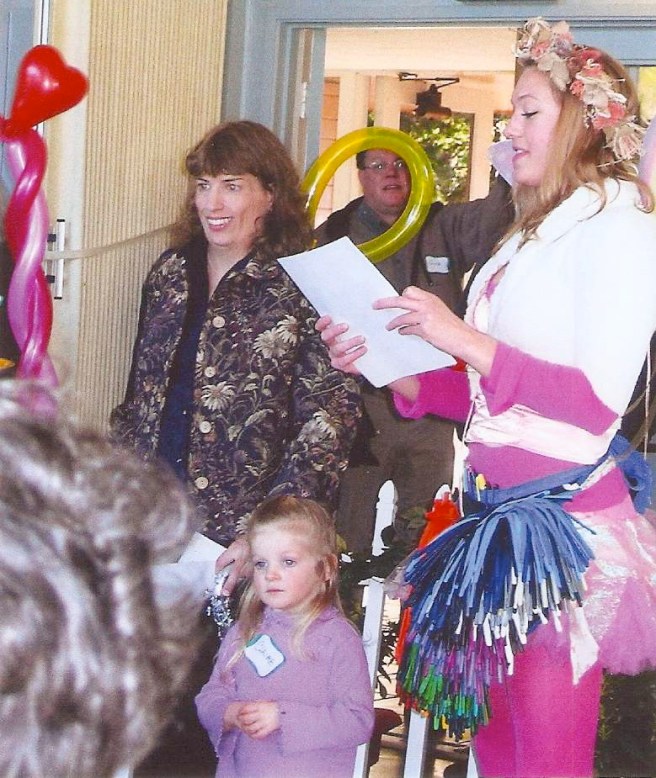
On March 14th, 2007 Cindy died of liver cancer. It had been only a few weeks since her extravaganza 40th birthday party. The celebration, which she planned herself, included costumes, food, activities for children and adults, and presents for all. Each person she invited to the party, whether they could attend or not, received a floaty pen she designed engraved with “Bloom where you are planted.” She knew as she planned that party that the liver cancer was in it’s final stages and there was nothing else that could be done to slow her death. She knew it would probably be her last birthday and she wanted it to be a grand celebration. I believe she wanted her friends to remember her with a smile

On Superbowl Sunday in 1995, I signed on to the National Hemophilia Association online. About 25 participants sat in front of our computers and introduced ourselves. That was how I met Cindy. She was in California. I was in Massachusetts. She was 28 years old and bubbling with enthusiasm. Her life story was different from my own in many ways.
 
Cindy had been diagnosed at birth with hypofibrinogenemia when her umbilical stump kept bleeding. Her fibrinogen level was abnormally low. From infusions of cryoprecipitate she had contracted HIV and Hepatitis C. She developed Transverse Myelitis, which compromised her ability to walk. None of this slowed her down much though.
 
She and I corresponded for years, we talked frequently on the telephone, but we only met once face to face.
 

She wrote to multitudes of friends, many who also had some of the same medical issues she had in her life. She actively sought out as many women as possible who had medical problems similar to her own. She wrote to the Hemophilia Treatment Centers Program Specialists requesting that they give their patients with rare bleeding disorders her contact information.  She created a website called Shemophilia and inspired a listserv for people with Fibrinogen (Factor I) Blood disorders and their close relatives.

 
Cindy traveled frequently to attend medical conferences, often as a speaker or panelist and wrote lots of articles. She published numerous articles and contributed to a book written by Bill Hayes entitled Five Quarts of Blood. In countless ways she put pressure on hemophilia organizations to include all bleeding disorders and genders. She was also very involved in HIV and disability communities. The advocacy work she accomplished in her lifetime spread across continents.
 
Her mission was to educate, inform and inspire others. It was her life’s work.
 
Today I also think of her playfulness of spirit, her love of children, her compassion and generosity. I remember her long and engaging search for the ruby red frogs, her holiday greeting cards written and decorated by her feline companions (Skipper, Grady and Cinderella) and her silly sense of humor.
 

It’s not easy being alien

One of my recurring fantasies as a teenager was being rescued by an alien space ship and taken to another planet where all of the inhabitants were like me, in that they had blood that would not clot. Bacteria that were killing anyone who had blood that would clot had infected Earth, in this fantasy. And so, there were only a few of us who had survived.

It was a mean-spirited fantasy, because the virus struck all the members of my family as well as my friends. The imaginary story, I believe, grew out of responding to too many people asking me if I would die from a cut on my finger, too many relatives giving me hugs and then exclaiming that they were overjoyed to see me still alive, and too many medical professionals telling me (or my parents) that I would not live long enough to become an adult. These reactions to my bleeding disorder didn’t make me timid or afraid; they made me angry.

The unwanted pity I received for not being allowed to ride a bicycle like others my age; the senseless praise I received for being brave, when it did not appear I had a choice, left me feeling set apart. The reality was that I was often lonely even when surrounded by friends and family. My most comfortable friendships were formed with children who either were hospitalized themselves or had gone through a long rehabilitation period for a major illness or injury. Those children understood the humor and the absurdity that I experienced. None of us seemed to feel sorry for one another or afraid of the judgments made upon our expected life spans.

When I was 12 years old, I had an internal bleeding episode that resulted in exploratory surgery requiring multiple transfusions and a lengthy hospitalization. In the children’s ward of the small city hospital, I met a boy who had deep tissue burns over much of his face and body. He had thrown an aerosol can into a campfire just to see what would happen. Patrick had already undergone many reconstructive surgeries and had been in the hospital for many weeks when I arrived. I wasn’t horrified, as so many others were, by the look of Patrick’s scarred and disfigured face. Neither did he back away from the I.V. pole that was my dancing partner. In the next few weeks to come, we formed an alliance. We raced wheelchairs down the hall to see how many nurses we could enrage and played countless practical jokes on unsuspecting doctors. I believe now, we were daring them to see us only as children — not to alienate us by calling us suffering, wounded, or courageous.

Decorating the tree

Friday we invited a tree into our house. It is a Fraser Fir, a bit asymmetrical, but then who isn’t? Standing upright by the glass doors that lead to our back yard, it looks as if it is glancing at its relatives the loblolly pines. The loblolly branches are high about the roof of our house. They are reaching for sky and the bark on their trunks look like scabs.

We filled the tin bowl at the base of our tree guest with water. We were busy with our human tasks, so it had a full day to get used to the space where it will spend the next month. The branches form a tight tangle around the trunk. We can smell the aroma of its sticky sap through the house. I wonder why we feel the need to decorate it. It looks so lovely unadorned, plump, and green.

Saturday we emptied the storage closet of the boxes containing strings of lights and ornaments. Putting on the lights is the hardest part: crawling on the floor around the tree to attach the lights to the lower branches, untwisting the curled cord that connects each light then walking around and around the tree, slowly and carefully spacing each bulb before it is attached to a branch until one of us is standing on the ladder to set the last lights in their place. We complain to each other about our aching knees and back. The older we get the more we wonder why we bother with this ritual.

“This might be the last year we will attempt to do this,” we say to each other. “I always forget how much work it is!”

Sunday we pulled the ornaments out of their storage containers. Many we made ourselves over the years. There are ones of felt, ribbon, lace trim and painted wood. I can still smell the cinnamon hearts we made by mixing the spice with glue years ago.

“This is one your mother gave us.”

“Here are the miniature birdhouses your father made one year.”

“We must put up these needle point snow flakes. You finished making them when you were in the hospital one year.”

“Susanne made the felt mouse that appears to be sleeping in a walnut shell bed!”

“Didn’t we buy the partridges in the pear tree in a gift store in Yarmouth, Nova Scotia?”

Decorating the tree is not something we can do quickly; there are too many memories to be touched before putting each in its proper place. Together the jumble of joy and sparkle of peace tells a story about our lives.

A Few More Words About Mother


On a prompt from the New York Times, I took the challenge of writing six words that described my mother. It wasn’t easy; she was a complex woman. The words I selected were: problem solver, determined and compassionate caregiver. These were all qualities of my mother and the ones that predominate in my memory now that she is no longer alive.

I could have just as accurately chosen other words to paint a picture of her: stubbornly opinionated and judgmental; sharp-tongued and intolerant especially of those she loved the most, or adults who did not care for their children; parsimonious; and an obsessive worrier.

She was also a gardener who never purchased a plant, fertilizer or insecticide; a self-taught botanist and ornithologist, who wanted to know about her friends… the birds and flowers; a humanist who learned to speak a few words of Portuguese when she was 90 years old so that she could converse with the Brazilian-born care givers in the nursing home; an unapologetic freethinker who l lived her life a reflection of her moral convictions; a confidant for many because she approached people with openness and love; a Canadian who considered herself a citizen of the world and a defender of the planet; a controlling woman who took charge of the health and welfare of her husband and daughter; a defender of children and people who were oppressed because of their race, ethnicity, gender, and physical or mental health problems; and a woman who felt intimidated by others who had more formal education than she.