Home Before Dark

Little girl with a green straw hat examinging a flower in her hands

It was late in the afternoon when the phone rang. I could hear the concern in my mother’s voice as she talked. Estelle, one of my second grade classmates, was missing. She was seven-years-old, leaner and more petite than I was. She left school that day as usual, but did not arrive home. Estelle’s mother began calling the neighbors as the evening shadows were darkening the city streets. No one had seen her. The police were called.

Much to everyone’s surprise, a confused Estelle returned home a short time later. A man who said he was a friend of her father’s had offered her a ride. When the man headed into unknown territory, Estelle became suspicious. She began a temper tantrum of admirable strength. Screaming, kicking, and biting the man, she ignored all of his protests. At last, the man wanted only to be rid of her. He let her out of his car and drove away. Estelle, then only a few blocks away from home, was totally lost. It took her hours to find her way back.

While her family, neighbors and friends sat awaiting news of her, Estelle was alone and disoriented. When she stepped inside her house at last, her father’s terror turned to rage. First, he spanked her for daring to trust a stranger. Then he took her to the Police Department to file a report. Back home again, she was sent to bed without her supper.

After that, the children of Mrs. Baxter’s second grade class were a little less naive. Our parents lectured about never accepting a ride from anyone: no matter what. We rehearsed marching directly from home to school and school to home. We became afraid of strangers.

Those of us who did not already know, learned that fear could turn to anger, blame and mistrust. We learned that victims could be punished. Life can turn quickly from fun to danger. None of us can prevent missteps. All we can do some times is to scream, kick or claw our way out.

Wound Healing


Bill, the nurse, took my blood pressure and temperature. He blotted my scars with saline, slathered Lidocaine gel onto two gauze pads, and secured the pads over my wounds. I was used to the routine; I had been going to the Wound Healing Center three times a week since early February. As he worked he said, “Have you had any pain?”

“None in the neck,” I said, but the arm hurt a bit.” He nodded his head in affirmation. He made notes in my chart, then set up the required tools on a metal tray.

“The doctor’s moving fast today,” he said, “It won’t be long.” Two weeks ago the doctor did the last of four minor surgeries. Now he was going to remove the stitches.

There was a quick knock on the door. The doctor strode in with a nurse following behind. The nurse removed the gauze on the back of my neck and the doctor efficiently pealed off the steri-strips. It didn’t hurt, yet when I felt his touch on my skin, I instantly remembered how the neck had been bruised and sore for a week. I hadn’t been able to sleep comfortably or turn my head from one side to the other without it throbbing. How could I have forgotten so quickly? I wasn’t attempting to be brave when the nurse asked if I had experienced any pain; I had sincerely forgotten.

“Looks great, all healed,” he announced before moving confidently to the arm. I felt a pinch as each stitch was plucked out. Vividly I remembered how it felt as my skin was sewn together like fabric. There was no discomfort until the next day when each time I shifted the left shoulder; it felt as if my skin was being ripped. After ten days, I had almost called him to check if this amount of discomfort was to be expected.

My brain forgets pain almost instantaneously once it has ceased, nevertheless my body will help me to remember. These new scars will fade like the others on my skin. I have a scar on each of my wrists. Each is a reminder of a cut made by a doctor when he could not insert a needle into a vein. I can hardly see them myself now that they have been a part of me for about 60 years. For years when I touch the slanting one on my left wrist, I could hear the doctor nervously whistling as he used the scalpel. I can sense his anxiety and feel my mistrust.

I know that my skin will help me remember the places it was cut, the void that was created, the sensation of being sutured, and the postsurgical soreness. From the doctor’s perspective it was “all healed.” However, my body will remind me that there is more healing to be done.

Communion

Sunday was chilly and the rain clouds were moving in as I set my pot of vegetarian chili onto the grill at the Church potluck. Even though my mother died two years ago, when I cook, I still cook with her guiding my hands.

When I was a child, every Sunday evening in the cold weather, we had waffles and ice cream for supper. Friends and neighbors would drop by our house on Sunday evenings even when the winter snow was falling fast and thick. Moreover, despite the weather outdoors, they would all arrive in enough time to join in the tradition my parents had created. However, it wasn’t just the waffles and the ice cream that brought them to our back door. Mom’s homemade canned peaches created the magic. At the end of every summer, my mother took bushel baskets of fresh peaches, peeled and pitted them, cooked them in sugar syrup and stored the sealed jars in our basement. There were enough jars of canned peaches to put on top of the ice cream covered waffles for each Sunday during the chilly days of late autumn and winter.

When the weather turns cold and dampness works it’s way into my aging bones, as it did today, I still think about cooking with my mother. I started “helping” her cook when I was so young I wasn’t tall enough to reach the counter top in our kitchen. My childhood friends and I learned how to measure and sift ingredients following my mother’s instructions. We kneaded bread dough and tasted cake batter by licking out the large wooden spoons we had used to stir it all together.

There was more than food processed in my mother’s kitchen. The conversations that happened as we prepared food and ate together were part of the plentiful feast, part of the communion.

One of my most vivid childhood memories is of the day that my friend Sherry was tossing the bread dough in the air and it went so high that it stuck to the kitchen ceiling. Slowly, as everyone in the room held their inhaled breath, the gooey and slightly gray colored substance oozed back down into my friend’s waiting hands. Sherry had an abusive alcoholic father. None of us was aware of the secrets she held inside herself then. Reshaping the sticky, soiled mess back into form, Sherry said with a satisfied tone, “That’s ok; I’ll bake this loaf for my Dad.” There was something about the way she said it that sounded important. No one, even my mother, questioned her decision. Sherry carefully carved “Dad” onto her loaf and baked it in the oven with the rest.

Somewhere Over the Rainbow

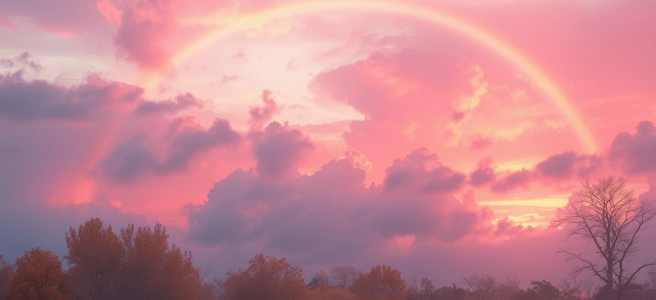
After a day of autumn rain and wind, the late afternoon skylight seemed to glow from the clouds above with a warm yellow. The world outside our windows was golden from the wet autumn leaves covering the ground or clinging to a few trees. It changed the light inside so dramatically that we stopped what we had been doing and went outside to get a clear view. As the rain diminished to a drizzle, the sun appeared for the first time all day, low in the West. As we watched, the winds blew away the remaining clouds and there was the rainbow at sunset. Cupped inside the rainbow, the sky was rosy pink and beyond the rim, it was blue.

The rainbow, symbol for hope, with the blue sky lying just outside of it… just the way the song from the Wizard of Oz describes. Happiness, just outside of our grasp.

My father taught me to hope. In my memories of him, I see him as he sometimes stood with his eyes on the horizon. He often commented that for him, “anticipation is better than reality.” Frequently, if I had experienced some pain or sorrow that day, my Dad would say, “tomorrow will be a better day.” As a child, it was reassuring to hear as I was tucked me into bed for sleep.

Most children have things to look forward to. When we are very young, it seems that much must be delayed until we have gained enough age, education or abilities. I spent years waiting to be old enough to apply for a driver’s license. When I was 9 years old I thought, if I only had a dog I would be happy. My mother told me that before I could get a dog I had to have enough money to buy it, feed it for at least one year, pay for all its required vaccinations and veterinary costs and incidental care.

Calculating this cost, I realized it would take years to save on the allowance I received. So, I took on my first fundraising campaign. I started by writing each aunt and uncle who had been known to give me a present in the past. My Aunt Ivy made the most frequent and generous donations to the “doggie fund.” Often she would write a little note with her check made out in my name about the dog she knew I desired.

Of course, when I finally did get the puppy of my dreams, it didn’t take long before I was dreaming of something else that would make me happy. The habit of hope was firmly fixed in my brain by then. It has the benefit of being an incentive to keep trying.

Delaying happiness has serious drawbacks though. Seeking perfection can be very isolating and disappointing. Chasing the elusive rainbow for the pot of gold, can distract me from what is happening this moment. Wanting to be something I am not, to be better, stronger, healthier, or more attractive to others leaves me feeling lonely. Perfection is in fact impossible to achieve.

The awareness of now brought me outdoors to see the rainbow at sunset. It had not been a perfect day. Yet, joy did not need to be postponed until tomorrow.

Return

Fallen tree in front of trees still standing
 

The sound of thunder alerts us to a sudden change in the weather. Soon the hail mixed with rain, falling tree twigs and pinecones create a percussion band. The rooftop becomes a drum. It’s a sound that sends the cat into hiding under the bed and brings me to the glass sliding doors to watch.

The squirrels that were jumping between tree limbs only minutes ago have all disappeared now. The hummingbirds and butterflies have all gone for shelter as well. The herbs and flowers, newly purchased at a local nursery, are tested for their durability and stamina by the wind and falling debris.

Only a short distance down the street, large tree trunks crack. It is humbling to watch as the micro burst prunes the wooded neighborhood.

By morning, television cameras are documenting the damage to homes. Landscaping crews are cleaning up the yards and lawns. The fallen branches are picked up and piled for removal later; like picking up a child’s toys after playtime. The human inhabitants desire that a sense of order be restored from the chaos.

The rain soaked earth rejuvenates the plants and the squirrels, butterflies, birds and humans seem refreshed as well. The air is cooler and dryer after the storm. The storm was brief, the damage will all be repaired quickly; not like the devastation of a major hurricane, forest fire, earthquake or Tsunami. Even so, I am reminded that ultimately the cycle of chaos and creation repeats and repeats and repeats; perhaps, as the myths tell us, from the beginning of time.

In spite of our human efforts to control or avoid the chaos and destruction, the wind and rain will return. The seas will rise, sinking boats and sucking in those on the shore. The earth will quake, volcanoes will send fire from deep below our planet and lightening will ignite wildfires. And, when the chaos has abated, those that remain will build again.