Out of Season

It’s been an unusual winter this year. Today, the air feels more as it would in March. Many days this winter have well above normal temperatures. And, there has been no snow that needed shoveling or that lingered on the ground for longer than 24 hours. The pond near our home has not frozen solid enough for the usual skating and ice fishing.

The unseasonable weather has left many on edge and nervous. Conversations turn to anxious discussions about global climate changes out of control. Other parts of the world, we hear in the news reports, are having quite the reverse turn of weather. Yet, despite the concern, many have admitted that the lack of snow and ice has been enjoyable. Of course, there has been just enough bitter cold and chilling wind to remind us all that it is still winter here. The weather could turn at any time. Those of us who have seen it snow in May mutter under our breath that winter is not over yet.

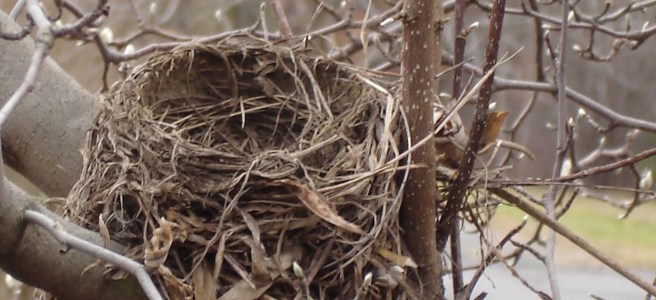
Despite that, I can now here the cheeping birds changing their tunes as they take on the challenges of finding a mate. Walking back to the parking lot from the Botanical Garden a bare pussy willow displayed its spring buds. Left within the branches of the small tree, clearly visible now that the leaves are gone, was a nest. It was carefully constructed and looked as if it had been placed there as an object for winter interest by the gardeners. Yet, I believe only a bird could have crafted this tangled weaving of grass and twigs. The pussy willow buds and nest spoke of spring. Is it false or true? I would guess that some teasing mocking bird pair made us stop and question our senses.

It was a perfect environment for a mocking bird nest, close to the garden with Dogwood blossoms, Holly berries, Sassafras, and Virginia Creeper, not to mention a tempting supply of caterpillars, beetles and earthworms. What better eating for hungry Mockingbird chicks and their parents?

Yes, just as I stop when I hear a mockingbird’s song bringing messages from other species and other places it has traveled, I stopped to observe this nest as if it were a banner. As I walked away, I thought that spring should be appreciated in the moment whether it is season or not. Otherwise, we might just miss it.

Grandma’s Hands

Older white woman siting in a chair, knitting out doors under a tree

By the time I was born, only my maternal grandmother, Ruby was still living. From children’s books and the experience of some of my friends, I had an idealistic picture of what a grandmother was like. Unlike my grandmother, she usually lived nearby and came to visit often.

My grandmother lived in a country farmhouse, far away from where I was raised as a child. She had given birth to one child every two years until she had five sons and five daughters. About seven years after the last of her ten babies was born, Ruby’s husband, my grandfather, died. The year was 1927. If the genealogy records are accurate, she was 52 years old by that time.

The household was already organized with economy, precision and determination. A few of the eldest sons had gone off to earn money that could then be sent back home. The eldest daughters had long been taking care of the very youngest children and the ones in-between were used to tending to the farm chores and household duties.

Ruby’s children reaped the health benefits of her ability to prevent the spread of disease by meticulous attention to hygiene. She learned her native nursing-care skills from her mother. Grandma’s attentive watchfulness and analytical problem solving enhanced her reputation as one who could cure the sick.

My grandmother was a strong and demanding woman. Observation of my aunts, her daughters, has given me a taste of what this must have been like. She may have felt that the family’s very survival depended upon her ability to make decisions quickly and enforce them with a critical tongue. The precision cutting of her words sometimes left jagged scars that required healing over time. Yet, there was enough comfort, compassion and caring for the mending of wounds within the family and beyond. Those who were ill, or in need, could count on my grandmother for comfort and aid.

Despite the Great Depression and outward poverty of the little farmhouse, there was enough healthy food to eat and enough to generously share with others in my Grandma’s house. Guests were always welcome, whether they were friends or strangers. And, when the workday ended, there was music, books to read, lively conversation, jokes and laughter.

Even though I only got to see my Grandma in person once, each time we visited the old farmhouse its seemed that Ruby’s powerful spirit was still there. It was revealed in more than just the chipped Blue Willow dinner wear in the China cabinet, or the rocking chair by the kitchen window. It could be observed in the qualities of her children, my aunts and uncles. It emanated whenever a guest, whether child or adult, entered the back door. And, it is still reflected in the values and actions of her grandchildren.

When I curl a loop of yarn around my fingers to knit I think of my Grandma’s hands knitting warm socks and mittens. When I cook, I imagine Grandma’s hands kneading the many loaves of bread, baking the pies and churning the butter. When I help care for someone who is sick or in pain, I reflect on Grandma’s care that lives on long past her lifetime.

Perhaps the ideal Grandma that I imagined as a child visits me more now than she did when I was a child.

Healing Stories

Memories take up more bandwidth in my brain the older I get. Perhaps this is true because I am acutely aware of having passed mid-life. For me, there is now more to recall from the past than there is left to plan for in the future. It seems that memories drift into my consciousness at the slightest trigger: a landscape; an odor in the air; a remark made by an acquaintance; a photograph; a tune. Some recollections are activated without any apparent cause. Most come in small tidbit-sized pieces, rather than long detailed illustrated narratives. In addition, I have no doubt that all of my memories have been altered by the passing of time until they represent a symbol rather than a truth.

I have heard it said that our first memory reveals traits and values that we carry for the rest of our lives it echoed the concept of a personal mythology. I tried to sift through my earliest memories and determine which one was my first. My youngest childhood experiences had become so intertwined in the storytelling of my family that I had come to believe that I remembered them.

There was the story my father liked to repeat about my ability to outsmart his attempts to keep me from upsetting my dinner plate from the high chair onto the floor. One could think that would be a memory he would have preferred to forget. For me, the story seems a bit unsettling. I am sure I would not be nearly so cheerful with any child who exhibited this skill. However, when my Dad told the tale of purchasing one guaranteed-to-be-spill-proof baby dish after another, only to watch me overcome the newest foil within minutes, he seemed pleased by his daughter’s ability to solve problems. This was a part of my father’s personal mythology. I have no memory of ever sitting in a highchair spilling pureed vegetables onto the floor for entertainment.

My mother liked to tell the story of leaving me at school for the first day of Kindergarten. I entered the schoolyard and didn’t even glance back towards her to wave good-bye. When my Mom recounted this memory, it was usually with a tone of feigned disappointment that I had shed no tears when we parted. However, it was also evident that she was more than a little proud of raising an independent and confident daughter. This was a part of my mother’s personal mythology. I have recollection of this day, although it does seem like a story that is more in keeping with my true nature.

Both of these memories do, however, qualify as healing stories for my parents and for me. Still, I had a desire to identify my own earliest memory. Quite accidentally one day, I happened to see old news footage of Queen Elizabeth II in her coronation ceremony on June 2, 1953. Suddenly, I remembered that day. I would have been four at that time and I can think of no personal memory that pre-dates it.

My mother had a friend, Ruth, who had been a schoolteacher. Ruth and my mother had grown up not far from each other in Nova Scotia, Canada. Yet, they had not become friends until they both married and moved to the U.S. Ruth seemed much older to me than my own mother and much more serious. When in Ruth’s presence, I was instructed to watch my manners carefully. It was Ruth who had suggested that I must witness the Queen’s coronation on television that day in early June.

My parents did not own a car or a television. Mom and I probably traveled by city bus to Ruth’s home. The long steep flight of wooden stairs, which we had to climb to get to the second floor apartment, seemed endless. As I climbed up those stairs, I thought it a silly way to spend such a lovely day. After Ruth opened her door, we were all seated in front of a large wooden cabinet with a small television screen. Still I was not impressed. The elaborate costumes, the formal music, the newscaster’s play-by-play account of the historic event, the pomp and ceremony bored me. Ruth gave me a stern lecture about never forgetting this event. She seemed to sense that I was not really paying much attention. Therefore, she explained I would need to remember because I would someday want to tell my children and my children’s children that I had watched the coronation of a queen. I wondered why any child or grandchild would care.

At first, I was appalled that despite my resolution to forget it, I had indeed remembered that day. It seemed as if I had betrayed myself. Then I realized that I had not held onto the memory of the actual coronation. I had succeeded in my intention to remember what it is like to be a child. I do remember clearly what it is like to have legs that are short enough to make a flight of stairs feel very long. I do remember what it is like to have an adult tell you things about the future that are really from their own past. Furthermore, it does reflect a quality that I have held all the years of my life: quiet defiance.

Bidens

Outside my bedroom window, some of the weeds around the side of our house are now tall enough to bob and tilt in the wind. The flower that looks like a white daisy is Bidens. Its common names are Beggar Tick or Stickseed because it has sharp seeds that cling to clothing, fur, or feathers. From my window I can see the flowers dance and swing, teasing the butterflies to catch them. I risk passing through the clump of Poison Ivy to view the daisies closer.

What makes a plant a weed? I wonder as I admire this thriving plant that has a system for transporting its offspring to faraway lands. Some would call it invasive for these very qualities of adaptability and endurance. Thorns are considered a nuisance by humans, not a survival technique. Perhaps I take the criticisms about weeds a bit too personally. I have a rather prickly disposition at times myself, or at least so I am told. My imagination tells me that our new neighbors are less than pleased by the weeds allowed to grow wild in our yard. I simply admire the way in which they invite butterflies to my window.

What makes a weed a weed is, in my view, not the audacity it displays by growing wherever. It is not even the persistence that it displays in returning again and again after it has been pulled out by its roots. It is the value it is given by humans. A weed is simply a plant that is not wanted.

What puzzles me the most is the great lengths that humans will go to in order to control and organize the natural world. Weeding, mowing and watering grassy lawns seems a waste of energy and resources to me. Some landscape designers plan gardens so they will mimic the natural forests. It seems presumptuous to me that the natural beauty of a forest could be improved by human intervention. I have a similar reaction to the planned burning in the National Forests. If there are not enough wildfires from lightening strikes, controlled fires are set to clean out the dead wood, unhealthy trees and help other plants to germinate. In my view, this reveals a lack of faith in nature.

It reminds me of the way in which religious beliefs are ranked by some as either true or false. Recently, I have started attending a Zen Buddhist group to practice meditation and chanting. A friend of mine told me that she would be afraid to practice meditation. She had been told in church that people who meditate are members of a cult. It seems extreme to define this religious practice, which has been in existence since at least the 7th Century CE, a cult. But, by calling any religion a cult, it labels it as negative and even dangerous. Like the weeds in my yard, it is considered undesirable. Some certainly believe that cults need to be weeded out, to protect the “true believers” and save all of our souls. I wonder, is it simply a belief that is not our own?

When I take a good look at the world around me, it gives me more faith in diversity, not less.

Uncle Byron

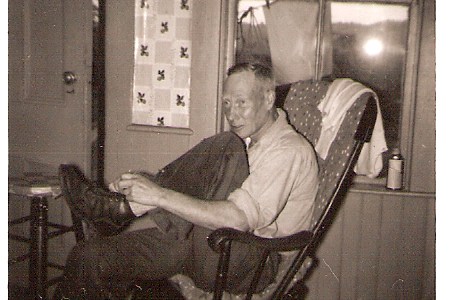
Older man with sunburn face sitting on a rocking chair inform of a window, tying one shoe

Uncle Byron sat in his rocking chair watching the sun set. The supper dishes were removed from the big dining table that in his childhood was used to spread out the meals for his nine siblings and whatever guests happened to come for a visit at mealtime. I piled the dishes in the sink and heated the water over the wood stove to wash and rinse them clean again, I watched as Byron gazed out over the front pasture that sloped down to the road. The road had not yet been paved and an occasional automobile passing by would raise a sandy dust as it rumbled over the gravel. The kitchen window faced the maple sugar camp that Byron had operated since he was a young man. But, Byron did not look in that direction; instead his eyes were fixed on the display of color in the sky from the setting sun

Slowly, Byron pulled out a cigarette paper and his pouch of tobacco. With the mindfulness of a Buddhist monk, he curved the paper with his fingers and filled the ridge with a small portion of dried tobacco. Then with care and gracefulness, that revealed how often he had practiced this ritual in the past, Uncle Byron rolled the paper around, licking it on the edge to hold the two ends together. The match he struck against the wood stove and as he exhaled he filled the room with the aroma of smoke.

He sat and rocked and watched the setting sun, seemingly unaware of the clatter of pots and pans. The women who were washing, drying and putting away seemed equally absorbed in their task. Byron had spent all of his life in that house, with the exception of his tour of duty in WWII. He had cared for his mother until her death and tended to the farm chores by himself when his five sisters and four brothers moved away one at time. He seemed during these times very comfortable in his solitude.

However, on the evenings when family and friends were in the house, Byron’s face displayed contentment. When the day was coming to a close, after each platter and plate, cup and saucer was set back in it’s spot in the china cabinet, people drifted back to the dinning room table. The deck of cards was shuffled and dealt to each player. The stories of neighbors and family were told and re-told. There was usually at least one joke about Byron’s elder sister whose Baptist faith scorned card playing as much as alcohol consumption. What would she think if she could see them shuffling and dealing for hours on end, or if she new that her own husband made beer in the basement?

Even Byron’s humor was tempered with compassion. He was a quiet man and when he spoke his words often revealed his empathy for those who were small or weak or ill. The night his youngest sister was killed in an automobile accident, it was Byron who received the telephone call. He sat by himself until dawn, not conveying the news to other family members. When asked, he said he did not want to upset their sleep.

When we arrived at the farmhouse for a visit or left to return home, Uncle Byron gave a hug that was so tight it seemed he did not want to let go. Had he suffered enough loss in his life already that his heart could bear no more?