Grab It and Go

As I pull out the suitcase, I see the satchel of items that I take whenever I travel. They are things I wouldn’t want to forget to pack. There is a toothbrush, toothpaste, nail clipper, comb, deodorant, a small tube of hand cream, the charger for my cell phone, my earbuds for listening and a pair of clean underwear. There is also a bag with a week’s supply of my prescription medications. If I’m flying, I will carry on this bag, so I will have the basics if my stored luggage doesn’t arrive at my destination

I’ve kept a bag prepared and ready to go at a moment’s notice since I was a child, although the contents have changed over the years. I had no need for prescriptions medications then, and cell phones hadn’t been invented yet. When I was young, it included pajama bottoms, but not the tops. The bag was what I needed for a stay in the hospital. I would be given one of those buttonless gowns to wear, the ones that tie in the back but flop wide open when you walk. Wearing the pajama bottoms satisfied my modesty.

For years, the only way I could get an infusion of clotting factor was as a hospital in-patient. These days it is rare for me to have to stay overnight in a hospital. Infusions can be done on an outpatient basis. Younger people who have bleeding disorders are often able to do their own infusions at home.

Pausing for a moment before I fill the suitcase with clothes and footwear, I feel thankful that now my “grab it and go” sack gets to be used for vacations more often than hospitalizations.

It’s not easy being alien

One of my recurring fantasies as a teenager was being rescued by an alien space ship and taken to another planet where all of the inhabitants were like me, in that they had blood that would not clot. Bacteria that were killing anyone who had blood that would clot had infected Earth, in this fantasy. And so, there were only a few of us who had survived.

It was a mean-spirited fantasy, because the virus struck all the members of my family as well as my friends. The imaginary story, I believe, grew out of responding to too many people asking me if I would die from a cut on my finger, too many relatives giving me hugs and then exclaiming that they were overjoyed to see me still alive, and too many medical professionals telling me (or my parents) that I would not live long enough to become an adult. These reactions to my bleeding disorder didn’t make me timid or afraid; they made me angry.

The unwanted pity I received for not being allowed to ride a bicycle like others my age; the senseless praise I received for being brave, when it did not appear I had a choice, left me feeling set apart. The reality was that I was often lonely even when surrounded by friends and family. My most comfortable friendships were formed with children who either were hospitalized themselves or had gone through a long rehabilitation period for a major illness or injury. Those children understood the humor and the absurdity that I experienced. None of us seemed to feel sorry for one another or afraid of the judgments made upon our expected life spans.

When I was 12 years old, I had an internal bleeding episode that resulted in exploratory surgery requiring multiple transfusions and a lengthy hospitalization. In the children’s ward of the small city hospital, I met a boy who had deep tissue burns over much of his face and body. He had thrown an aerosol can into a campfire just to see what would happen. Patrick had already undergone many reconstructive surgeries and had been in the hospital for many weeks when I arrived. I wasn’t horrified, as so many others were, by the look of Patrick’s scarred and disfigured face. Neither did he back away from the I.V. pole that was my dancing partner. In the next few weeks to come, we formed an alliance. We raced wheelchairs down the hall to see how many nurses we could enrage and played countless practical jokes on unsuspecting doctors. I believe now, we were daring them to see us only as children — not to alienate us by calling us suffering, wounded, or courageous.

All the News I Need

After two hours in the Hospital’s Emergency Room lobby, I was transported into a room on the 4th floor. I clicked through the stations on the television until the monitor displayed the one I wanted. On the screen was the repeated pattern spreading out in shades of green, pink and blue representing the local weather. The commentator chatted about the recent extreme drought. Today, however, the problem would be flood damage. I turned to the window and watched sheets of rain descending from the sky.

The map on the television switched to national weather patterns. A second talking head on the western side of the map explained, “This is just storm number two. The third storm will be here by this weekend.” The U.S. Doppler radar swirled images depicting the intensity of rain and snow. Like the bell-shaped curve on a cardiogram chart, the precipitation moved downward from Northwest to Southeast and then up again to the Northeast. One of the nurses entered the room with a flip chart in hand. I muted the television to answer her questions.

Tornadoes and flood warnings flashed on the television screen. Brilliant dots of yellow and red symbolized dangerous conditions as the nurse entered my medical data into the hospital system. Even in the shelter of the hospital room I could hear thunder booming and see the wind splashing rain and broken leaves onto the window. My mind went back to the cryoprecitate thawing in the Blood Bank.

Most days I consciously avoid weather reports. I find the forecasts less reliable than looking at the sky or sniffing the wind. The I.V. Therapist entered the room. The task now was to find a viable vein on my body, one without too many scars or connecting valves. I turned the drama of the Weather Channel off. It was in my best interest to actively participate. I offered suggestions. “Teamwork,” the nurse commented, “always helps.”

The first stick was successful. In an hour I was free to go home. The second storm was ending and the third… well, I would prefer not to speculate.

Weary bones and a backache

It started with my anklebones. I was twelve years old when I twisted my left ankle learning to dance the Highland Fling. I don’t remember when I first sprained the other ankle, however both ankles had many subsequent injuries. I was fourteen when an orthopedic surgeon suggested that I would be in a wheelchair soon if I did not have them surgically fused. When he said he didn’t think my bleeding disorder was a problem, I refused his recommendation. Fifteen years later, I was still using my feet to get around when another orthopedic surgeon looked at my x-rays and made the same prognosis. I refused again. Then I walked out. Thirty years later the ankles had fused by themselves and sure enough they no longer hurt.

The anklebones are connected to the knee bones. Both of my knees have torn cartilage and calcium deposits. The only knee injury I remember happened when I fell in1980. I landed hard on the right knee. I called the hematologist and explained that I had just started a new job and must get an infusion to stop the bleeding into the joint.

His answer was simple, “No way. Blood products are not safe. Put ice on the knee and keep it elevated for as long as it takes to heal.”

The next morning I loaded my lunch bag with ice packs, pulled out my cane and managed to get into my car. I used the cane to hit the gas and the break pedal while I drove to work. When I got to my job I turned the trash can upside down under the desk, elevated my leg and put ice on it. I don’t think that was what the doctor had in mind, but I considered it a reasonable compromise. I kept this routine up for ten days. I wouldn’t recommend it to anyone else though.

The knee bones are connected to the hipbones and even though I can only remember one hip bleed it was a whopper.

The hipbones are connected to the backbones. Wow, does my back ache! So enough already, I say to myself. It’s time to get serious about physical therapy.

This morning I was in the exercise room working on strengthening core muscles and balance. It is not exactly pumping iron, but for me it really helps. Two days a week I do my physical therapy in the pool. I never learned to swim but I sure do like being in the water.

Half of the pool is about 4 feet deep. I do the warm-up walking in this shallow end and then I work through my routine for about an hour. As my reward I stuff the noodles under my arms and inch my way to the deep (5.5 feet) end to just swing my legs and then just hang. It’s great for my back tension. I sort of let my eyes close half way and pretend I am a frog.

Frogs, I believe, do not have weary bones.

Shoe Laces

A long time ago, I was born with a very rare bleeding disorder. Actually, I bleed just fine. My clotting is disabled. To be more specific, my blood does not clot at all without a transfusion of the clotting factor that my body does not produce on it’s own. It seems appropriate to me to use the term “disorder.” Living with a bleeding disorder can topple my to-do plans into chaotic debris at the most unexpected times.

It’s not like the fairly tale “The Princess and the Pea” or the phrase that has been spoken to me so many times in an anxious tone, “does that mean you could bleed to death from a small cut?” No, it does not and no, it is not about a softer mattress. It means that shoelaces can be hazards to my health.

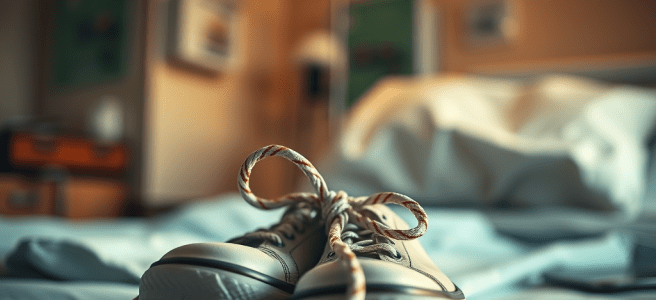
Recently, I spent the better part of one day in a hospital being infused with clotting factor to stop a bruise that was swelling at the top of my foot. “How did this happen?” the doctor asked. As I feel my shoulders droop and my eyes focus on my own knees, it seems I have taken on the body language of the three-year old still inside me. I mutter, “I laced my shoes too tightly.”

More often than not, it is the kind of accident that would have no noticeable impact for someone with the ability to clot. Like the accident that happened to me in a parking lot, on my way to my annual mammogram appointment. On that occasion, my right arm met the side-view mirror of a parked car. On the side-view mirror it says, “Objects in mirror appear closer than they really are,” and this mirror itself was closer to me than I expected.

Because of my bleeding disorder, this type of accident can transform my plans for several days and even weeks. This one refocused my attention almost immediately. The bruise, between my wrist and elbow, was noticeable within minutes. It swelled and grew as I fretted about my options. The technician in radiology could provide no ice pack for temporary relief. Even after all these years, it’s hard to switch plans, like the ones I had made for the remainder of that weekend.

I’ve learned not to listen to the mother‘s voice that I internalized long ago. I still hear her voice saying, “What did you do?” Those words sound accusatory to me, as if I had inflicted the pain on myself through my carelessness or stupidity. Mom meant well, though, and her training about how to be attentive has minimized my injuries. It still crosses my mind that if I hadn’t been in a hurry to get to the appointment on time… if I just hadn’t been so preoccupied with having a mammogram, it would not have happened. After all, I did not get a bruise from the mammogram itself, which sometimes happens. So, why can’t I just listen to Bobby McFerrin’s voice singing in my head? “Don’t Worry, Be Happy.”

“What happened to you?” I imagine people asking me in the next three to four weeks as the bruise enlarges, spreads and then fades away slowly. “Oh, I got into a fender bender with a parked vehicle and my arm was damaged, but the car is fine.”