Burden or Blessing

On Tuesday evening when we came back home after having dinner with friends, there was a voice mail message from my father in-law saying, “I fell again today.” He is 87 years old and this was the second time he fell this month. His voice sounded weak and his breath shallow. After we called him back, he was gently persuaded to go to the Emergency Room and get an x-ray. We drove him from his senior housing apartment to the hospital. It was clear that he was having a lot of trouble walking just to get from his doorway to the car. It was almost midnight when the doctor informed him that he had two cracks in his pelvis. They admitted him to the hospital and told him that he would need to learn to use a walker. He would have to keep all weight off his leg for the next six weeks. With a barely audible voice, he responded, “I just don’t want to be a burden.”

Loosing independence is hard. I have experience at that. And, this will indeed cramp both his independence as well as ours. The sadness that comes from thinking you are a burden, is a familiar feeling for me. My earliest childhood memories are mingled with my repeated medical issues. Since I was born with a severe bleeding disorder, I learned at a very young age how suddenly a joyful day’s walk in the park could change into a medical emergency. As a result, family plans can be altered for days and even weeks. Before I was 6 years old, I had convinced myself that I was a burden on my parents and nothing that my parents said really changed my mind.

In fact, because my parents had rarely been ill themselves, I now think they didn’t understand why I would feel this way. They didn’t seem to notice that most of our family defined their worth by what they did, not their medical diagnosis. I could see my parent’s worries about money, even when they tried to hide them. I knew money in our home was short because of the bills that were received after each trip I made to a doctor or to the hospital. I knew why vacation plans had to be cut short or holiday celebrations ended abruptly for every member of my family. It was because of a crisis that required me to get immediate medical attention.

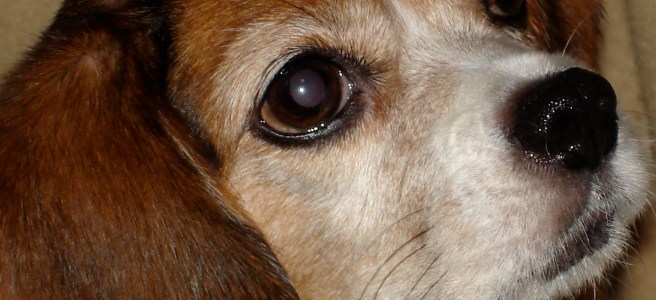
Now, however, I can see the other side. Part of that I learned from taking care of our dog, Penny. We adopted Penny from a local humane shelter eleven years ago. She hadn’t lived with us for a full year when she began having seizures, not unlike epilepsy. Being part Beagle, she also loves her independence. She doesn’t follow commands easily and seems to believe she knows best what is right. Yet, she wants to be as close as possible to her family, which she considers to be her pack. Penny demands the center of attention when the human family members try to have a conversation, and wedges her body between my spouse and myself when we attempt to sit side by side. She is a needy and willful dog that often stretches my compassion and generosity to the limit. The veterinary bills for her care have shrunk our budget just as her medical needs have limited our independence. She has triggered my anger and made me feel ashamed at my emotions.

Finally, I came to understand that Penny is my shadow self. Her traits remind me of the parts of myself that I would rather not see or recognize. When I opened my heart to Penny, I healed something deep inside of me. When I understood why I chose to care for her, protect her; provide for her needs I could finally see the full value in myself.

Penny has given me the gift of knowing that it is not what you do for yourself, or for others, that make you a being of value. Burdens can also be a blessing.

Not Ivy

“Ivy had hands just like yours,” my mother said as I struggled to practice my piano lesson. “Her fingers didn’t reach a full octave either, but it didn’t stop her from playing the piano.”

It made me want to scream, “I am not Ivy.”

Ivy spent every weekend doing the laundry and cooking for her brother Byron and their mother. As far as anyone knew, she had made no friends in Kentville and had never been smitten by love. After her mother died in 1959, Ivy continued to spend her days off from work with Byron at the farmhouse.

On a Sunday night in late June of 1962 Ivy died in a car accident. She was driving back to her apartment in Kentville from her weekend at the farmhouse. The Royal Canadian Mounted Police (RCMP) notified Byron who sat alone in the dark until morning before calling his brother Guy. The telephone tree was started from one sibling to the next. “I can’t believe it,” my mother said as she hung up from the call she received that morning. Even though she was forty-four years old, they still considered Ivy the baby of their family. She had been the last to be born and now she was the first to die. Those who had moved out of Nova Scotia caught flights from Toronto, Montreal and Boston. They had not been together since their mother had died three years earlier.

When some of Ivy’s brothers and sisters met with the RCMP to hear the report of what had caused the accident, they learned an intoxicated driver had tried to pass her car. Ivy slowed down to let him pass. The driver saw an oncoming car and swerved to get back into the space he had just left. He didn’t notice that the car he had attempted to pass was not where it had been before. He knocked Ivy’s car off the road. Trying to do the other driver a favor, she lost her life.

As mourners came to her funeral I heard people saying, “She was so loyal to the family homestead.”

“She took care of her mother and her brother and never thought about herself.”

My mother’s grief was complicated by regret. Ivy was four years younger than my mother and Mom felt closer to her than her older sisters. However, a disagreement the last time they had seen each other had ended in angry words.

After Ivy’s death, when my mother compared me to Ivy it made me feel like spiders were crawling up my back. On my birthdays Mom began commenting, “If Ivy was still alive it would be her birthday this week too.”

On a chilly autumn night in 1993, I had left work about ten p.m.. I was tired, having worked since early that morning. I was enjoying the 45 minutes of quiet in my car. The traffic was light as compared to the usual rush hour times of day. I had traveled this route daily. The straight, well-lit highway required little thought or concentration.

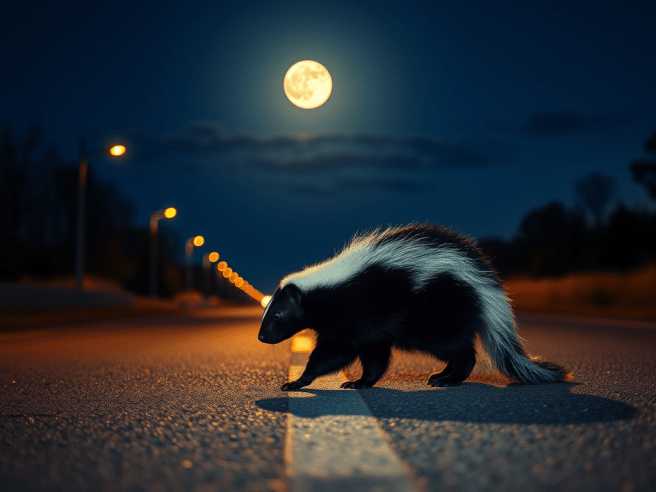
The harvest moon seemed to smile down on me from a cloudless sky. When I lowered my eyes back to the road I spotted a skunk meandering across the highway in the path of my car. The slow-moving skunk seemed out for a relaxing stroll. Without thinking, I jerked the steering wheel to the left in an attempt to avoid crushing the critter. Instantly I realized my car was now heading toward the median strip, and the oncoming vehicles on the other side. I yanked the wheel of the car, this time to the right, and slammed my foot on the brake. This action sent the car out of my control. I was forty-four years old. My first thought was “I’m going to die just like Ivy.”

In a heartbeat, I hit the curb on the right. The car flipped over as I gripped the wheel in disbelief. In a few brief seconds, it was over. My car toppled upside down, and landed right side up in a strip of grass between an exit and an entrance ramp. I stared at the tree, just inches in front of my car.

I unbuckled my seat belt and stepped out to see a beautiful night sky filled with glowing planets and blinking stars. I averted my eyes from the crumpled car beside me. In minutes a State Police trouper came to investigate. A truck driver who witnessed the accident had reported it. The trouper asked, “Did you fall asleep at the wheel?”

I responded, “No, I was awake for the whole thing.” I wanted to laugh or maybe cry. Adrenalin was still making my heart pump faster than usual. I was alive and I could feel giggle bubbles rising in my chest. I wanted to shout, “I’m not dead!” The police trouper looked like a no nonsense kind of person and I decided to suppress my joy for the moment.

“We’ll get your car towed and I’ll drive you to the station where you can call someone to pick you up,” he said. I could see him watching me walk as he led me to the cruiser. I was still a little dizzy and wondered if the car had rolled over more than once. My knees were weak but I had no trouble getting into the cruiser. I babbled about the skunk and how I hadn’t wanted to hit it. He glanced at me in his rear view mirror and said, “Next time, hit the skunk.”

When we got to the State Police barracks I realized that my first call should be to my doctor. As a person with a bleeding disorder I could not believe that I had escaped with no injuries. My hematologist was on call. He listened and then said, “I want you to put the phone down and feel all over your head for any sore spots.” I looked around at the police officers behind the desk and heaved a sigh. This I thought would cause the officers to question my sanity. I did as the doctor requested. I ran my fingers across my face and massaged my scalp. “No soreness,” I said, picking up the phone again.

“Good,” he said, “but I want you to come to the hospital anyway.” Like me he was doubtful that I had escaped with no internal injury.

Next, I called my spouse, Robin. “Would you come get me?” I said, trying to keep my voice as calm as possible. “I’m at the State Police Barracks. I’m fine. I’ll tell you the story when you get here.”

After examination in the hospital it was determined that I was unhurt. Back at home as I drifted off to sleep, I thought for one last time, “I am not Ivy.”