Full Speed Ahead!

The older I get, the longer it takes me to get ready for vacation. No matter how far in advance I start making lists of things to put in the suitcase, I forget something. My great uncle Eustace said he could stick a toothbrush in his shirt pocket and be packed, ready to travel. He claimed that he did this routinely when he flew to visit his daughter, Connie. I was envious and somewhat dubious that he was telling me the truth.

This year I put together a grab-it-and-go bag for our family, including our cat and our dog. It is for emergency preparedness, hurricanes, floods, and other disasters that could force us to leave our home quickly. This bag contains just the essentials: a change of clothes, underwear, toothbrush, comb, pet food and a week’s supply of medications. What is challenging is determining the basics. Can we survive without a cell phone charger? What toiletry supplies are most critical? Do we really need duct tape?

It took me two weeks to get that bag packed and I am still thinking of things I have forgotten to include. The decision making process slowed me down. Planning for disaster feels like making out an advance health care directive or buying car insurance. I don’t like thinking about the worst case. I have discovered over the years that what I think might go wrong, often does not happen.

I carry some metaphorical baggage in my head. When I was a young adult I kept a weekender bag packed in case I was hospitalized. Pregnant women were the only other people I knew who did this, but their suitcases were emptied after the baby was born. I went to the hospital each time I required a transfusion. My hospitalizations were unpredictable and sporadic. The overnight bag included things like deodorant, toothbrush and a pair of special pajamas, which I designed and made myself so that I would not have to wear a johnny gown. When I was released from the hospital, I packed the luggage again for the next time.

Because of my bleeding disorder, I have done a lot of thinking ahead. I keep my vision focused a few steps in front of where I walk; my thoughts are directed towards problem solving. The Girl Scout motto, “Be Prepared,” echoes within me. Even so, something completely unexpected is likely to make my plans meaningless. No amount of preparedness will give me control over my future. President Dwight D. Eisenhower said it well, “In preparing for battle I have always found that plans are useless, but planning is indispensable.”

In my heart though, I am a person who wants to live for today and let tomorrow take care of itself. I would like to be as free as Uncle Eustace, able to get away with nothing but a toothbrush stuck in my pocket.

Somewhere Over the Rainbow

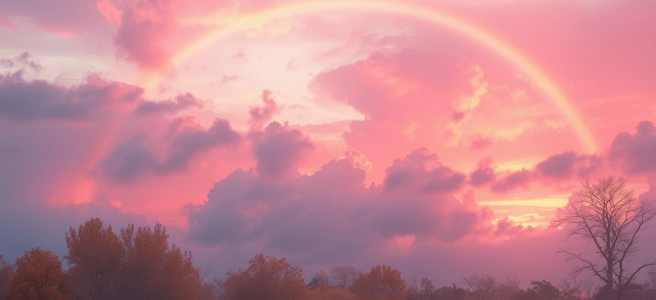
After a day of autumn rain and wind, the late afternoon skylight seemed to glow from the clouds above with a warm yellow. The world outside our windows was golden from the wet autumn leaves covering the ground or clinging to a few trees. It changed the light inside so dramatically that we stopped what we had been doing and went outside to get a clear view. As the rain diminished to a drizzle, the sun appeared for the first time all day, low in the West. As we watched, the winds blew away the remaining clouds and there was the rainbow at sunset. Cupped inside the rainbow, the sky was rosy pink and beyond the rim, it was blue.

The rainbow, symbol for hope, with the blue sky lying just outside of it… just the way the song from the Wizard of Oz describes. Happiness, just outside of our grasp.

My father taught me to hope. In my memories of him, I see him as he sometimes stood with his eyes on the horizon. He often commented that for him, “anticipation is better than reality.” Frequently, if I had experienced some pain or sorrow that day, my Dad would say, “tomorrow will be a better day.” As a child, it was reassuring to hear as I was tucked me into bed for sleep.

Most children have things to look forward to. When we are very young, it seems that much must be delayed until we have gained enough age, education or abilities. I spent years waiting to be old enough to apply for a driver’s license. When I was 9 years old I thought, if I only had a dog I would be happy. My mother told me that before I could get a dog I had to have enough money to buy it, feed it for at least one year, pay for all its required vaccinations and veterinary costs and incidental care.

Calculating this cost, I realized it would take years to save on the allowance I received. So, I took on my first fundraising campaign. I started by writing each aunt and uncle who had been known to give me a present in the past. My Aunt Ivy made the most frequent and generous donations to the “doggie fund.” Often she would write a little note with her check made out in my name about the dog she knew I desired.

Of course, when I finally did get the puppy of my dreams, it didn’t take long before I was dreaming of something else that would make me happy. The habit of hope was firmly fixed in my brain by then. It has the benefit of being an incentive to keep trying.

Delaying happiness has serious drawbacks though. Seeking perfection can be very isolating and disappointing. Chasing the elusive rainbow for the pot of gold, can distract me from what is happening this moment. Wanting to be something I am not, to be better, stronger, healthier, or more attractive to others leaves me feeling lonely. Perfection is in fact impossible to achieve.

The awareness of now brought me outdoors to see the rainbow at sunset. It had not been a perfect day. Yet, joy did not need to be postponed until tomorrow.

Return

Fallen tree in front of trees still standing
 

The sound of thunder alerts us to a sudden change in the weather. Soon the hail mixed with rain, falling tree twigs and pinecones create a percussion band. The rooftop becomes a drum. It’s a sound that sends the cat into hiding under the bed and brings me to the glass sliding doors to watch.

The squirrels that were jumping between tree limbs only minutes ago have all disappeared now. The hummingbirds and butterflies have all gone for shelter as well. The herbs and flowers, newly purchased at a local nursery, are tested for their durability and stamina by the wind and falling debris.

Only a short distance down the street, large tree trunks crack. It is humbling to watch as the micro burst prunes the wooded neighborhood.

By morning, television cameras are documenting the damage to homes. Landscaping crews are cleaning up the yards and lawns. The fallen branches are picked up and piled for removal later; like picking up a child’s toys after playtime. The human inhabitants desire that a sense of order be restored from the chaos.

The rain soaked earth rejuvenates the plants and the squirrels, butterflies, birds and humans seem refreshed as well. The air is cooler and dryer after the storm. The storm was brief, the damage will all be repaired quickly; not like the devastation of a major hurricane, forest fire, earthquake or Tsunami. Even so, I am reminded that ultimately the cycle of chaos and creation repeats and repeats and repeats; perhaps, as the myths tell us, from the beginning of time.

In spite of our human efforts to control or avoid the chaos and destruction, the wind and rain will return. The seas will rise, sinking boats and sucking in those on the shore. The earth will quake, volcanoes will send fire from deep below our planet and lightening will ignite wildfires. And, when the chaos has abated, those that remain will build again.

Weary bones and a backache

It started with my anklebones. I was twelve years old when I twisted my left ankle learning to dance the Highland Fling. I don’t remember when I first sprained the other ankle, however both ankles had many subsequent injuries. I was fourteen when an orthopedic surgeon suggested that I would be in a wheelchair soon if I did not have them surgically fused. When he said he didn’t think my bleeding disorder was a problem, I refused his recommendation. Fifteen years later, I was still using my feet to get around when another orthopedic surgeon looked at my x-rays and made the same prognosis. I refused again. Then I walked out. Thirty years later the ankles had fused by themselves and sure enough they no longer hurt.

The anklebones are connected to the knee bones. Both of my knees have torn cartilage and calcium deposits. The only knee injury I remember happened when I fell in1980. I landed hard on the right knee. I called the hematologist and explained that I had just started a new job and must get an infusion to stop the bleeding into the joint.

His answer was simple, “No way. Blood products are not safe. Put ice on the knee and keep it elevated for as long as it takes to heal.”

The next morning I loaded my lunch bag with ice packs, pulled out my cane and managed to get into my car. I used the cane to hit the gas and the break pedal while I drove to work. When I got to my job I turned the trash can upside down under the desk, elevated my leg and put ice on it. I don’t think that was what the doctor had in mind, but I considered it a reasonable compromise. I kept this routine up for ten days. I wouldn’t recommend it to anyone else though.

The knee bones are connected to the hipbones and even though I can only remember one hip bleed it was a whopper.

The hipbones are connected to the backbones. Wow, does my back ache! So enough already, I say to myself. It’s time to get serious about physical therapy.

This morning I was in the exercise room working on strengthening core muscles and balance. It is not exactly pumping iron, but for me it really helps. Two days a week I do my physical therapy in the pool. I never learned to swim but I sure do like being in the water.

Half of the pool is about 4 feet deep. I do the warm-up walking in this shallow end and then I work through my routine for about an hour. As my reward I stuff the noodles under my arms and inch my way to the deep (5.5 feet) end to just swing my legs and then just hang. It’s great for my back tension. I sort of let my eyes close half way and pretend I am a frog.

Frogs, I believe, do not have weary bones.

Change of Place

The move has been completed. We are settling ourselves into a new place called “home.”

I prefer to think of myself as a person who enjoys change, not one that resists it. Flexible people bend and do not break, I remind myself. But, as I awoke this morning in a place 1,300 miles away from where I was born, grew up, went to school and lived for more than 50 years of my life, I had to admit how difficult change can be.

It took months to prepare for this particular change; our family’s move to a new home. The transition prompted a volatile mixture of emotions in me. The process often felt as if I was unraveling the threads that had held my former life together in order to reweave a new fabric and texture for the remainder of my life. It was understood that when we left the place we had called “home,” we would not return even for a visit. We would take ourselves to another place and we would call that place “home.”

Early in the process, as part of planning for the move, I pulled the shoeboxes stuffed with letters out from the back of my closet shelves. I began opening correspondence that I had saved and reading it piece by piece. Mementoes of my past, carefully sorted and filed by date, stuffed each box. Preserved and saved for another time. Now the time had come.

Sifting through years of personal correspondence, I rediscovered letters written to me by friends and family members. There were also journals, which I had kept as a child. For years, my Aunt Ola had sent me a diary as a Christmas gift. I had faithfully filled the blank pages starting on January 1 of each year, recording my passage from childhood through adolescence.

Mixed among the diaries and personal letters were report cards from schoolteachers, many noting the excessive absent days due to illness and my eagerness to catch up with the rest of my grade once I returned to the classroom.

In addition to the correspondence, which I had saved, I came across the letters my parents had kept during their lifetimes. I had saved their keepsakes without reading them since their deaths a few years ago. Now it seemed like it was time to read these too. Here I found journals that my father had written almost 100 years earlier when he was a young man; letters my parents wrote to each other; and also letters written by me to my parents after I had moved away.

Classification tables copied in my father’s hand writing for identifying minerals, mingled oddly with his genealogical research. My mother, who kept so little, had managed to preserve lists of bird names, wildflowers and mushrooms that she had identified on her regular walks in the woods. My mother had also saved correspondence from the physician who had diagnosed my bleeding disorder. These letters from the doctor included advice and reassurance in response to her anxious questions.

Why had I and others in my family been driven to write so much? And, why did we keep so much of what was written to us? I wonder. What were we trying to document? What had we intended with these archives from our lives? Had we hoped to pass our experiences on to others? Or was the purpose simply to aid our own memories at a later time? For myself, I wondered if my intention was some attempt at immortality.

As I sifted through and reviewed the pages of writing it seemed almost as if it was new information. Time had changed my attitudes and my perceptions of what was true. My memories had been altered and were different than what my journals had documented in a previous time.

For whatever reason, I made the decision to let the past go. One piece at a time, the destination for these written words was the paper shredder. Grinding out thin strips of paper to be recycled and reused, I watched in amazement at the impermanence of life.