Weary bones and a backache

It started with my anklebones. I was twelve years old when I twisted my left ankle learning to dance the Highland Fling. I don’t remember when I first sprained the other ankle, however both ankles had many subsequent injuries. I was fourteen when an orthopedic surgeon suggested that I would be in a wheelchair soon if I did not have them surgically fused. When he said he didn’t think my bleeding disorder was a problem, I refused his recommendation. Fifteen years later, I was still using my feet to get around when another orthopedic surgeon looked at my x-rays and made the same prognosis. I refused again. Then I walked out. Thirty years later the ankles had fused by themselves and sure enough they no longer hurt.

The anklebones are connected to the knee bones. Both of my knees have torn cartilage and calcium deposits. The only knee injury I remember happened when I fell in1980. I landed hard on the right knee. I called the hematologist and explained that I had just started a new job and must get an infusion to stop the bleeding into the joint.

His answer was simple, “No way. Blood products are not safe. Put ice on the knee and keep it elevated for as long as it takes to heal.”

The next morning I loaded my lunch bag with ice packs, pulled out my cane and managed to get into my car. I used the cane to hit the gas and the break pedal while I drove to work. When I got to my job I turned the trash can upside down under the desk, elevated my leg and put ice on it. I don’t think that was what the doctor had in mind, but I considered it a reasonable compromise. I kept this routine up for ten days. I wouldn’t recommend it to anyone else though.

The knee bones are connected to the hipbones and even though I can only remember one hip bleed it was a whopper.

The hipbones are connected to the backbones. Wow, does my back ache! So enough already, I say to myself. It’s time to get serious about physical therapy.

This morning I was in the exercise room working on strengthening core muscles and balance. It is not exactly pumping iron, but for me it really helps. Two days a week I do my physical therapy in the pool. I never learned to swim but I sure do like being in the water.

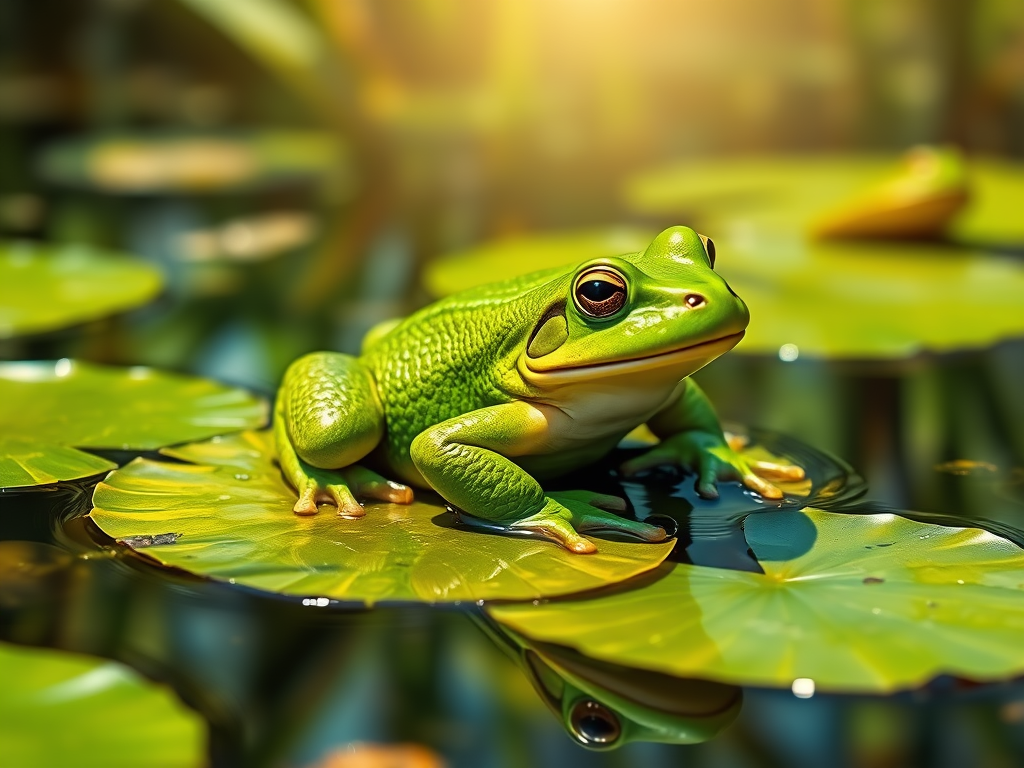
Half of the pool is about 4 feet deep. I do the warm-up walking in this shallow end and then I work through my routine for about an hour. As my reward I stuff the noodles under my arms and inch my way to the deep (5.5 feet) end to just swing my legs and then just hang. It’s great for my back tension. I sort of let my eyes close half way and pretend I am a frog.

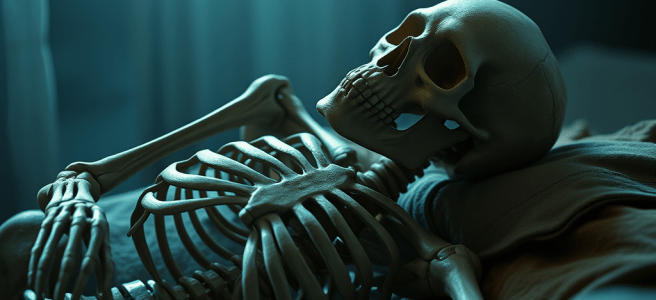
Frogs, I believe, do not have weary bones.
Change of Place

The move has been completed. We are settling ourselves into a new place called “home.”

I prefer to think of myself as a person who enjoys change, not one that resists it. Flexible people bend and do not break, I remind myself. But, as I awoke this morning in a place 1,300 miles away from where I was born, grew up, went to school and lived for more than 50 years of my life, I had to admit how difficult change can be.

It took months to prepare for this particular change; our family’s move to a new home. The transition prompted a volatile mixture of emotions in me. The process often felt as if I was unraveling the threads that had held my former life together in order to reweave a new fabric and texture for the remainder of my life. It was understood that when we left the place we had called “home,” we would not return even for a visit. We would take ourselves to another place and we would call that place “home.”

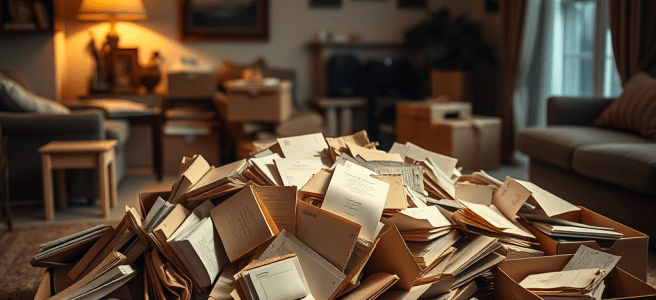
Early in the process, as part of planning for the move, I pulled the shoeboxes stuffed with letters out from the back of my closet shelves. I began opening correspondence that I had saved and reading it piece by piece. Mementoes of my past, carefully sorted and filed by date, stuffed each box. Preserved and saved for another time. Now the time had come.

Sifting through years of personal correspondence, I rediscovered letters written to me by friends and family members. There were also journals, which I had kept as a child. For years, my Aunt Ola had sent me a diary as a Christmas gift. I had faithfully filled the blank pages starting on January 1 of each year, recording my passage from childhood through adolescence.

Mixed among the diaries and personal letters were report cards from schoolteachers, many noting the excessive absent days due to illness and my eagerness to catch up with the rest of my grade once I returned to the classroom.

In addition to the correspondence, which I had saved, I came across the letters my parents had kept during their lifetimes. I had saved their keepsakes without reading them since their deaths a few years ago. Now it seemed like it was time to read these too. Here I found journals that my father had written almost 100 years earlier when he was a young man; letters my parents wrote to each other; and also letters written by me to my parents after I had moved away.

Classification tables copied in my father’s hand writing for identifying minerals, mingled oddly with his genealogical research. My mother, who kept so little, had managed to preserve lists of bird names, wildflowers and mushrooms that she had identified on her regular walks in the woods. My mother had also saved correspondence from the physician who had diagnosed my bleeding disorder. These letters from the doctor included advice and reassurance in response to her anxious questions.

Why had I and others in my family been driven to write so much? And, why did we keep so much of what was written to us? I wonder. What were we trying to document? What had we intended with these archives from our lives? Had we hoped to pass our experiences on to others? Or was the purpose simply to aid our own memories at a later time? For myself, I wondered if my intention was some attempt at immortality.

As I sifted through and reviewed the pages of writing it seemed almost as if it was new information. Time had changed my attitudes and my perceptions of what was true. My memories had been altered and were different than what my journals had documented in a previous time.

For whatever reason, I made the decision to let the past go. One piece at a time, the destination for these written words was the paper shredder. Grinding out thin strips of paper to be recycled and reused, I watched in amazement at the impermanence of life. 

Lightning

When my father would hear the first rumble of thunder, he would often gather us all into the car and drive to the highest point of land where we could get the best view. If it weren’t possible to chase the storm, Dad would position himself on the covered patio on the side of our garage. He would stand there, smoking his pipe, watching and listening attentively. The display of electricity as the sparks shot down from the sky and met the ground below never disappointed him.

It was with the deepest reverence and respect that I learned to watch the bursts of light cutting through the clouds. Even today, I find myself counted the seconds off between the audible jolts of sound that precede and follow the long, jagged, tentacles of sparks. It is hot meeting cold, positive crashing against negative. It is energy and brilliance being discharged so that it can be seen and heard. All the elements of wind, rain, sky and earth are present. Atmospheric scientists explain that the push of two sea breezes, one from the east and one from the west, force air upward. This is a common cause of lightning. The pressures of wind and gravity produce an enormous electrical potential.

It feels so much safer to surround myself with other people who share my values. I search for news reports that reflect opinions I already hold. I protect myself from the explosive power of opposites.

Not too long ago, I looked out the window to see two women walking towards the front door of my house. It was a cold, rainy morning. The two women were carrying pamphlets and I had a moment of panic as the doorbell rang. Should I just pretend that there is no one home and let them leave their religious tracts by my door? They looked almost as surprised as I did when instead I opened the door wide and invited them to step inside. For a moment, I felt their surprise and indecision, as I had when I saw them come walking down my path. When I risk conflict, I can feel the pressure rise. Often, I can see it rising from the other side too.

The two women chose not to be tempted by the warmth of my home. Returning to their preset agenda, they stood outside in the drizzle and offered me a pamphlet. I declined to accept their gift. We all missed the energy of the opposite forces pushing against each other. We all missed the possibility of conflict and the potential of transformation.

New Years Eve


There are ghosts on New Years Eve and hobgoblins too. I am sure of it. Like All Hallows Eve and Mardi Gras, it is a night to celebrate chaos, drunkenness and the seven deadly sins: wrath, greed, sloth, pride, lust, envy, and gluttony. My personal favorites are sloth and gluttony, However, I wonder if righteous indignation can be counted as wrath. If so, it would be at the top of my list.

My father used to say that one can only appreciate joy to the extent that one has known sorrow. I say that one can only be thankful for health to the degree that one has experienced disease and injury. Perhaps we can only value the potential for creation in our future after we have fallen into the abyss of chaos.

When I was a child, in bed and in pain from a bruised knee or swollen ankle, my father would say, “Things will be better in the morning.” They often were. Tomorrow will be the beginning of a new calendar year. Tonight the end of the old year is calling darkness and fear. Tomorrow, I will lean towards the future, but tonight I must embrace the past.

Knitting Reincarnation

There is no need to check the calendar; it is late autumn. Each night begins earlier and earlier and the daylight time is decreasing in noticeable increments. As the winds blow, rubbing bare tree branch against bare branch outside, the chillier temperatures leak into the house through unseen cracks. It is clear that winter is coming. It’s time for me to start a knitting project.

I usually knit only in the colder weather. I’m not an expert knitter, but, I find it very soothing and almost trancelike. The strands of yarn loop and curl around my fingers cross over the needles to transform into a new shape. Stitch by stitch the connections are made by my hands, my heart and my soul. The winding yarn wraps family, friends, people who knit and places both known and unknown to me all in one re-embodiment.

As I pick up the knitting needles, I remember the time when my great-uncle Eustace asked me with a solemn tone, “Do you know what ‘dyed in the wool’ means?” I was a young child at the time and I had no idea. We were visiting in Nova Scotia. My grandmother’s spinning wheel was still prominent in the front room of the house. It was a working farm where cattle, poultry and sheep had been raised for years to feed and support the family. So, I was sure that my great-uncle would know the answer. “Well,” he said with a twinkle in his eye, “It means that the sheep were left out in the rain and their wooly coats shrank around their necks strangling them.” My father began to chuckle at this point, assuring me that it was a joke.

Knitting not only connects me with people it also connects me to places I have been. A finished knitted garment will remind me each time I wear it of the place I sat as it was created with my fingers. The ones I keep to wear myself all have stories. Some of the ones I give away have stories too, like the ‘comfort caps’ a group of us from church made last year for the local Cancer Treatment Center.

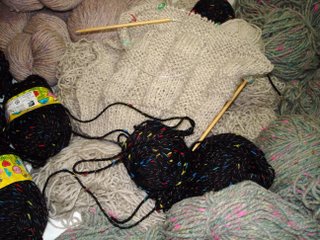
In my storage bin there are skeins each packed in tightly wrapped plastic bags. One bag holds sand-colored soft medium weight wool, purchased in Blacks Harbour. Handling this yarn, I remember the journey we made to Grand Manan Island. By the time I discovered that I did not have enough yarn to finish the project, I was a long way from New Brunswick. Another choice in my collection is a bulky green wool that still smells of lanolin even after several years. This yarn I purchased from Peace Fleece. With it, I had attempted to knit a “Coup d’etat Cardigan” only to discover that I had gotten hopelessly confused about the cables. A third bag holds remnants from a finished project. Selected in the Wilde & Wooly Yarn Shop, it is a brilliant blue shot through with white strands reminding me of the mist rising over the Blue Ridge Mountains.

The last bag I pull out is a half-finished vest in black tweed. In the cold of the November afternoon, I can see that the project is flawed beyond repair. So, as I have done many times before, I unravel it row by row. Time for it to return to a ball, until my creativity is rejuvenated and I am inspired to begin again.

There is a satisfaction in turning my past failures into a success. What better time than now?