The Two Wolves in My Heart

An American Indian story tells of a grandfather who was talking to his grandson. The grandfather says, “I feel as if I have two wolves fighting in my heart. One wolf is the vengeful, angry, violent one. The other wolf is the loving, compassionate one.” The grandson asks, “Which wolf will win the fight in your heart?” And, the grandfather replies, “The one I feed.”

Most of the time, I prefer to see myself as willing to get involved to help others. I don’t perceive myself as vengeful, angry or hostile. Yet when I come across aggressive people, like some of the drivers I encounter when I venture into the city, I realize that I also refuse to be bullied.

The other day, I was driving through a city that, many years ago, was familiar to me. A lot of the landmarks I formerly used to help me navigate are gone now. There are empty lots where I remember buildings and construction has changed the look of the area enough so that I slowed down in an attempt to read street signs. It seemed like a reasonable thing to do. An impatient driver with a very large red truck pulled up closer to the rear bumper of my car than seemed safe to me.

Sensing by his hand motions and reading his lips in my rear view mirror it was clear he was angry at my driving speed. Yet, on the narrow streets he was also unable to pass and I was unwilling to pull over. Instead of speeding up, as the man in the red truck seemed to want, I slowed down. Much to my companion’s horror I said, “You think this is slow, now try this!”

The truth is, I value slowness more and more as I age. It has wonderful benefits to my health as well as my spirit. The cliché about stopping to smell roses is indeed true for me. Several years ago, the story about the two wolves fighting inside of the grandfather inspired me to maintain a regular meditation practice. For meditation one must slow down to be aware of just one moment at a time. I believe that practice feeds the part of me that is loving and compassionate, making it stronger. The vengeful side of me is still there, although less and less these days. And, when it arises, I do not let it win my heart.

Independence Day

Parades with banners, stars and stripes flags, and marching bands; barbeque grills, potato salad and watermelon; open air concerts and firework displays all send the messages of victory from oppression and the “unalienable Rights” that include “Life, Liberty and the pursuit of Happiness.”

Liberty brings thoughts of a man I correspond with in Texas. He has been incarcerated now for about 15 years for a crime that he says he did not commit. Perhaps he is guilty. Maybe he is innocent.

I have never been incarcerated myself. For several years I worked as a consultant to librarians in State residential facilities. The libraries were for people with severe developmental disabilities, mental illness, and those awaiting trial in county jails or convicted felons in state prisons.

As part of my job preparation, I attended the Department of Correction Orientation program. The tour guide informed us that the people doing time are most likely to have had access only to a court appointed lawyer. The people I would see on the inside, he explained, are those without financial resources or the ability to read. I was amazed by the candor of the orientation. The purpose of the prison system is not to punish or reform, but to separate those who have been convicted from the general public.

I thought about how few “free” people have witnessed what I did when I walked through cellblocks where the decibel level of noise alone makes it difficult to control confusion and anger. The smell of human bodies not allowed to shower while confined in lock down for weeks at a time lingers in my memory even now. I recall the voices of many women and men explaining to me that when they were incarcerated they had not been taught to read. In prison they had the time to teach themselves. They were not stupid, just uneducated. I wondered if I could contain my resentment and rage if none of the rules that governed my day-to-day activities made any sense to me. Would I be able to stay calm if I were myself in this situation? Would my heart yearn for contact with friends or family separated by the walls?

I watched men, released directly to the street from isolation in a space 12 feet 8 inches by 7 feet 6 inches, stumble through the door because they no longer had any peripheral vision.

It is not the nature of the crime that determines where a convicted person will be housed. People who do not display anger at being incarcerated are placed in minimum security. Those who resist the confinement in an overcrowded environment, lack of privacy, limited time outside of a cramped cell; these people are placed in medium security. And those people who display aggressive behavior are confined to maximum security or solitary.

As I write to this man I have never met and probably never will, I remember what I saw and heard in person. It is not easy. I think about liberty and I suspend judgment to simply read his letters and respond.

Lift Every Voice and Sing!

This morning I could hear a voice outside my window. At first, I thought it was one of our young neighbors singing and happily unaware that the tune was drifting on the wind to my ears. Then, the voice became louder and more powerful. I realized that it was not a child, but an adult singing. How rare, I thought to hear a solitary and spontaneous song coming in my window. The voice came from a woman who was gardening. When I looked out the window, I could see that she was listening to tunes with a headset, unaware of the musical energy that she was creating for others to hear. Absorbed in the music as she dug into and pounded the earth, she seemed as if propelled by it. She was rejoicing in the moment and unaware of any outer or inner censor that might have told her to hush.

In my life, I have met two people who told me that they actually thought in music. One of these was a woman who often whistled or hummed songs aloud. In this way, clever listeners could actually read her mind by listening to what tunes came from her lips.

Most of the time the thoughts that drift through my head are in the form of words. Yet, often in the morning as I awaken it is with a song in my head. Music is often in harmony with my mood rather than my thoughts. When my mother was in the last weeks of her life, I heard music in my head that I had not heard for many years. The tunes were the lullabies that she had sung to me as a child and the music that had given me spiritual solace in times of pain.

When I was undergoing a strenuous medical regime a few years ago, I asked a friend to mail me a CD of healing songs. She had intended to use her own voice, yet she invited a child who was visiting her that day to participate. My friend’s songs were lovely and soft. The little girl spontaneously composed several tracks and these were tender even mournful at times. The refrain of the child’s song was, “Pretty blue sky, why are you blue?” The child, who was just reaching an age where she was becoming self-conscious, began to laugh with a mix of embarrassment and joy at her singing. The laughter was a clear note in the chords of the blues she sang.

My cousin B tells me that she believes the blues have the most meaning for her. One of her photos is inserted with this post. When I look at it, I can almost hear the music and it lifts my spirit.

Witness

I believe we all need witnesses in our lives. We desire the kind of empathetic bystanders that care for us. We want other people with the willingness to observe and be present even though they are at some distance or have never met us face to face.

At a distance, it’s often the images and the written words that give the ability for others to witness events. Storytellers, songwriters, reporters and photographers can be very skilled at being the eyewitness to events that happen too far away for us to personally behold. Perhaps that is why so many of us have started blogging. It is certainly one of the reasons why I sometimes randomly look at other blogs. I assume that the people who created them wish for others to see what they see or read what they have to say.

To bear witness is a burden to take on. It can be hard to be fully present for a wedding ceremony or a funeral service. To bear witness is not just to be in attendance, but also to fully observe, despite the personal anxiety or conflict it can create. Some people cannot tolerate sitting by a hospital bed even with a loved one. Some carry gifts in the hope that the giving of an object will bring joy or convey sympathy without the need for more personal interaction. Egos get in the way, harsh words can be spoken easily in argument or defense of opinions. But, what has the most meaning for me when I am ill or facing a difficulty is the witness of a loving presence. I had a reminder of this during the past week.

Those times in my life when I have been able to let go of my own fears and conflicts to listen deeply to someone who is in need of such a witness, have widened my world. So, I strive to do this more.

The power of having a witness has shown me a light at many times in my life. And, I am particularly grateful when someone is willing to bear witness for me and give testimony to the events that shape who I am.

Veterans Memorial

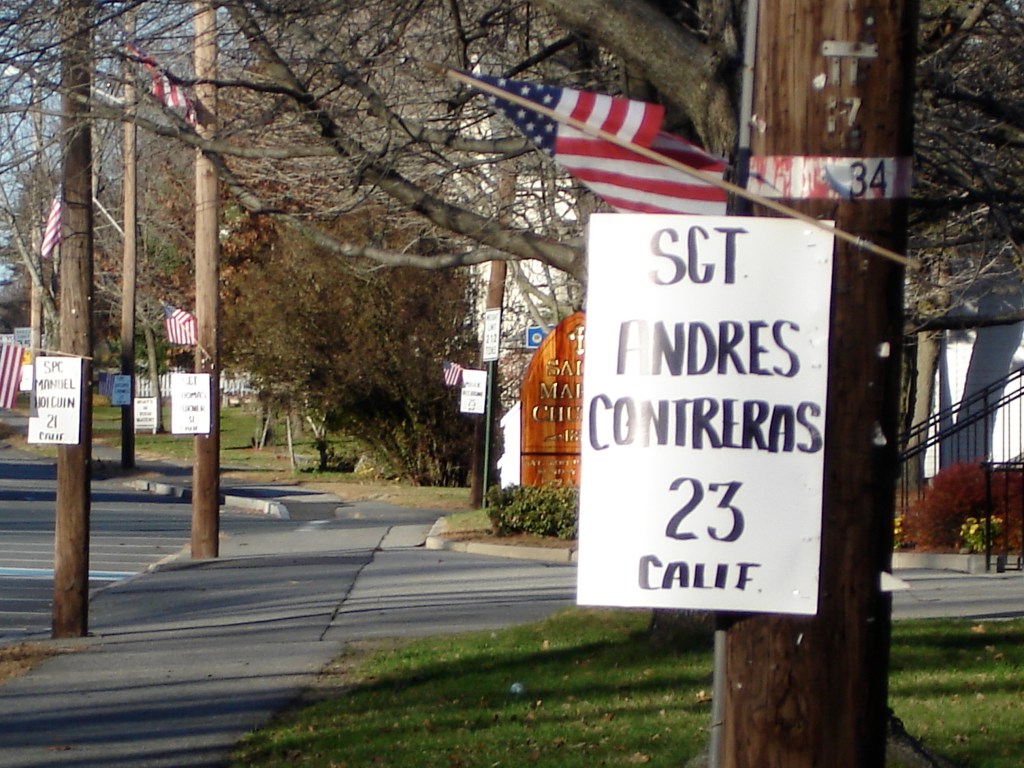
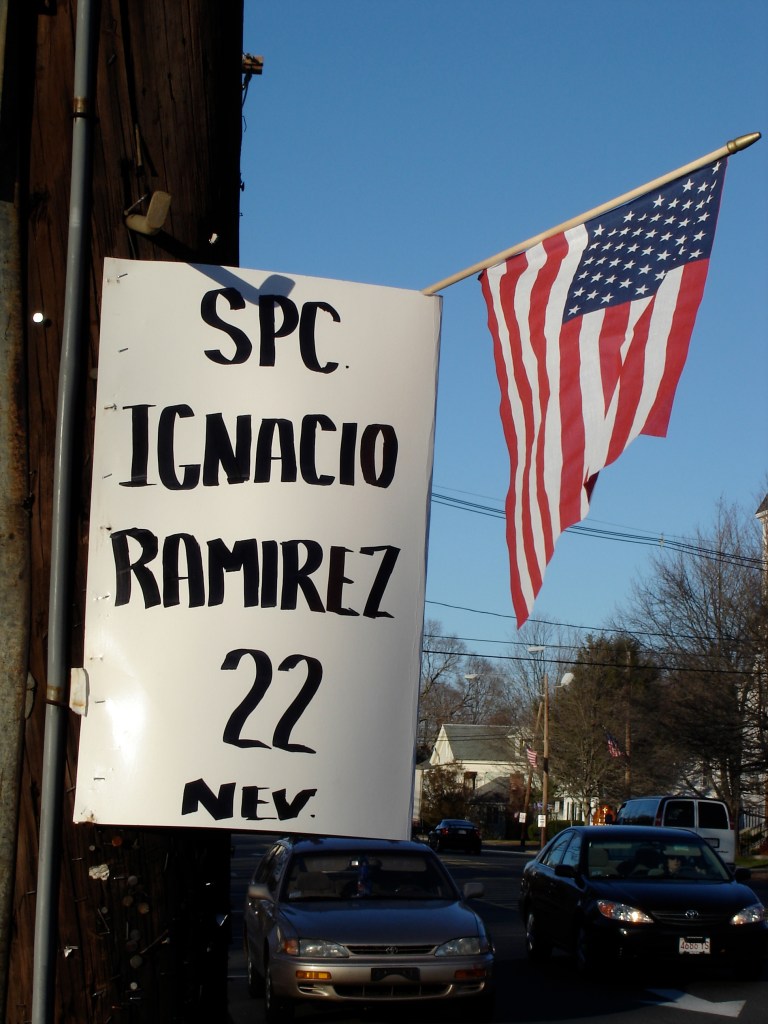
In the town of Holliston, Massachusetts, there is a veteran who has a mission. Each year he hand letters white signs in bold clear black letters with the name, rank, place of birth, and age of each soldier who died in the past year. He has been doing this each November since 2003. With the help of some of his friends, he posts the signs with the names facing the oncoming traffic in both directions on telephone poles that run through streets in town. Each sign has the flag of the country where the soldier was a citizen above the name. They are not all from the United States. They are not all men.

There are so many signs, that they extend into the bordering towns. And, even though the town is small, it takes several minutes just to drive through the long and winding road from one side of the town to the other. The main street is heavily traveled, used by many people from neighboring communities who drive through on their way to work, or shop, or get to some other destination.

When I first noticed the signs, I had already driven past several of them unaware. My thoughts were on where I was going. As one by one the signs and their messages began to enter my consciousness, I realized what they meant. Their simple message began to insert itself into my soul. My breath became shallow and my heart began to beat harder. I slowed down my driving to notice each sign. I tried to read as many names as I could while continuing to drive.

When the traffic speed would pick up, I might get only the first name of a person: Eric, Jose, Chris, Jared, Shawn, James, Terry, and Scot. Then, the ages began to have meaning for me: 18, 25, 32, 50. Each was a person; some may have had children of their own, and even grandchildren. They all had families and friends who missed them now. And each person had a place he or she had hoped to return to some day: Arizona, New Hampshire, Arkansas, or Ohio.

This year someone complained to the telephone company because the “names kept coming at me and coming at me until I was shaking.” Shaking in the presence of so much loss, so much sacrifice, seems the least we can do.