Who Are Your People

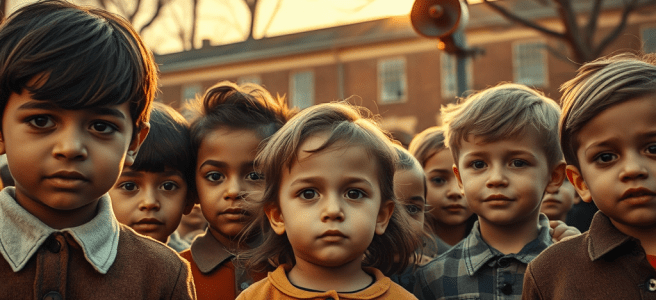
A group of young children stand close together outdoor with serious expressions. The children have different racial characteristics a school building with air raid siren on a pole is in the background.

After a song by Lea Morris

Recently a friend asked me, “Who are your people?” She wanted to know who I could trust for help when I needed it. It is a question that has seemed loaded to me since I was a child. I remember two of my young friends demanding to know, “If you aren’t Irish and you aren’t Italian, then what are you?” I was only six years old. I didn’t know the answer and I didn’t understand why it was so important to them. I had not yet learned how ethnicity, race, and identity could be used as weapons.

In the mid-1950’s people said we were in a Cold War. We couldn’t trust the Soviet Union. They were not like us. An air raid siren that was routinely tested stood in one corner of the school yard. When it went off our teacher had us practice by lining up single file and marching quickly down the stairs to the basement where we sheltered in place. We were told we would be safe from nuclear fallout there. We crouched against a wall until the all-clear sounded. Then we marched back to our classroom and pretended that we didn’t think the exercise was both terrifying and foolish.

My childhood home was near an Air Force base. When a jet took off, loaded with supplies, it looked as if it would barely miss scraping the roof of our two bedroom house. The china cups in the kitchen cabinet rattled. Pictures on the living room walls tilted a bit more to one side each time the house shook. All conversation came to a halt as we waited until we could hear one another again. We learned to live with the frequent disruptions, ignoring the roar of the engines. I didn’t wonder what cargo the planes held in their bulging belly or who was being killed.

The war was no longer cold. First the planes were on their way to Korea and then they took off for Vietnam. At first, I was too naive to know that our people were killing people.

My father was six years old when World War I ended. He had believed that was the “war to end all wars.” When the United States entered World War II, Dad enlisted in the Navy. The ship he served on transported both equipment and personnel. Years later he was still troubled by how the black soldiers who came on board were mistreated. He did not understand why some people could be treated so differently.

If asked today, “Who are your people?” I would respond,”all people are my people.”

Bone Body Mind: Ankle Reflections

After Loving Our Own Bones by Julia Watts Belser

In 1968, I tossed a prosthetic ankle brace into my closet. Wearing that brace had caused a purple welt on the back of my knee. A hematoma formed from the pressure of the strap. The brace had to be modified more than once before I could wear it without injury and, when that was done it did not give the support that my ankle needed. I wore it for almost a year before throwing it into my parent’s attic forever.

In addition to being less than functional, it exposed me as a cripple. The looks strangers gave me were of pity. At nineteen, I did not love my own bones, yet I would rather use a wheelchair if necessary, than do additional harm to my body.

Osteoarthritis in both of my ankles, both knees, both shoulders, one hip and, one wrist, is the legacy of my congenital bleeding disorder. Over the years however, I have become proud of my identity as a disabled person and learned the power of coming out of the crip closet.

Since that first brace, almost sixty years has passed. The doctor looked at my X-ray and ordered me a new brace. After I wore it once, I refused to wear it again. Instead I did physical therapy for what the doctor called “serious arthritis.” That helped to make walking more stable. For the second time in my life I tossed another prosthetic support aside.

When the ankle became inflamed and so painful a few weeks ago that it would not bare my weight, I pulled the brace out from the closet. My bones may be fragile, fused, and misshapen but, I care for them.

Ruby Geneva Harnish

Ruby Geneva Harnish

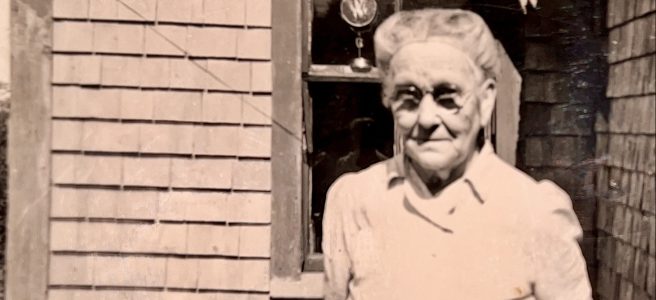
Gramma Ruby was born in 1875 in Annapolis Royal, Nova Scotia, Canada. At the age of twenty-four, she married my maternal grandfather, Samuel Harnish and moved into the two-story farmhouse he helped to build. He was a logger, which meant that he spent his days destroying trees in the Mi’kmaq heartland. Of course, that wasn’t how people thought about logging in those days.

Beginning in 1900, Ruby gave birth to ten children, five girls and five boys each one approximately two years apart. When a neighbor gave birth to two children in less than two years, Gramma would scoff that perhaps they did not know how to use a thimble. This story stuck for me because I have no idea how a thimble could be used as an effective form of birth control. It was, however, only one of the stories I heard of how judgmental she could be.

All her children lived to be healthy strong adults, even the one who contracted lock jaw from stepping on a rusty nail in the barn. Surviving tetanus was unheard of in those times, but Gramma dribbled bone broth between his lips until he could once again move his jaw.

Ruby assigned all of her children jobs. Whether it was knitting mittens and hats for winter or bringing in the firewood, everyone had at least one task to do. The boys did most of the outside chores. The girls separated the cream from the milk, stitched clothing, mended socks and did countless other things to keep everyone fed and clothed.

My grandfather Samuel died in 1927 at the age of fifty-two. His corpse was transported from the Halifax hospital back to the farmhouse where the Annapolis Royal Baptist pastor, performed the funeral. I imagine the viewing and ceremony took place in the front parlor. There was still a small organ in that room in 1956 when I first visited that home.

As soon as they were old enough most of Ruby’s children took jobs in town, teaching school, being housekeepers, or nannies. They all sent back the money they earned to support Gramma and their younger siblings. It was the Great Depression and everyone had to pitch in to survive, but Ruby continued to feed anyone who arrived at dinnertime. As a teetotaler, there would be no liquor in her house.

Four of Ruby’s sons and three of her daughter’s married, despite her strong objections. Why she tried to stop any of her children from marrying, no one in the family can explain.

Ruby was the only grandparent who was alive when I was born. I only met her once. I was five years old and she was eighty-one. I was disappointed that she was not as pleased to meet me as I was to meet her. She wasn’t the cuddly grandmother I had longed for. Ruby’s solution for getting me out of her way was to introduce me to a little girl,my age, who lived just down the road. It was a gift that has lasted seventy years.

Most of what I know of her is by way of observing my mother and my aunts and uncles. Many of them inherited Ruby’s critical tongue, organizational skills, and generosity to those in need. Those traits and the friend she introduced me too are my legacy from her.

In Memory of Horace

This week marks the twentieth anniversary of my father’s death. It is a date that I usually let slip from my memory. I don’t want to remember the day he died or the two days prior as he lay in a hospital bed, while I sat by his side day and night unable to find the words to say goodbye. I prefer to remember him animating my childhood stuffed animals, bringing them to life in my imagination. I want to see the twinkle in his eye when he told a trickster tale. I want to remember his generosity, especially to those who were very young and undervalued by others. I want the images in my head to be of his love of the natural world, including animate and inanimate beings.

Yet, too many nights as I try to drift into sleep I see images of him during his last days. I replay the early morning telephone call from the doctor. “Your father had a massive heart attack last night. He is in the intensive care ward now. We don’t expect him to live more than a day or two.”

My heart still races when I recall how I rushed to his side, finding him engulfed in beeping machines and an entanglement of electrical monitors. Years earlier he and my mother had written their living wills and discussed their wishes with me. Now I had to tell the nurses and doctors to remove all the equipment and transfer him to a private room where he and I could be alone.

I wish that I could forget watching helplessly as he shared what it felt like as his organs failed to function. When he turned to me and said, “This is just like being born,” he was teaching me what it was like to die. He was a penultimate learner and teacher. I am so grateful to have had him as my father.

Father pushing baby daughter in a stroller.
In the park

Survivor

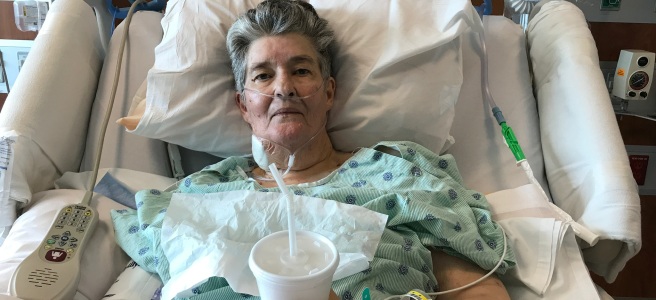
Four years ago I was reclining in an intensive care hospital bed, connected to fluids running in and draining out. High on steroids and pain killers I was ecstatic to be allowed to take a few sips of water. I prayed silently to my vital organs. “Heart, kidneys, lungs, please welcome your new partner, a liver from another body.” Silently I repeated this mantra over and over, asking that they all work as a team.

Each morning when the doctors from the transplant team made their rounds they asked “How are you today?”

I grinned and responded. “Fabulous!”

My gratitude was expansive. Thankful for the anonymous donor’s family, the team of surgeons, my treasured hematologist, my supportive family and generous friends. Most of all I was comforted by my loving spouse who was camped out, spending her days and nights in the cluttered Intensive Care room with me.

Just four months earlier I had sat in front of the sad-faced gastroenterologist. He said, “You know this was a possibility. The scan shows you have HCC, hepatocellular carcinoma.”

I did know, but suddenly I could not comprehend or focus on the doctors words. I glanced a my new-found friend who was sitting silently in the chair beside me. She was scribbling notes and staring at her lap. With immeasurable gratitude, I let go of trying to understand right now. Right now I needed to breathe deeply.

It was incredible that I had lived with Hepatitis C for more than forty years before reaching what many had predicted would be my end. It was astounding that despite my life-long bleeding disorder I had survived long enough that liver transplants were now sustainable, due to improvements in anti-rejection medications. It was amazing that even with my bleeding disorder I could not only survive a transplant, I would move up on the waiting list because of my bleeding disorder.

It was miraculous to me that the newest Hepatitis C treatment had cleared me of the virus, just a year before I was diagnosed with liver cancer. If this had not happened a transplanted liver would quickly be contaminated with the virus and the cycle of liver deterioration would begin all over again. Now a transplant would replace my cirrhotic liver, give me blood that would clot, and get rid of the spot that appeared on the MRI image that signaled alarm.

Recovering from the surgery took months of physical therapy, ongoing testing and regular check-ins with the surgical team.

Now, four years later I sit in a row with four other women awaiting a COVID-19 vaccine booster shot. We are all survivors. We have all lived longer than anticipated. We all live with compromised immune systems. We all need others to get vaccinated for COVID-19 and use recommended personal protective equipment.