Going on a library hunt

During the summer months, my friends and I walked to the Liberty Branch Library. Each child carried a few books we had read under the shade of a tree or illuminated by a flashlight. We turned the pages faster as our reading improved with practice. “Just one more chapter, please!”  we begged if our parents called us.

Our short legs walked at a meandering pace and it took us at least half an hour to get to our destination. We passed by the elementary school and skirted a side of the city park. There was only one busy street for us to cross at a traffic light.  We dropped our books at the check-in counter.

Mrs. Walker, the children’s librarian, never seemed to tire of questions. Instead she took an immediate interest in whatever we found curious. We knew we could count on her to find out which bird built that nest in our maple tree or what makes lightening flash and thunder boom. She would glide her finger across the rows of books on a shelf and, like magic, pull out the very one that held the answer.

When we heard the bell ring we would gather in front of the basement door and wait until Mrs. Walker led the row of assembled children down the stairs and into the story telling room. We took our places in the metal folding chairs eager for the stories and songs. Some of the stories we repeated almost every time. My favorite was the Bear Hunt. We would slap our hands, alternating left hand then right, to our thighs making pat, pat noises that were supposed to sound like foot steps. Each line of the story that Mrs. Walker told, we echoed.

“Let’s go on a bear hunt!” Mrs. Walker would begin.

“Let’s go on a bear hunt,” repeated the children’s voices.

On cue, we all made the appropriate hand movements and sounds for walking through the tall grass in the field, crossing the bridge, walking through the fallen leaves in the forest, swimming across the river, and squishing through the mud. Finally when Mrs. Walker announced we had reached the deep dark cave we would reach out our hands in front of us and pretend to feel around.

“I feel a wet nose.”

“I feel a wet nose,” as if we all felt it too.

“I feel furry ears.” Mrs. Walker said with concern in her voice.

“I feel furry ears.” we repeated in unison.

“It’s a bear!” Mrs. Walker shouted, “let’s get out of here!”

“It’s a bear!” we shouted, “let’s get out of here!”

This was the signal to reverse our previous steps rapidly, making squishing noises through the mud, swimming strokes crossing the river, crackling through the forest, parting the tall grass and finally opening the door to home. We heaved a sigh of relief and collapsed as if the race had been run on our legs, not our imaginations  and hands.

After story time we would pick out more books before reversing our steps home. Past the Italian bakery that smelled of warm bread, stopping at the traffic light to cross the street, feeling the cool breeze coming from the park and past the school yard. By the time we got home we would be ready to sit and begin one of the books before we were called to supper.
Mad Hatter Birthday Party

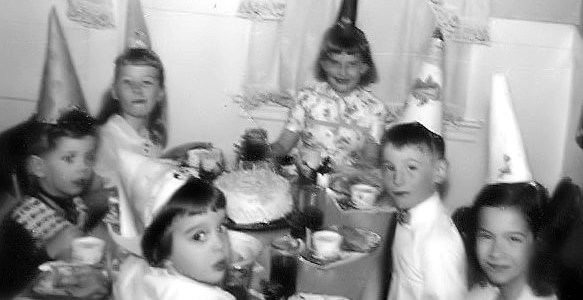
Each child was dressed in her or his best outfit to attend my birthday party. No doubt a mother briefed each child before the party with instructions for proper etiquette. Looking a bit stiff,  befuddled or anxious, we all wore paper cone hats, which we had decorated ourselves. We sat politely around the rectangular wooden table in the kitchen while the little Dixie cups of vanilla ice cream softened and we waited for the cake to be cut.

Before the cake was served, however, we had to pose for the obligatory snap of a camera that would freeze the moment in time. If it were not for that now grayed and tattered black-and-white photo, I would have no memory of that day. Now as I stare at the photo I can recall the names of each child.

Television was just entering our homes and it was an “Ozzie and Harriet” world that came up on the little screen. The subliminal message was that all nuclear families were cheerful, loving and content, not explosive mine fields. The television families had a mother who stayed at home, did the laundry cheerfully, cleaned house spotlessly and cooked healthy tasty meals flawlessly. Supper was served when father came home from a hard day at work.

The reality in our own homes did not match the images we saw on t.v. in 1956. Our mothers were mostly lonely, bored and frustrated women. Many did not like raising children or cooking or doing laundry. They were prone to unexplainable fits of violence or tears. Few of our fathers came home with a smile. For at least half of my friends, the nuclear family had a mushroom cloud lifting from the dinner table. Each of the children at my birthday party that year held a secret truth that they had been cautioned never to discuss.

Secrets have a way of leaking out, however, and our mothers talked to each other within the hearing of our curious little ears. Some secrets were not revealed until we were adults. Adam’s father was an alcoholic who regularly beat and terrorized his wife and children. Sherry’s father sexually abused her older sister and he would later do the same to her. Other children had secrets we never learned about. We all kept our distance from Philip.  He took out the rage he felt by bullying anyone weaker or smaller than he. We all thought we were the only ones who did not have a perfect family and that our home lives were the oddity.

A Belated Valentine to My Body

Dear Body,

In our 63 years, I have often forgotten to thank you or to say how much I love you. I do love you and I have come to admire so many of your features. While others of my generation look in the mirror and frown at the wrinkles on their face, the imperfections in their skin tone, thinning hair, and flabby chins I laugh. These superficial things mean little to me.

I remember when you and I were young and I saw you for the first time in a mirror. You were quite a charmer then. I smiled to see
the blonde baby curls that transformed over the years to brown with golden strands and I smile today when I see that gold has turned to silver.

You have done many hard and complex tasks for me over the years. You have endured my anger and my frustration at the things you cannot do and repaid me with a gentleness. Perhaps the thing I admire the most about you is your ability to heal and to learn new and different ways of responding when you have been assaulted.

Without fibrinogen you have faced many challenges that most other bodies have not confronted. You have adapted to blood that will not clot and made me trust you when others told me you would be unfaithful. When the doctors judged you as being weak you proved them wrong. They said you would desert me in less than 10 years and when you did not they said you would leave before we had spent 20 years together. So now after 63 years, I love you even more. I am so grateful for the gifts you continue to give me.

I’m sorry that I ever doubted you. I am sorry that I have wasted so much of our time together worrying about you.

You have never lied to me even though I have often ignored your warnings. Yes, I have even come to value the pain and fatigue you give me. You tell me when to slow down, get some rest, and when to call for medical assistance. I apologize for the times I have not paid attention to your needs, the weight I have gained, the times I have delayed treating an injury, and my stubborn streak that has overruled you.

Last week when I sat in the doctor’s office filling out the five-page medical history, I checked off the list that is your resume: bleeding disorder, stroke, arthritis, seizure, high blood pressure, and cataracts. What great life experience you have had, I thought to myself. So, with confidence I check off the box that says “good,” beside overall health.

Then I smile.

Orange Helix

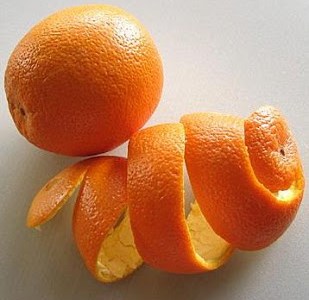
From the fruit bowl on the counter, I pull out a naval orange. It fits comfortably in my hand and I give it a little squeeze to sense the firmness. It is as if I have plucked the rising sun from the sky. The color is radiant as I rinse the pebbly skin under the water at the kitchen sink. With my fingers I gently rub the bumps and indentations in hopes of sending any lingering pesticides down the drain with the gurgling water.  The round shape is interrupted at the bottom where the folds bunch the skin in a disorganized jumble of orange, specks of green and brown. If it didn’t have this imperfect outside, it’s appearance would not be so intriguing. It’s a connection, like the human naval, with it’s past. I know that under the external bumps lie little baby-like wedges of delicious fruit. This orange came from a grafted tree, not from a seed. And so even though it has no seeds in it’s own belly, it carries children with it. It is a childless mother, like me.

Standing at the kitchen sink peeling an orange in one continuous curl is something I watched my mother do time after time. So I reach for a paring knife and begin the ritual I observed my mother doing. I insert the paring knife, and turn the orange around and around until the rind falls away in a spiral whirl.
It is a meditation that requires some precision and some self-control. As the knife blade pierces the protective skin my hand is spritzed with the fragrant orange nectar. The thin orange outer layer of skin is cushioned by a thicker cream color layer. That is soluble fiber and I plan to eat most of that with the orange pulp. The smell of sweet orange is powerful and I quickly forget everything except that I want to separate the sections and pop them into my mouth.

When I make the final twist, the orange skin drops into the stainless steel sink in a single piece, empty as an abandoned snake skin. I look out of the window that is over the sink, the way my mother always did at the end of the ritual. I eat the orange slowly, the taste is milder than the scent and it has a way of making my mouth feel clean and my belly satisfied. Gazing out the window at the mottled sunshine, I can see the jagged burnt sienna bark of the loblolly pine, the ground cover of crackling brown oak leaves and the fence that marks the beginning of my neighbor’s yard. A pale yellow butterfly flits in-between the trees; it has it’s own spiral dance.

Reflecting on the circularity of life, round and round without returning to the same spot again, I scoop out the orange peel and drop it into the compost bucket.

January Thaw

When I lived in New England, the winter temperatures froze the soil, making it as rigid as cement. Ice crusted the sidewalks, stairs and streets. The most dangerous ice, however, was the wafer-thin sheets you could not see. You knew it was there only after you found yourself slipping and sliding in a frantic attempt to maintain some balance. Layers of old snow would pile up and shrink back, solidifying into granular piles of dirty gray. It had no resemblance to the white fluffy flakes that had fallen from the sky days or weeks before.

 
What was fun as a child became a drudgery as an adult. At the end of the driveway where the snowplows had scraped the street clean, the snow was packed hard and formed into angular chunks. My shoulders ached from shoveling; piling the mounds higher than my head I was hot under my winter coat while my nose was red from the cold.
 
“There’s always a thaw in January,” Mum would say with reverence. “The snow and ice will melt. We’ll have a short break from winter before it returns again in force.” Sure enough, usually in the last week of January, the temperatures would rise above freezing for several days in a row. The fog from the warm air against the cold ground would form drops of dew on windows.  The snow piles along the paths would shrink and some would disappear.  The top layer of ice covering the pond would turn into puddles. I could almost smell the earth softening.
 
Winter in North Florida is not cold; I don’t miss snow or ice. This week, it was warm enough for me to go outdoors without a sweater. Inside, I opened the windows and listened to the birds chirping. The old timers here say it is one of the warmest winters they can remember. The same is true, say my friends up North. Although we are glad, it also makes us feel uneasy. Thirteen of the warmest years since record-keeping began have occurred in the last fifteen years. It is hard to miss the photos of icebergs melting and breaking away. The number of extreme weather catastrophes around the globe are increasing year by year; droughts, massive fires, hurricanes, tsunamis, earthquakes, tornadoes make it hard not to notice that the climate is changing. 
 
Is it more than an ordinary January thaw?