The Marathon

All human beings should try to learn before they die what they are running from, and to, and why.

—James Thurber

It is Marathon Day in Boston. This year, I am not there to watch the crowds of people arrive from places around the planet. Even so, I know that there are people speaking many languages in the small town of Hopkinton, Massachusetts. They are filling up their bellies with high carbohydrate breakfasts, then getting in lines for their numbers. The media are taking up whatever space they can find with their cameras and video equipment. Enthusiastic fans are competing with the local residents for a space where they will be able to see the race begin.

For many years, I would position myself at the top of Heartbreak Hill, not far from where the runners would finally reach the city limits of Boston. As each runner came up that stretch of pavement, looking tired and defeated, I would clap and shout encouragement. It was Jeff who had taught me to show up at the most difficult stretch of the route to cheer.

Jeff moved into my parent’s attic one spring. His father had beaten him up for the last time. When my mother opened the back door that afternoon, she saw Jeff standing there with a bloodied face and a satchel full of clothing slung over his shoulder. It was not the first time my mother had harbored one of the children from that family. A little first aid, a home cooked meal and Jeff recovered enough to explain that his Dad was drunk again. Jeff had come home for spring break in his freshman year of college. His father had announced that he would not pay for any more school. It was time, his father screamed, for his son to go off to the war that was in Vietnam. No more would he have a son who shirked his duty and hid behind books to evade the draft.

When I arrived home from college a few weeks later, I could hear John Lennon’s music filling the space that previously had only held empty suitcases and dusty photographs. Jeff said very little to anyone. Some evenings, after we had dinner together, he would linger long enough for a game of cards after the kitchen table had been cleared of dishes. Most nights he would go directly to his private space with the unpainted plywood floor and bare rafters stuffed with insulation. He would read, play music and only occasionally go out to meet one of his friends.

In a few weeks, Jeff had a job as an orderly in the city hospital. He applied for nursing school and was accepted. Whether he was truly a pacifist or whether he did it to spite his father, he received an exemption from the draft. His war was a private one. His spirit seemed full of inward battles fought in solitude. He ran, it appeared, not just from his abusive father, not just from the war he opposed, but to save his own life.

Each morning, before he dressed in his scrubs and walked down the hill to the city hospital, he ran. He arose earlier than any of us and left the comfort of his loft to run. He ran in the heat and the cold, in the rain and even in the snow. His goal was to run the marathon; not to win the race, but to finish. The first few times that he entered a race, it took him so long to finish that the race officially ended before he triumphantly reached the point where the finish line had been.

During the next two years, while he lived with my parents, I drove him to and from the site of several marathons. Even though Jeff’s race for life was directly opposite to my own, I understood the importance of a cheering section and a friend to reach out with some fresh water along the way. So, at several points along the route, I would stand until I saw him come into view. Then, I would begin calling out his name and enthusiastic encouragement until I saw his dazed eyes acknowledge me.

The physical demands of long distance running were foreign to me. I could not quite understand why someone would voluntarily put himself through such an arduous and punishing experience. Having a bleeding disorder, I had chosen a life that was structured to minimize injuries. By that time, I had already spent years listening for the early warning signs in the twinge of a sore muscle. The smallest of body aches could indicate the need for medical intervention for me. To win my race for life, no pain was a gain. It horrified me to see him limp in at the end of the race, doubled over in agony and exhaustion. His muscles would be cramped and his body contorted. The heat and dehydration left him depleted that he collapsed into the car seat for the return ride. Even more baffling to me was the way in which he recovered within hours. He would be up the next morning running as usual before going to work. It was a lesson to me to observe how his body could endure this amount of pain without fear or mental suffering. How different from the sense of defeat, self-blame and guilt that I felt when my body was hurting. How unlike the days it would take me to heal an injured joint or muscle if there was internal bleeding.

In spite of our different strategies for survival, Jeff and I had each experienced our own wounds. And although our reactions were so dissimilar, I understood his resolve and resilience. It is a winning combination and it deserves applause.

Plum Pudding

Mom was grateful for many things; Christmas was not one of them. It was nearly impossible to give her a gift that she liked. My father had given up years before I was born. It was a lose/lose proposition. Mom did not like surprises and she did not like routine, she considered gifts that were not practical to be frivolous while presents that were ordinary she considered mundane.  Dad purchased her a dozen nylon stockings each Christmas from the most expensive department store in the city. Mom silently tucked them in her dresser drawer and wore them only for special occasions, but at least she did wear them. She would feign pleasure when neighbors or relatives sent her a gift and then grumble about the waste or inappropriateness when they were out of sight. Over the years, I gave her wallets and scarves and gloves that she stuffed in the very back of the closet and called “too good to use.”’
When at last I asked her why she didn’t like Christmas, she told me that when she was a little girl, she received a lump of coal in her stocking. “No!” I said truly shocked.
“Yes,” she replied. She never quite recovered from that disappointment. Silly as she knew that sounded, she looked embarrassed and changed the subject. I thought that lump of coal had settled in my mother’s heart as a reminder that she was not good enough.
Mom also did not like shopping for gifts. Each December just before Christmas, she would purchase the supplies for making steamed pudding. She would put the suet through the meat grinder and make a pot of strong tea. While the tea cooled, she mixed the eggs, sugar, and molasses, then added the chopped dried fruit. It was such a gooey dough that it required a strong arm to stir. I watched my mother through her weight into the wooden spoon. Even on the coldest day, there would be sweat on her forehead as her shoulder rotated. Throwing the weight of her whole body, she would thrust the reluctant batter into one mixture.
The aroma of cinnamon and allspice from the steaming pudding drifted through our house. While the puddings were cooking, Mom would mix the powdered sugar and butter for the hard sauce. It was my job to roll the stiff icing into balls, forming little snowmen with current eyes.
Mom would sit beside me at the kitchen table, writing out the instructions for re-heating the pudding in three by five cards. “They won’t take the time to warm it properly,” she mumbled, “they will ruin the pudding and people will think it is my fault.”
Its hard to give or receive a gift if you do not believe you are worthy.

If a tree falls on the wood pile, what does it mean?

The November chill has pierced through the walls of the house for several nights. I go out the front door to fetch some of the stacked wood piled high on the porch. Ever since it was delivered a few weeks ago, I have been eager to begin using it up.

I crumple a few pieces of newspaper, lay the kindling, tinder and a single log into the wood stove, and then strike the match to the paper. I wait until I see the flame catch hold. The flames lick the wood, like a cat pruning its fur. When I see the flame shrink I open the stove door a crack, letting in more oxygen. Poof, the sparks sprinkle in many directions and the wood begins to glow.

They belong together, the wood, the flame and the air. When they meet at last, however, they will release their energy and die. Fires need watching and tending as they die, I muse, much like people.
 
As a child I watched a pine tree in the yard of a neighbor. I could see it clearly from my bedroom window. When I first noticed it, it was the height of a Christmas tree, perhaps 6 or 7 feet tall. It grew so slowly that I was surprised one day too see that it had surpassed the height of the houses on our street. It terrified me to watch it during a storm. The tall trunk would sway and tip from side to side. I wondered if it fell, would the top hit the roof of my house?
 
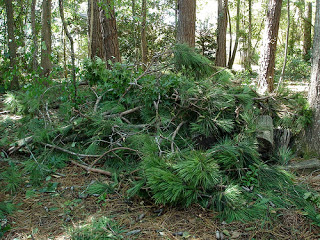
The loblolly pines in Tallahassee often fall when there is a heavy rain or wind, bringing down other trees, crushing cars, crashing through homes, destroying lives and transforming the landscape. Many homeowners have had all of the beautiful tall pines removed from their yards.
 
I love the giant trees covered in crusty bark. Their branches stretch towards the clouds and their roots extend deep and wide under the earth. Last summer, we had three trees cut down from our yard because the tops had died and the chances were that they would come crashing down in the next big storm. It pained me to watch the guide ropes being attached and hear the power saws buzz, and smell the wood being ground into pulp. Not more than a month later one of the many remaining trees in our yard fell and landed directly on the woodpile. It seemed an act of suicide. It also reminded me that as much as we might try to predict the greatest threats to life and safety, we can not control what will topple next or where it will land.

Living the High Life

After Mrs. Gilbert’s husband died, the house that had once been full of conversation, music and laughter seemed hollow. Her two daughters were both married adults with busy and active lives. They were worried about her, she knew that, but there was little they could do except to call her on the telephone once a week.

Before he died, Mrs. Gilbert’s husband had spent his days and nights in a hospital bed. The bed was still in the spot where once there had been a dining room table. Each time she passed that empty bed she felt the stark reality that Howard had died. Oddly she also felt his presence and so she refused to have the bed removed.
 
Just up the hill from her house was a seminary. “Mom, why don’t you inquire if there are any students who need housing in the area?” one of her daughters suggested. She rather liked that idea; it would give her joy to share her home with someone studying for the ministry.
 
What Mrs. G. did not expect was that two women, one studying for a master’s degree in Divinity and one studying for a master’s degree in Library Science, would ask if she might rent them both rooms. “Why not?” she said, “One of you can sleep on the third floor and one on the second. That still leaves me two spare bedrooms.”
 
I was the woman studying to be a librarian. We moved in, relieved to be out of the basement studio apartment in the city that a friend had generously invited us to share temporarily. We felt incredibly lucky to have found such a charming and inexpensive place to live.
 
In early November, Mrs. G. informed us that she would be visiting her daughter for several weeks in December. She was glad that we would be keeping an eye on things in her home.
 
The first night after she left for D.C., I awoke. I could hear distinct footsteps coming up the stairs from the first floor. Gripped by fear I lay as still as I could, hoping the intruder wouldn’t notice that I was there. The footsteps went past my door and directly to Mrs. G.’s empty bedroom, then down the stairs again. I never heard the door to the outside open or shut. I decided it was best not to investigate until sunrise.
 
In the morning when I got up for breakfast there was no evidence that anything was disturbed, no broken windows, no unlocked doors, nothing seemed to be missing. When it happened the second night I began to question my hearing.
 
“Did you hear anything last night?” I said tentatively to Robin.
 
“You mean the footsteps?” she replied.
 
After several nights of interrupted sleep, I decided to take action.
 
When I heard the first creek on the staircase, I said loudly, “Howard, she is in D.C. visiting your daughter, Madeline. She’ll be back soon.”
 
I never heard those footsteps again.

Vigilance

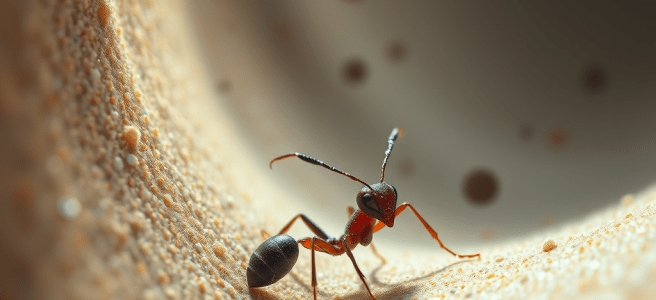
Squatting on the ground, my eyes stared at the hole in the sand; I watched ants slide one at a time down the slope and into the waiting grasp of the antlion. I couldn’t see the antlion and neither could the ant. As soon as the ant began to lose it’s footing, however, it seemed to know that it was in trouble. Sometimes an ant would make a brave attempt to climb back up and escape to freedom. When this happened, a sand-pebble barrage would shoot from the hole in the middle of the funnel, knocking the ant off balance and rolling it down hill once again. I routed for each ant, but very few made it out to freedom.

The antlion was hiding in the hole at the bottom of the trap it had constructed so meticulously. The sand was soft, dry, and rolled easily to the bottom. From my perspective I could see each ant tumble and become swept into the cascade of fine sand until it reached the bottom. Up would reach the jaw of the antlion; zap the ant would disappear below.
 
The unsuspecting ant had done what I have done so many times myself. It was determined to stay on the task: carrying food, returning to its safe home, or following the scent of water. It was so fixed on sticking to the job that it didn’t look up to see what obstacles might be in its way. For the ant it was a fatal mistake.
 
As a person with a bleeding disorder, I had empathy for those ants. Booby-traps seemed to be everywhere when I was a child. At a young age I learned to be vigilant about my surroundings. Even today, I watch for cracks in the pavement. I notice when I walk into a room if there are sharp corners on coffee tables or slippery area rugs. Still there are times when I forget to watch for pitfalls. If my mind is occupied with things other than what is immediately in my path, I know a carnivorous predator won’t eat me, but I could be badly bruised.
 
One day at work, I got up from the desk quickly and headed towards the filing cabinet. Tripping on an electrical chord I landed hard on my right hip. Within minutes I could feel the bruise enlarging. When I managed to stand up I no longer cared about the filing cabinet, I headed for the telephone. It took several infusions of cryoprecipitate to get the bruised hipbone to stop bleeding.
 
As anyone who meditates knows, it is hard to be attentive to just one thing. I have been practicing mindfulness for almost thirty years. The single focus I found so easy as a child is now something I need to practice. It is worth it though to be fully conscious and awake to the things that can trip me up, whether they are physical, emotional or spiritual.