Levees and the Illusion of Flood Control

At the prompt of a friend I am writing to the same title as a recent guest blog in Scientific American.

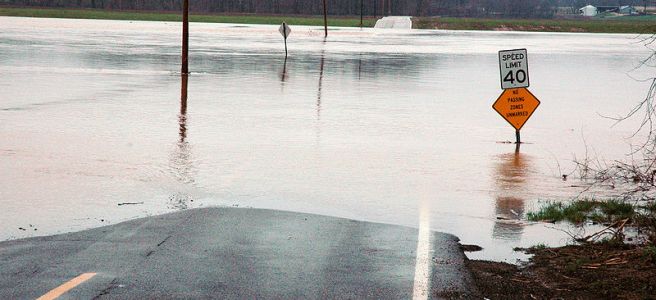
As I drove around the curve of the winding country road, I saw in the distance that the long stretch of pavement ahead seemed to be flooded. There had been no other cars pass me on the road that afternoon. That didn’t seem unusual this far away from the city. I was exploring new territory with no particular destination in mind. I continued to drive along the narrow road, wondering if the spot that appeared to be wet was a mirage created by the heat. It was a steamy afternoon, and I was enjoying the ride, besides there seemed to be no easy way for me to turn the car around, so I kept driving forward. As I got closer, I could see a body of water on either side of the road; closer still I could see that the water had overflowed its banks and was covering the road. The water appeared to be calm, a mirror of the sky above. Now when I looked ahead I could not see a point where the road reemerged. It was as if the road had disappeared beneath the water. Had I missed a sign that said, “boat ramp?” Irrationally I kept driving, wondering if my car would hydroplane, float or sink.
 
As I awoke from the dream, I sobbed uncontrollably.
 
I was raised to believe that anger and sadness were out of place. Anger was more than inappropriate; it was dangerous for me and for those around me. It had the power to displace me. “Go to your room and stay there until you calm down,” my mother would say.
 
I remember an illustration in one of my children’s books of a child kicking a tree and longed to do the same, but I knew that I would begin a hematoma in my foot that would require ice and perhaps even a trip to the Emergency Room of the hospital. Eventually I constructed a wall to hold the anger in and channel it away. When I went into therapy as an adult, the therapist asked, “Aren’t you angry?”
 
I could only reply, “What good would that do?”
 
The anger didn’t all flow down stream; some came out in short spurts of sniping sarcasm. The tears I shed were mostly in movie theaters. The barrier walls were strong enough to contain my emotions even though the levees made them run faster and rise higher. I could see the evidence as the blood pressure cuff squeezed tight and then released around my wrist.
 
I reinforced the embankment of defenses to control my anger and my sadness. I reasoned that displaying either would only make the ones I loved fearful and sad too and I certainly did not want that. “Smile and the world smiles with you, cry and you cry alone,” was the refrain. It didn’t make me feel any happier or any less alone.
 
Being in control is an illusion, I learned. The climate around me was changing and the old ways of coping were inappropriate for the conditions of my life now.
 
In the same way that the levee works well when the water volume is moderately increased, and not so well when there is a torrential flood, I started having recurring dreams about water after four of my cousins and both of my parents died within the space of two years. I was living on an internal flood plain and I didn’t know it consciously. If I remove the containment walls and let the water spread wide, will I find myself on fertile ground?

Let it be a dance we do

This morning I awoke earlier than usual, jittery, and craving sweet foods. It is the day after an infusion of clotting factor. Years ago I began having allergic reactions, which included hives and shortness of breath. Now I receive pre-treatments that control these reactions, however one of the pre-treatments is a corticosteroid. It makes me hyperactive for at least 24 hours before I crash. It is a familiar feeling to me now and I have learned to adjust.

In the 60th year of my life, I changed my approach to dealing with my bleeding disorder once again.

I realize that I am part renegade and part coward when it comes to treating my bleeding disorder. In my childhood, the advice from my hematologist was to infuse with Factor I (fibrinogen) only when I had a life threatening bleed. Blood products were dangerous and not to be used freely.

Frequently long days of rest, elevation and ice would slow a bruise enough for it to be managed without and infusion. There were topical solutions like Gelfoam sponge™ and Blood Stop™ that could be used on surface wounds.

When I was a teenager one physician who did not believe that I could be a girl and have a “real” bleeding disorder carried this advice to an extreme. During those difficult growth spurt years I suffered unnecessarily from bleeds into my ankles. The effect of the untreated bleeds has been permanent arthritic damage.

For a period of time in the 70’s, I took the other road and joined the flock. The mantra then was “when in doubt, infuse.” I was on the Board of the National Hemophilia Foundation when HIV began to infect the flock. We were once again the canaries in the mineshaft. Many of the flock already had Hepatitis C.

I abruptly left that heavily trafficked road, to follow “the road less traveled.” It felt familiar and safer although more challenging. Like Robert Frost described, it has “made all the difference.” Frost never said it was a better road. Most people like to think that is what he meant. I would like to think that my choice of roads brought me to the age of 60, but I don’t say that anymore. I do believe it was just the road that made all the difference in my life.

So now that I am over 60, I have chosen still another path. Each month I go into the outpatient hematology/oncology clinic and get a dose of cryoprecipitate. It brings me up to about 50% of normal clotting. The half-life is long and even though the research does not back me up on this one, I believe I can notice an effect for at least two weeks.

It’s a matter of choice. Even if my body can no longer dance, I feel like it gives me some time for my spirit to dance.

Spontaneous Bleed

One day when I was about nine years old, I was dancing around the kitchen while my mother cooked supper. My feet slid on the newly waxed floor and before I knew it, plop I landed hard on my bottom. My mother was convinced that there would be a large bruise from the fall. A few days later no bruise at the point of impact and I had forgotten about the fall. My mother vowed never to wax the kitchen floor again and breathed a sigh of relief.
 
Later that same week I started noticing a rash in my arm pits. It prickled and burned a bit. A day after the rash appeared, the armpits seemed to be hot, puffy and sore. By the next day the swelling had increased to a point were I could not lower my arms and I was in excruciating pain. I looked like Frankenstein with my face contorted, my neck stiff and my arms outstretched. I knew what this meant, there was bleeding under my arms and I needed an infusion of factor to make it stop. I can still remember that during the car ride to the hospital, each bump in the road felt like a hot knife was cutting off my arms.
 
My unusual condition created some curiosity in the Emergency Room. Several doctors and nurses came to observe and wonder about the cause. It wasn’t until days later that I remembered the fall in the kitchen and how I had thrown both of my arms over my head and back trying to keep my balance.
 
This week a hematologist asked me, “Have you ever had a spontaneous bleed?”
 
Firmly I responded, “No, although sometimes it takes me a long time to identify the cause of a bleed.”
 
The doctor looked confused. Perhaps I just don’t understand what is meant by “spontaneous bleed,” I mused. Spontaneous combustion, I learned in the dictionary, is defined as, “the ignition of organic matter (e.g., hay or coal) without apparent cause, typically through heat generated internally by rapid oxidation.”
 
Is it too late to change my answer to that question, doctor?

Sentient Beings

Last week I grabbed the railing beside the incline up to our doorway and then noticed that I had squished a dozen or more little red mites. The tiny mites do me no harm, they don’t hurt my dog or cat either, or even the rose bush that is now in full bloom. If they didn’t like to travel in groups, people would probably never notice them. True, it is annoying that they are so small they can slip between the screening in the windows and the cracks around the doors. The rusty red stain on the palm of my hand made me feel like Lady Macbeth. “This is a sorry sight,” I muttered.
There are insects for all seasons in Florida. Soon the fireflies will be lighting up the backyard after dark and dragonflies will be spreading their luminescent wings; in early autumn the love bugs will go a courtin’ two by two. They are silly looking creatures with bulging red eyes; oblivious to cars or pedestrians they cling awkwardly to each other as they fly through the air.
 
For as long as I can remember insects and spiders have fascinated me. When I was young, I would squat for hours watching ants tumble down the sandy funnel into the mouths of ant lions at the bottom. I collected spiders and studied the differences in web designs in different classes. Holding a spoon of water in front of a praying mantis, I watched it lower it’s head like a horse drinking from a trough. I collected caterpillars and watched the moths emerge from the cocoons I had placed in jars. Gently I held the squash beetles close to my ears and listened as they sang.
 
Here in Florida we have a pest control service that comes quarterly to spray around the exterior of our house so that the insects don’t come in.  Sometimes we eliminate insects because they are a threat to our health or safety. Being human, however, we also, without malice or intent, take a toll on the small lives around us.

The Faces of Hemophilia

I celebrated my 62nd birthday a few weeks ago. At two years old, I was diagnosed with a rare bleeding disorder, congenital afibrinogenemia or Factor I deficiency. In addition to having blood that does not clot, I have battled attitudinal barriers all of my life.
 
When I was young, and people were told of my medical disorder, it often triggered a fear response. “Does that mean you will bleed to death, if you cut yourself?” It didn’t take me long to notice that some adults were overly concerned for my safety, while others were simply afraid to be around me.
 
In the fairy tale story of the Princess and the Pea, the real princess was so sensitive she could feel a single pea on a bedstead piled with twenty feather mattresses on top of it. I always felt I had something in common with her. Not that I claimed to be a real princess, but because the smallest object could leave a painful mark on my body. The little girl in that story, however, lost a good night’s sleep and gained a Prince; I lost being allowed to participate in sports and received odd stares and nosey questions day after day.
 
“What did you do to get that bruise?” or “Why are you limping today?” people would ask. If I explained that I did not know what caused the injury, the questioner’s faces would show disbelief.  If I had no visible bruises I would hear how cute I was, or how smart. When my disorder was apparent in bruises or limping, the disability was all that most people saw when they looked at me. The other parts of me became invisible.
 
At eight years old, a doctor told my mother I would not live past ten. At twelve years of age an orthopedic surgeon told me that I did not have a bleeding disorder and he could replace my damaged ankle joints without factor replacement therapy. When I was sixteen a medical technician told me that people with severe bleeding disorders did not live longer than twenty. None of those opinions were true.
 
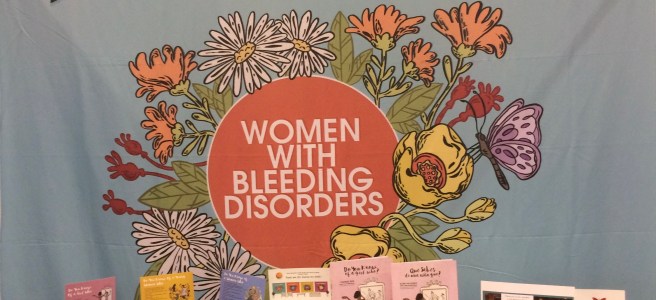
Those who fear me have distorted my self-image; medical judgments have threatened to contaminate my view of what I could achieve. Still I have believed in myself. I treasure the benefits of living in the moment. I am proud to be a woman with a bleeding disorder, a retired librarian, a writer of creative non-fiction and coach for other women with bleeding disorders who want to write their own stories.
 
Most of all however, I long for a day when I, and other people with bleeding disorders, are seen as people first.