Marking Time

This week I sent my friend Marie a birthday message. I am so grateful for the years that we worked together, and for the many lessons she taught me about never giving up on people. We don’t see each other often any more, yet we remember each other by sending postcards from our travels, holiday greetings, notes of sympathy and birthday wishes.

She responded to my birthday message and wrote, “I am in the middle of redoing my house … Now walls and woodwork have been painted and though I’m delighted with the changes, I have much to sort out and am ready to have the house back to myself. So much for progress. I love the ‘Lily Lavender’ color of my living room. Maybe I’ll finally get through the boxes from my folks’ house.”

When she wrote that the oxymoron “now then” had tickled her into laughter, it set me to wondering.

Now the apples, squashes, pumpkins, cabbages piled high in farm stands signal that the harvest is in. The work of planting, fertilizing, weeding and picking is ending for another year. There are fewer flowers in bloom from the seeds planting last spring in gardens. I have shifted my potted perennials indoors again as the nights are becoming chilly. Now then.

“To everything there is a season” from the Book of Ecclesiastes, 3:1-8, in the Jewish Bible, was a reading in the funeral service I attended last week. The rite of passage honored the 82 years of a woman’s life. Her children, in-laws, nieces, nephews, grandchildren and friends came to remember and observe the harvest of that life. It was a time for honoring the differences that one life had made in the lives of so many others. It was a time to notice that this woman’s grandchildren are now adults themselves and some of them will undoubtedly have children and grandchildren of their own some day. Now then.

As the fruits from the season before are spread out, I observe the harvest today and turn towards setting in provisions for the season ahead. Today I will cook applesauce from the apples picked off the trees yesterday. I will freeze most of that applesauce to use this winter. Now then.
What lies behind us and what lies before us are tiny matters compared to what lies within us. —Ralph Waldo Emerson


On the way to my annual mammogram appointment, I pulled into the parking garage of the radiology center. I was nervous. The hospital had stopped doing routine ultra sounds and CT scans. When I had mammography in the hospital, my doctor had authority. That gave me a sense of safety. On the cover of my chart, written in large red ink, the doctor had scrolled, “BRUISES EASILY.”

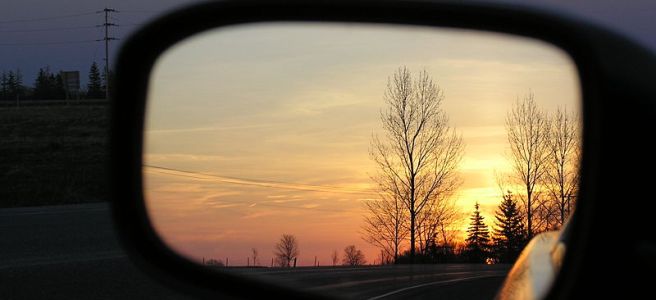
Distracted with concern for what might happen without the supervision of my physician, I found a parking spot, opened the car door, grabbed my purse and zigzagged between tightly spaced mini-vans and sedans. Just then, my right arm hit the side-view mirror of a parked vehicle. On the side-view mirror it said, “Objects in mirror are closer than they appear.” I should have taken this warning more seriously.

Anyone else would have said a simple “Ouch!” and moved on as if nothing had happened. It would have been insignificant. However, I live with a bleeding disorder that can topple my plans into chaotic debris at the most unexpected times. My blood’s inability to clot creates the disorder in my life.

I suppressed my desire to kick the parked car or utter an obscenity that would echo in the concrete and steel. From painful experience, I have learned that anger doesn’t provide optimal healing. However, when I have one of these absurd accidents, I have been known to take my rage out on the nearest inanimate object, stranger or loved one. Most of the time, I can control the fight-back response that the adrenalin brings up, with the understanding that it could create a secondary injury for me.

The margin of error is as narrow as the space between two parked vehicles. Once a bleed begins, the decisions before me stretch between what I want and what I need. Often I make compromises that result in getting neither.

I sniffed the exhaust fumes in the parking garage and fretted about my options. By the time I stepped up to the check-in desk, the bruise between my wrist and elbow was hot to the touch and swelling. Soon blood began to fill the space under the skin making the arm heavy and painful. It would hurt to hold the arm down by my side for the mammogram. What I wanted immediately was to apply ice while I sat in the waiting room.

“Imagine a medical facility without an ice pack,” I snarled, when I was told there was none available.

Once back at home, I began searching my closet for summer outfits with long sleeves. One thing was certain, in the coming weeks the bruise would turn from red and blue to purple and finally yellow green. Pretty colors in other locations, but they would raise questions, horror and sympathy that I would want to avoid.

“What did you do to yourself?” friends and strangers will ask me in the next three to four weeks as the bruise enlarges, spreads and then fades away slowly. “What did you do?”

The question sounds accusatory to me, as if I had inflicted the pain on myself through my carelessness or stupidity. I plan to glibly reply, “Oh, I got into a fender bender with a parked vehicle; my arm was damaged, but the car is fine.”

Wild berries

 
When someone asks me how I became a librarian, I say that I was recruited. In part, this is a diversionary tactic. People seem to either have strong positive or negative reactions to librarians. By stalling, I can wait for the person to begin to share how he or she “always wanted to be a librarian.” This is usually followed by how nice it must be to sit and read all day in a quiet place. Conversely, the person sometimes explains that libraries are old fashioned now that the Internet is available. Printed books are yesterday’s technology, they tell me. Since I never worked in a quiet library or read all day on the job and I believe that many people still do need libraries, both of these responses make me wince.
 
But, I was recruited to be a librarian. My four years of under graduate study had been to achieve another goal. During spring break of my senior year, I went to the City Library with a ten-year-old child.
 
Wanda, the Children’s Librarian, asked me what my plans were after graduation. I explained that I had applied for teaching jobs. “You should be a librarian,” she said firmly to me. I was doubtful. Still, she insisted that I go directly up to the administration office and complete a job application while she checked out the books. I didn’t give it much thought at the time.
 
Following graduation, I moved back to my parents’ home. Only a few days later I received a telephone call from the Assistant Director in charge of personnel at the library. There was an opening for a Children’s Librarian at one of the branches. Did I want it? Even if I had doubts, I quickly responded in the affirmative. Teachers were plentiful at that time and I had been warned that jobs were hard to get.
 
On my first day at the Branch Library I felt like Alice falling down the rabbit hole. Summer Reading Club was beginning. When I reached the granite steps, several children were already waiting for me to unlock the doors and let them inside. Among the children on the stairs was a toddler still holding a bottle to her lips. She would occasionally remove the bottle to curse obscenities. The other children ignored her epithets. When I reached the top step, she stopped long enough to look up and smile. “Hey, the Lie-berry Lady!” she announced to everyone. My key unlocked the door and the older children moved to form a queue in front of my new desk.
 
Soon I discovered that my job was to listen to the seemingly endless row of children who stood patiently in line. Each child was to report on the books he or she had read while I recorded them in the tally sheet. Some of the children were gregarious, some were shy, some had families that spoke English, and others had families that spoke only Portuguese or Spanish.
 
The school-aged children were members of the Summer Reading Club and they would go back to school classrooms in September with much improved reading skills.
 
The youngest children were two to four years old. They could not yet read. They came because their older siblings were caring for them while their parents were at work all day. They would go outdoors to the front steps at noontime to munch on their peanut butter and grape jelly sandwiches.
 
They came to ask what to feed the stray kittens that lived behind their housing complex. They came to ask whether lightning bolts shoot down from the sky or up from under the ground. They came to trade postage stamps that arrived from relatives in other parts of the world. They came to talk about books and stories with the “lie-berry lady.”

I.D. Bracelet

The pre-op instructions were specific; remove all jewelry on the day of your eye surgery. Dutifully I followed the directions.

I left my watch on the oak bedside table. I dropped my wedding band and three other rings into the china jewelry box. The octagonal lid of the fragile box made a raspy sound as I closed it. I hesitated when it came to the Medic Alert bracelet.
“Perhaps it won’t matter if I leave it on a little bit longer,” I thought. After all I might get into a car accident on the way to the ophthalmologist.
I have worn a form of Medic Alert for as long as I can remember. It has hung around my neck on a stainless steel chain or, in its most recent incarnation, around my wrist in links of gold.  More than one doctor has cautioned me to wear it at all times. I wear it when I sleep, when I shower, when I am working, or driving and even when I am hospitalized.
That morning there was also a plastic catheter inserted in a vein on my arm just above the Medic Alert bracelet. The eye surgeon had explained, “The risk of any bleeding with this surgery is very low. However, it is better to get an infusion of clotting factor the day before surgery, just to be safe.”
 
“Wonderful,” the nurse at the day surgery exclaimed when she saw she would not have to start the I.V. line herself. “That will really speed things up,” she added as she led me to the room with the stretchers. With a few quick tugs she pulled the curtain shut so I could change into a johnny.
 
“We need to sedate you just enough so that you are awake but cooperative,” she explained, “I’ll be back in a minute to take your vital signs.”
 
Then the nurse spotted the I.D. bracelet still on my wrist. “How silly of me,” I said as the nurse asked me to allow her to unhook it and remove it to a safe place.
 
I did not tell her that it is my good luck charm. It is intended to ward off the evil spirits of inappropriate treatment in ambulances or emergency rooms. It is a health care surrogate if I were unconscious or unable to advocate for myself in an emergency.
 
As long as I have worn this talisman its purpose has never been tested. Not once have I been in a situation where its imprinted medical data has been required. The bracelet has never lived up to its promise. Perhaps it says more about my identity than I want to admit.

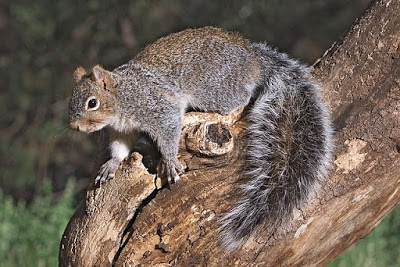
A Skitter of Squirrels

Scurry, tackle and play the squirrels are dashing into the yard for the morning romp. They are noisy, scratching up trees in a spiral twist, and racing through crackling leaves. They cavort with each other, doing somersaults and tumbling. They freeze only when I let the old dog out, but when they realize the dog is not a threat they go back to foraging for food on the ground.
 
I sit at the dining room table in front of the glass french doors munching on my breakfast cereal and watching two squirrels who are sitting upright just on the other side of the glass chewing their breakfast of seeds. They have finished their game of tag. Their tails are gracefully curled upward. They can see me munching. I can see them chewing. Have they come to thank me for the peanuts scattered on the patio just for them? Most people who feed the birds don’t like having squirrels. The truth is whenever we buy birdseed we also purchase a bag of peanuts for the squirrels. They don’t bother the birdseed that is in the bird feeders when there are peanuts for them to eat.
 
The squirrels seem to mingle in a balanced harmony with the birds. After all, they share the same trees. If only humans could be that reasonable.