Ruby Geneva Harnish

Ruby Geneva Harnish

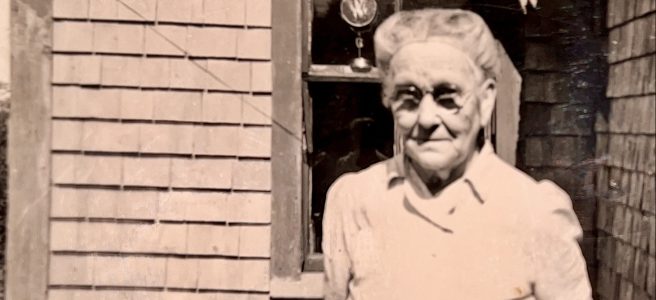
Gramma Ruby was born in 1875 in Annapolis Royal, Nova Scotia, Canada. At the age of twenty-four, she married my maternal grandfather, Samuel Harnish and moved into the two-story farmhouse he helped to build. He was a logger, which meant that he spent his days destroying trees in the Mi’kmaq heartland. Of course, that wasn’t how people thought about logging in those days.

Beginning in 1900, Ruby gave birth to ten children, five girls and five boys each one approximately two years apart. When a neighbor gave birth to two children in less than two years, Gramma would scoff that perhaps they did not know how to use a thimble. This story stuck for me because I have no idea how a thimble could be used as an effective form of birth control. It was, however, only one of the stories I heard of how judgmental she could be.

All her children lived to be healthy strong adults, even the one who contracted lock jaw from stepping on a rusty nail in the barn. Surviving tetanus was unheard of in those times, but Gramma dribbled bone broth between his lips until he could once again move his jaw.

Ruby assigned all of her children jobs. Whether it was knitting mittens and hats for winter or bringing in the firewood, everyone had at least one task to do. The boys did most of the outside chores. The girls separated the cream from the milk, stitched clothing, mended socks and did countless other things to keep everyone fed and clothed.

My grandfather Samuel died in 1927 at the age of fifty-two. His corpse was transported from the Halifax hospital back to the farmhouse where the Annapolis Royal Baptist pastor, performed the funeral. I imagine the viewing and ceremony took place in the front parlor. There was still a small organ in that room in 1956 when I first visited that home.

As soon as they were old enough most of Ruby’s children took jobs in town, teaching school, being housekeepers, or nannies. They all sent back the money they earned to support Gramma and their younger siblings. It was the Great Depression and everyone had to pitch in to survive, but Ruby continued to feed anyone who arrived at dinnertime. As a teetotaler, there would be no liquor in her house.

Four of Ruby’s sons and three of her daughter’s married, despite her strong objections. Why she tried to stop any of her children from marrying, no one in the family can explain.

Ruby was the only grandparent who was alive when I was born. I only met her once. I was five years old and she was eighty-one. I was disappointed that she was not as pleased to meet me as I was to meet her. She wasn’t the cuddly grandmother I had longed for. Ruby’s solution for getting me out of her way was to introduce me to a little girl,my age, who lived just down the road. It was a gift that has lasted seventy years.

Most of what I know of her is by way of observing my mother and my aunts and uncles. Many of them inherited Ruby’s critical tongue, organizational skills, and generosity to those in need. Those traits and the friend she introduced me too are my legacy from her.

In Memory of Horace

This week marks the twentieth anniversary of my father’s death. It is a date that I usually let slip from my memory. I don’t want to remember the day he died or the two days prior as he lay in a hospital bed, while I sat by his side day and night unable to find the words to say goodbye. I prefer to remember him animating my childhood stuffed animals, bringing them to life in my imagination. I want to see the twinkle in his eye when he told a trickster tale. I want to remember his generosity, especially to those who were very young and undervalued by others. I want the images in my head to be of his love of the natural world, including animate and inanimate beings.

Yet, too many nights as I try to drift into sleep I see images of him during his last days. I replay the early morning telephone call from the doctor. “Your father had a massive heart attack last night. He is in the intensive care ward now. We don’t expect him to live more than a day or two.”

My heart still races when I recall how I rushed to his side, finding him engulfed in beeping machines and an entanglement of electrical monitors. Years earlier he and my mother had written their living wills and discussed their wishes with me. Now I had to tell the nurses and doctors to remove all the equipment and transfer him to a private room where he and I could be alone.

I wish that I could forget watching helplessly as he shared what it felt like as his organs failed to function. When he turned to me and said, “This is just like being born,” he was teaching me what it was like to die. He was a penultimate learner and teacher. I am so grateful to have had him as my father.

Father pushing baby daughter in a stroller.
In the park

Survivor

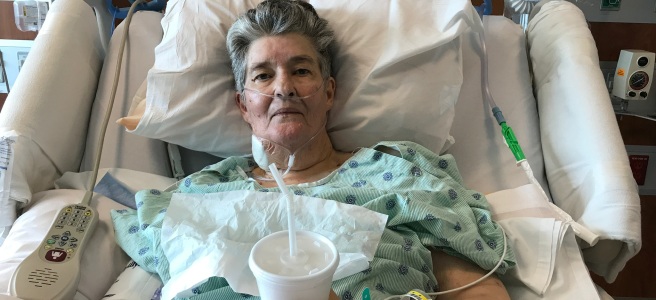
Four years ago I was reclining in an intensive care hospital bed, connected to fluids running in and draining out. High on steroids and pain killers I was ecstatic to be allowed to take a few sips of water. I prayed silently to my vital organs. “Heart, kidneys, lungs, please welcome your new partner, a liver from another body.” Silently I repeated this mantra over and over, asking that they all work as a team.

Each morning when the doctors from the transplant team made their rounds they asked “How are you today?”

I grinned and responded. “Fabulous!”

My gratitude was expansive. Thankful for the anonymous donor’s family, the team of surgeons, my treasured hematologist, my supportive family and generous friends. Most of all I was comforted by my loving spouse who was camped out, spending her days and nights in the cluttered Intensive Care room with me.

Just four months earlier I had sat in front of the sad-faced gastroenterologist. He said, “You know this was a possibility. The scan shows you have HCC, hepatocellular carcinoma.”

I did know, but suddenly I could not comprehend or focus on the doctors words. I glanced a my new-found friend who was sitting silently in the chair beside me. She was scribbling notes and staring at her lap. With immeasurable gratitude, I let go of trying to understand right now. Right now I needed to breathe deeply.

It was incredible that I had lived with Hepatitis C for more than forty years before reaching what many had predicted would be my end. It was astounding that despite my life-long bleeding disorder I had survived long enough that liver transplants were now sustainable, due to improvements in anti-rejection medications. It was amazing that even with my bleeding disorder I could not only survive a transplant, I would move up on the waiting list because of my bleeding disorder.

It was miraculous to me that the newest Hepatitis C treatment had cleared me of the virus, just a year before I was diagnosed with liver cancer. If this had not happened a transplanted liver would quickly be contaminated with the virus and the cycle of liver deterioration would begin all over again. Now a transplant would replace my cirrhotic liver, give me blood that would clot, and get rid of the spot that appeared on the MRI image that signaled alarm.

Recovering from the surgery took months of physical therapy, ongoing testing and regular check-ins with the surgical team.

Now, four years later I sit in a row with four other women awaiting a COVID-19 vaccine booster shot. We are all survivors. We have all lived longer than anticipated. We all live with compromised immune systems. We all need others to get vaccinated for COVID-19 and use recommended personal protective equipment.

Liverversary

Three years ago today, I was wheeled into surgery at 6:30 in the evening. I had been on hold in the Intensive Care Unit of Florida State University’s Hospital. During those eighteen hours, I was acutely aware that I was waiting for one person’s life to end so that my life could be saved. As I watched the clock move forward, I had time to sit with the choice I had made to have a transplant, then consider the choice some family would be making to donate the organs of a loved one. It felt like I had been given a gift I was not worthy to receive and that someone else had received a punishment they did not deserve.

I was also aware that I was not alone. Robin had slept on a day bed in the room with me the night before. More than forty friends and family members had signed up to be with me virtually through my hospitalization and recovery period. Some of those folks kept in touch with me through text messaging and well wishes online. Some of those folks lived close enough that they checked on our house while we were away. Many would help me once I returned home in more ways than I can count. I was overcome with gratitude and still am today.

When the transplant surgeon came to my room earlier that morning he asked me how I was feeling about the surgery. I said, “Excited and terrified.”

Since my blood did not clot without infusions of clotting factor, I was an unusual challenge for the surgical team. I was not the only person who was anxious. The nurse coordinator blurted out one day, “I’m sure you are almost as worried as I am.” I imagine she meant to say that the other way around. Hours of meetings, weeks of testing and re-testing were done to reassure everyone involved that this procedure could be done successfully. Still I’m pretty sure we all had our lingering doubts. Like a rollercoaster ride there was something risky and something thrilling about to take place. Something that would be written up in the medical journals no matter what the outcome.

Robin was in the waiting room that night for almost eight hours. It was 2:05 am when the doctor came out to tell her all had gone well. That wasn’t the end of the story, but it was a new beginning.

Tomorrow will be my three-year liverversary. I will never know about the person who was born with the liver that is now in my body. This is not a happy anniversary for that person’s family. I wish I could offer them sympathy. I will never know all of the medical specialists who read the results of tests I took or who were consulted on my unusual case. I wish I could say thank you to all of them. I don’t remember the faces of all the nurses or names of the respiratory therapists who assisted me when I needed them. I will always be grateful for their compassion. They taught me about the way kindness ripples out further than any one of us may ever realize.

Topsyturvey-World

When a song gets in my head and I just can’t seem to stop hearing it, I wonder why. Today that song is Natalie Merchant’s “Topsyturvey-World” From the album Leave Your Sleep. This song speaks to my inner child, the child who was born with blood that would not clot. My world could be tipped upside down by a tumble onto the sidewalk. People didn’t understand what I could do safely and what I could not. Many tried to confine me, others pitied me, some avoided me, a few were frightened by me.

Isolated at home with an injury until it healed, I did the things I could do, things I enjoyed, things I was skilled at. I practiced problem solving while other children my age practiced raising a hand before speaking. I wasn’t afraid.

Of course I preferred being with other children, but when I could not, I learned to reach out to friends on the telephone, laughing, joking, even playing magic tricks. These moments of joy sustained me until I could rejoin the outer world. I wrote letters to aunts and uncles, pen pals and one boy who I didn’t know. He was a friend of a friend who had broken his back falling from a horse. He was in a hospital bed and might never walk again. He didn’t feel sorry for me and I didn’t feel sorry for him.

In many ways I feel prepared for the Covid-19 virus that is bearing down on my part of the world. I know more than many of my friends about ways to cope when I am afraid, or lonely, or uncertain.

The lessons I have learned in my lifetime have given me an advantage in this time of pandemic. I believe for most of us uncertainty is the norm. It means we are human and the one thing we can count on is change.

I have never met anyone who has not experienced a disaster or a loss that turned them upside down. That doesn’t stop us from experiencing joy. Joy, bursts up in unexpected moments. You don’t need to cling to it, just notice it.

Joy can unstick you from anxiety and propel you into action. Joy is your super power. It can lead you to do the next right thing, the most compassionate thing, and for now that is stay home.

“Inside the word “emergency” is “emerge”; from an emergency new things come forth. The old certainties are crumbling fast, but danger and possibility are sisters.”
― Rebecca Solnit, Hope in the Dark