Survivor

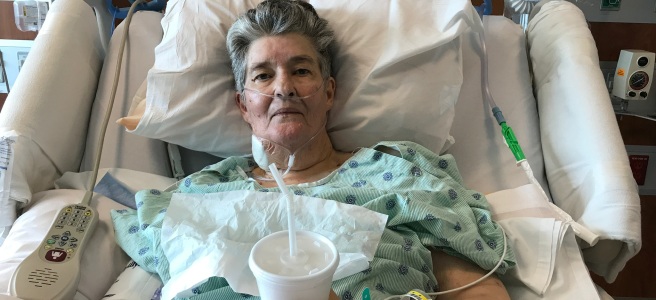
Four years ago I was reclining in an intensive care hospital bed, connected to fluids running in and draining out. High on steroids and pain killers I was ecstatic to be allowed to take a few sips of water. I prayed silently to my vital organs. “Heart, kidneys, lungs, please welcome your new partner, a liver from another body.” Silently I repeated this mantra over and over, asking that they all work as a team.

Each morning when the doctors from the transplant team made their rounds they asked “How are you today?”

I grinned and responded. “Fabulous!”

My gratitude was expansive. Thankful for the anonymous donor’s family, the team of surgeons, my treasured hematologist, my supportive family and generous friends. Most of all I was comforted by my loving spouse who was camped out, spending her days and nights in the cluttered Intensive Care room with me.

Just four months earlier I had sat in front of the sad-faced gastroenterologist. He said, “You know this was a possibility. The scan shows you have HCC, hepatocellular carcinoma.”

I did know, but suddenly I could not comprehend or focus on the doctors words. I glanced a my new-found friend who was sitting silently in the chair beside me. She was scribbling notes and staring at her lap. With immeasurable gratitude, I let go of trying to understand right now. Right now I needed to breathe deeply.

It was incredible that I had lived with Hepatitis C for more than forty years before reaching what many had predicted would be my end. It was astounding that despite my life-long bleeding disorder I had survived long enough that liver transplants were now sustainable, due to improvements in anti-rejection medications. It was amazing that even with my bleeding disorder I could not only survive a transplant, I would move up on the waiting list because of my bleeding disorder.

It was miraculous to me that the newest Hepatitis C treatment had cleared me of the virus, just a year before I was diagnosed with liver cancer. If this had not happened a transplanted liver would quickly be contaminated with the virus and the cycle of liver deterioration would begin all over again. Now a transplant would replace my cirrhotic liver, give me blood that would clot, and get rid of the spot that appeared on the MRI image that signaled alarm.

Recovering from the surgery took months of physical therapy, ongoing testing and regular check-ins with the surgical team.

Now, four years later I sit in a row with four other women awaiting a COVID-19 vaccine booster shot. We are all survivors. We have all lived longer than anticipated. We all live with compromised immune systems. We all need others to get vaccinated for COVID-19 and use recommended personal protective equipment.

Bidens

Outside my bedroom window, some of the weeds around the side of our house are now tall enough to bob and tilt in the wind. The flower that looks like a white daisy is Bidens. Its common names are Beggar Tick or Stickseed because it has sharp seeds that cling to clothing, fur, or feathers. From my window I can see the flowers dance and swing, teasing the butterflies to catch them. I risk passing through the clump of Poison Ivy to view the daisies closer.

What makes a plant a weed? I wonder as I admire this thriving plant that has a system for transporting its offspring to faraway lands. Some would call it invasive for these very qualities of adaptability and endurance. Thorns are considered a nuisance by humans, not a survival technique. Perhaps I take the criticisms about weeds a bit too personally. I have a rather prickly disposition at times myself, or at least so I am told. My imagination tells me that our new neighbors are less than pleased by the weeds allowed to grow wild in our yard. I simply admire the way in which they invite butterflies to my window.

What makes a weed a weed is, in my view, not the audacity it displays by growing wherever. It is not even the persistence that it displays in returning again and again after it has been pulled out by its roots. It is the value it is given by humans. A weed is simply a plant that is not wanted.

What puzzles me the most is the great lengths that humans will go to in order to control and organize the natural world. Weeding, mowing and watering grassy lawns seems a waste of energy and resources to me. Some landscape designers plan gardens so they will mimic the natural forests. It seems presumptuous to me that the natural beauty of a forest could be improved by human intervention. I have a similar reaction to the planned burning in the National Forests. If there are not enough wildfires from lightening strikes, controlled fires are set to clean out the dead wood, unhealthy trees and help other plants to germinate. In my view, this reveals a lack of faith in nature.

It reminds me of the way in which religious beliefs are ranked by some as either true or false. Recently, I have started attending a Zen Buddhist group to practice meditation and chanting. A friend of mine told me that she would be afraid to practice meditation. She had been told in church that people who meditate are members of a cult. It seems extreme to define this religious practice, which has been in existence since at least the 7th Century CE, a cult. But, by calling any religion a cult, it labels it as negative and even dangerous. Like the weeds in my yard, it is considered undesirable. Some certainly believe that cults need to be weeded out, to protect the “true believers” and save all of our souls. I wonder, is it simply a belief that is not our own?

When I take a good look at the world around me, it gives me more faith in diversity, not less.