A Belated Valentine to My Body

Dear Body,

In our 63 years, I have often forgotten to thank you or to say how much I love you. I do love you and I have come to admire so many of your features. While others of my generation look in the mirror and frown at the wrinkles on their face, the imperfections in their skin tone, thinning hair, and flabby chins I laugh. These superficial things mean little to me.

I remember when you and I were young and I saw you for the first time in a mirror. You were quite a charmer then. I smiled to see
the blonde baby curls that transformed over the years to brown with golden strands and I smile today when I see that gold has turned to silver.

You have done many hard and complex tasks for me over the years. You have endured my anger and my frustration at the things you cannot do and repaid me with a gentleness. Perhaps the thing I admire the most about you is your ability to heal and to learn new and different ways of responding when you have been assaulted.

Without fibrinogen you have faced many challenges that most other bodies have not confronted. You have adapted to blood that will not clot and made me trust you when others told me you would be unfaithful. When the doctors judged you as being weak you proved them wrong. They said you would desert me in less than 10 years and when you did not they said you would leave before we had spent 20 years together. So now after 63 years, I love you even more. I am so grateful for the gifts you continue to give me.

I’m sorry that I ever doubted you. I am sorry that I have wasted so much of our time together worrying about you.

You have never lied to me even though I have often ignored your warnings. Yes, I have even come to value the pain and fatigue you give me. You tell me when to slow down, get some rest, and when to call for medical assistance. I apologize for the times I have not paid attention to your needs, the weight I have gained, the times I have delayed treating an injury, and my stubborn streak that has overruled you.

Last week when I sat in the doctor’s office filling out the five-page medical history, I checked off the list that is your resume: bleeding disorder, stroke, arthritis, seizure, high blood pressure, and cataracts. What great life experience you have had, I thought to myself. So, with confidence I check off the box that says “good,” beside overall health.

Then I smile.

How long have you had hemophilia?

My friend Bill and I used to joke about the questions health care providers asked us. Bill had Hemophilia B, a factor IX deficiency. Although our bleeding disorders were different, our experiences with doctors had been much the same. Medical professionals rarely wrote our answers down or consulted our previous medical records for information. Not surprising to us the questions didn’t make any improvement in our medical care. What was startling though was how the questions we had been asked so routinely were identical. By the time we were in our twenties we had answered the same questions countless times. More than once I had been asked. “How long have you had congenital afibrinogenemia?” I felt as if I should carry a dictionary with me and open it up to congenital: adjective (esp. of a disease or physical abnormality) present from birth.

Often two or three different doctors would ask the same questions in one day. Once the doctor had finished asking his or her questions, they showed little or no interest in us. It felt like we were rare birds in a zoo, not people who had gone to a hospital for treatment. It took years for us to understand that we were viewed as subjects for research. We were offering a short cut for doctors who didn’t want to use the medical library.

Bill started responding with “Are the answers to your questions going to help you treat me or are you asking me because you need to learn?” He didn’t say this with a sarcastic tone of voice; he simply wanted the inquisitive doctor to be honest.

Like many people we wanted to be of help in educating doctors. We weren’t acknowledged for providing a service; instead we were expected to respond to questions that seemed irrelevant, even foolish, before we could receive medical attention. It seemed as if the priorities were upside down.


I remember

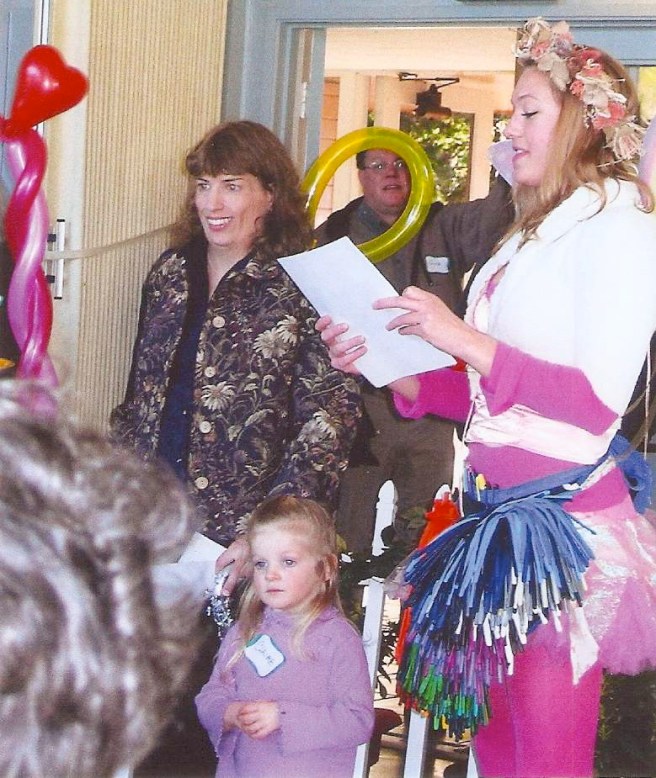
On March 14th, 2007 Cindy died of liver cancer. It had been only a few weeks since her extravaganza 40th birthday party. The celebration, which she planned herself, included costumes, food, activities for children and adults, and presents for all. Each person she invited to the party, whether they could attend or not, received a floaty pen she designed engraved with “Bloom where you are planted.” She knew as she planned that party that the liver cancer was in it’s final stages and there was nothing else that could be done to slow her death. She knew it would probably be her last birthday and she wanted it to be a grand celebration. I believe she wanted her friends to remember her with a smile

On Superbowl Sunday in 1995, I signed on to the National Hemophilia Association online. About 25 participants sat in front of our computers and introduced ourselves. That was how I met Cindy. She was in California. I was in Massachusetts. She was 28 years old and bubbling with enthusiasm. Her life story was different from my own in many ways.
 
Cindy had been diagnosed at birth with hypofibrinogenemia when her umbilical stump kept bleeding. Her fibrinogen level was abnormally low. From infusions of cryoprecipitate she had contracted HIV and Hepatitis C. She developed Transverse Myelitis, which compromised her ability to walk. None of this slowed her down much though.
 
She and I corresponded for years, we talked frequently on the telephone, but we only met once face to face.
 

She wrote to multitudes of friends, many who also had some of the same medical issues she had in her life. She actively sought out as many women as possible who had medical problems similar to her own. She wrote to the Hemophilia Treatment Centers Program Specialists requesting that they give their patients with rare bleeding disorders her contact information.  She created a website called Shemophilia and inspired a listserv for people with Fibrinogen (Factor I) Blood disorders and their close relatives.

 
Cindy traveled frequently to attend medical conferences, often as a speaker or panelist and wrote lots of articles. She published numerous articles and contributed to a book written by Bill Hayes entitled Five Quarts of Blood. In countless ways she put pressure on hemophilia organizations to include all bleeding disorders and genders. She was also very involved in HIV and disability communities. The advocacy work she accomplished in her lifetime spread across continents.
 
Her mission was to educate, inform and inspire others. It was her life’s work.
 
Today I also think of her playfulness of spirit, her love of children, her compassion and generosity. I remember her long and engaging search for the ruby red frogs, her holiday greeting cards written and decorated by her feline companions (Skipper, Grady and Cinderella) and her silly sense of humor.
 

The Waiting Game

“So much for the toast I had planned to eat for breakfast,” I muttered when I saw that I sliced my finger with the bread knife.
 
It was 8:30 a.m. on a Saturday. I knew immediately it was not going to stop bleeding. I wrapped the finger with gauze and taped it as tightly as I could without cutting off the circulation, then I called the hematologist.
 
“Don’t worry,” she said, “I’m on call this weekend, so have them page me when you get to the hospital.”
 
It was 9:00 a.m. The waiting room outside the ER looked deserted. It took the receptionist a few seconds to notice me standing in front of him. I said, “Dr. Jefferson wants to be paged and told that I have arrived.”
 
Without responding, he handed me a clip board and pen, “Just write your name and insurance information on the form, then bring it back to me.”
 
Holding my left hand up above my head, I struggled to keep the blood from leaking through my bandaged finger and onto the paper. I watched the parade of people enter the waiting room. Soon there was a woman with a blanket wrapped around her shoulders. She looked as if she had slept in an alley last night and she was babbling to no one in particular. An ambulance driver rolled in a young woman on a stretcher. I overheard the young woman explaining to someone on her cell phone that she believed her leg was broken. A car had hit her while she was riding her bicycle. Her voice was shaky and she glanced around the room at the rest of us. “They don’t have a room for me yet,” she told the person on the phone, “can you come get me and take me to another hospital?”
 
It was 10:00 a.m. when the triage nurse called me into a cubical behind the reception desk. She took my blood pressure, and documented my injury. “I know it looks like just a small cut to you, but my blood does not clot.” She looked doubtful. Once again, I said, “Dr. Jefferson wants to be paged and told that I have arrived.”
 
“We can’t do that until you are in a room,” the nurse said tersely.
 
Several people drifted into the waiting room while I had been in triage. A woman holding an infant occupied the chair I had been sitting in. I found another chair near a person who appeared to be coughing up phlegm into a tissue.
 
It was 11:00 a.m. before my name was called. The room I was assigned was directly in front of the nurses’ station. I could overhear the nurses discussing the upcoming football games that weekend.
 
When the nurse came in to take my vital signs, I glanced at the clock and noticed that it was now 11:30 a.m. I attempted to contain my irritation as I said, “Dr. Jefferson wants to be paged and told that I have arrived.”
 
“We will do that as soon as the ER doctor has seen you.”
 
The resident doctor meandered into my cubical just after noon. He looked as if he hadn’t slept the night before. “It says you have afibrinogenemia, what’s that?”
 
“Just call my hematologist,” I snapped.
 
It was after 3:00 p.m. before the bleeding finger was treated and I was released. By that time, the waiting room had filled to standing room only. I thought of all the people who have asked me if I could bleed to death from a small cut. “No it wouldn’t kill me,” I always reply, “but it could take a long time to heal.”