Awake

Pulled out of a deep sleep, I became conscious of what seemed to be the whine of a thousand-pound mosquito. No, I realized someone was sawing a tree. The thud when the tree fell vibrated in my chest. It invaded my peaceful quiet. The annoying whine buzzed on and on.

Later that day, I drove to the post office. Just a block away from home, I slowed the car as I approached the stop light on the corner and saw the clutter of downed trees and heavy equipment parked on both sides of the street. So that was where all this noise was coming from. The traffic light turned green and I went on my way.

The month before we had noticed a new sign at this corner announcing, “Luxury Home for Sale.” We laughed. Before then, at the end of the unpaved driveway there had been a metal gate with a sign reading “KEEP OUT.” We thought there was a house somewhere behind all that bramble. We pictured a recluse living in a run down house, perhaps with a loaded rifle standing his ground.

Yet the next time I set out on an errand in that direction, I was startled to see the lot completely cleared and the ground flat. There was no house, apparently there never was one. I now had a clear view of our next door neighbor’s back yard and house.

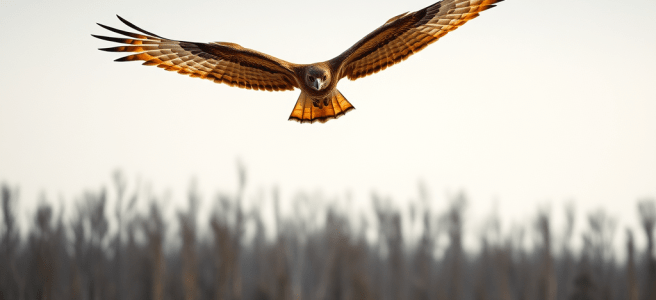
As I waited for the light to change, I caught a glimpse of motion in my peripheral vision. Above my car a Red Tailed Hawk gently descended heading to where only a day or two before there had been trees. It crossed over my windshield gliding, wings spread wide. The outstretched feathers displayed an intricate pattern in staggered checks of tan and brown. Then seeing no trees to land upon, it tilted slightly, gave its powerful wings a flap, and lifted skyward. I gasped at its beauty.

I wondered if the hawk was as startled as I to see the empty space. I imagined bird and squirrel nests crashing to the ground when the trees were felled. I imagined the Live Oak, Pine, Arrow Wood, Magnolia and dozens of other trees in our property sensing some biochemical impact when their companions were killed.

Day by day the changes are so gradual we don’t notice, but they are there. Clear cutting land to build a house seems so harmless. But we know that trees change our water table and our air quality. Wangari Maathai was awarded the 2004 Nobel Peace Prize for her work planting trees. It wasn’t just my peaceful sleep that was disturbed by the removal of those trees.

Recognizing that sustainable development, democracy and peace are indivisible is an idea whose time has come… Today we are faced with a challenge that calls for a shift in our thinking, so that humanity stops threatening its life-support system. We are called to assist the Earth to heal her wounds and in the process heal our own – indeed, to embrace the whole of creation in all its diversity, beauty and wonder.


Wangari Maathai

Bidens

Outside my bedroom window, some of the weeds around the side of our house are now tall enough to bob and tilt in the wind. The flower that looks like a white daisy is Bidens. Its common names are Beggar Tick or Stickseed because it has sharp seeds that cling to clothing, fur, or feathers. From my window I can see the flowers dance and swing, teasing the butterflies to catch them. I risk passing through the clump of Poison Ivy to view the daisies closer.

What makes a plant a weed? I wonder as I admire this thriving plant that has a system for transporting its offspring to faraway lands. Some would call it invasive for these very qualities of adaptability and endurance. Thorns are considered a nuisance by humans, not a survival technique. Perhaps I take the criticisms about weeds a bit too personally. I have a rather prickly disposition at times myself, or at least so I am told. My imagination tells me that our new neighbors are less than pleased by the weeds allowed to grow wild in our yard. I simply admire the way in which they invite butterflies to my window.

What makes a weed a weed is, in my view, not the audacity it displays by growing wherever. It is not even the persistence that it displays in returning again and again after it has been pulled out by its roots. It is the value it is given by humans. A weed is simply a plant that is not wanted.

What puzzles me the most is the great lengths that humans will go to in order to control and organize the natural world. Weeding, mowing and watering grassy lawns seems a waste of energy and resources to me. Some landscape designers plan gardens so they will mimic the natural forests. It seems presumptuous to me that the natural beauty of a forest could be improved by human intervention. I have a similar reaction to the planned burning in the National Forests. If there are not enough wildfires from lightening strikes, controlled fires are set to clean out the dead wood, unhealthy trees and help other plants to germinate. In my view, this reveals a lack of faith in nature.

It reminds me of the way in which religious beliefs are ranked by some as either true or false. Recently, I have started attending a Zen Buddhist group to practice meditation and chanting. A friend of mine told me that she would be afraid to practice meditation. She had been told in church that people who meditate are members of a cult. It seems extreme to define this religious practice, which has been in existence since at least the 7th Century CE, a cult. But, by calling any religion a cult, it labels it as negative and even dangerous. Like the weeds in my yard, it is considered undesirable. Some certainly believe that cults need to be weeded out, to protect the “true believers” and save all of our souls. I wonder, is it simply a belief that is not our own?

When I take a good look at the world around me, it gives me more faith in diversity, not less.