Survivor

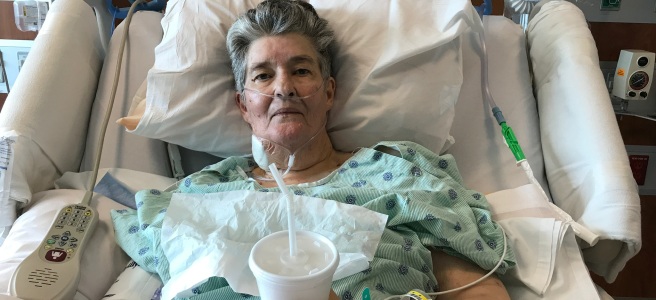
Four years ago I was reclining in an intensive care hospital bed, connected to fluids running in and draining out. High on steroids and pain killers I was ecstatic to be allowed to take a few sips of water. I prayed silently to my vital organs. “Heart, kidneys, lungs, please welcome your new partner, a liver from another body.” Silently I repeated this mantra over and over, asking that they all work as a team.

Each morning when the doctors from the transplant team made their rounds they asked “How are you today?”

I grinned and responded. “Fabulous!”

My gratitude was expansive. Thankful for the anonymous donor’s family, the team of surgeons, my treasured hematologist, my supportive family and generous friends. Most of all I was comforted by my loving spouse who was camped out, spending her days and nights in the cluttered Intensive Care room with me.

Just four months earlier I had sat in front of the sad-faced gastroenterologist. He said, “You know this was a possibility. The scan shows you have HCC, hepatocellular carcinoma.”

I did know, but suddenly I could not comprehend or focus on the doctors words. I glanced a my new-found friend who was sitting silently in the chair beside me. She was scribbling notes and staring at her lap. With immeasurable gratitude, I let go of trying to understand right now. Right now I needed to breathe deeply.

It was incredible that I had lived with Hepatitis C for more than forty years before reaching what many had predicted would be my end. It was astounding that despite my life-long bleeding disorder I had survived long enough that liver transplants were now sustainable, due to improvements in anti-rejection medications. It was amazing that even with my bleeding disorder I could not only survive a transplant, I would move up on the waiting list because of my bleeding disorder.

It was miraculous to me that the newest Hepatitis C treatment had cleared me of the virus, just a year before I was diagnosed with liver cancer. If this had not happened a transplanted liver would quickly be contaminated with the virus and the cycle of liver deterioration would begin all over again. Now a transplant would replace my cirrhotic liver, give me blood that would clot, and get rid of the spot that appeared on the MRI image that signaled alarm.

Recovering from the surgery took months of physical therapy, ongoing testing and regular check-ins with the surgical team.

Now, four years later I sit in a row with four other women awaiting a COVID-19 vaccine booster shot. We are all survivors. We have all lived longer than anticipated. We all live with compromised immune systems. We all need others to get vaccinated for COVID-19 and use recommended personal protective equipment.
Topsyturvey-World

When a song gets in my head and I just can’t seem to stop hearing it, I wonder why. Today that song is Natalie Merchant’s “Topsyturvey-World” From the album Leave Your Sleep. This song speaks to my inner child, the child who was born with blood that would not clot. My world could be tipped upside down by a tumble onto the sidewalk. People didn’t understand what I could do safely and what I could not. Many tried to confine me, others pitied me, some avoided me, a few were frightened by me.

Isolated at home with an injury until it healed, I did the things I could do, things I enjoyed, things I was skilled at. I practiced problem solving while other children my age practiced raising a hand before speaking. I wasn’t afraid.

Of course I preferred being with other children, but when I could not, I learned to reach out to friends on the telephone, laughing, joking, even playing magic tricks. These moments of joy sustained me until I could rejoin the outer world. I wrote letters to aunts and uncles, pen pals and one boy who I didn’t know. He was a friend of a friend who had broken his back falling from a horse. He was in a hospital bed and might never walk again. He didn’t feel sorry for me and I didn’t feel sorry for him.

In many ways I feel prepared for the Covid-19 virus that is bearing down on my part of the world. I know more than many of my friends about ways to cope when I am afraid, or lonely, or uncertain.

The lessons I have learned in my lifetime have given me an advantage in this time of pandemic. I believe for most of us uncertainty is the norm. It means we are human and the one thing we can count on is change.

I have never met anyone who has not experienced a disaster or a loss that turned them upside down. That doesn’t stop us from experiencing joy. Joy, bursts up in unexpected moments. You don’t need to cling to it, just notice it.

Joy can unstick you from anxiety and propel you into action. Joy is your super power. It can lead you to do the next right thing, the most compassionate thing, and for now that is stay home.

“Inside the word “emergency” is “emerge”; from an emergency new things come forth. The old certainties are crumbling fast, but danger and possibility are sisters.”
― Rebecca Solnit, Hope in the Dark

Pondering Pandemic

Even though I no longer have a television and only listen to the radio when I am driving, the news comes to me without me looking for it. So I already knew about the virus predicted to kill globally, I was surprised when I went out to lunch last week with friends I hadn’t seem in three years. I was taken aback that no one would touch me, no one hugged me, no one would even do a fist bump. They were all afraid of getting COVID-19. All but one of us was over sixty years of age, and most of us had serious medical weaknesses. The consequences were in deed worrisome.

After I regained my composure from being told there would be no touching, my first thought was “We’re all going to die anyway.” I don’t want to live my life in voluntary seclusion. I get energy from being with people. In my childhood I spent days, sometimes weeks, confined to a bed and wondering about what my friends were doing in school or at play. Over my lifetime I have learned to adapt when I needed to be hospitalized but, I never learned to enjoy social distancing.

I also have considerable experience being told I would not live long. At a young age I not only knew I was going to die, I thought it would happen soon. I’ve meditated on my own death, a spiritual practice that help me gain some perspective on my minuteness in this world. I’ve developed a rather cynical sense of humor. I’ve recently read “Smoke Gets in Your Eyes: And Other Lessons from the Crematory,” It’s a book I recommend. The author, Caitlin Doughty is on a mission. She also has a blog and a podcast because she is serious about normalizing death or as she puts it, “Accepting that death itself is natural, but the death anxiety and terror of modern culture are not.”

It still astonishes me when I’m confronted with death deniers. I chuckle at folks who believe that mid-life is age fifty. In a way, I understand. My imagination isn’t broad enough to fully comprehend a world where I do not exist even if I know that will happen. Knowing I will die sooner rather than later leads me to think about what I want to do while I am still alive. It does not make me want to crawl under the bedcovers.

What startled me last week escalated into a swirling vortex of anxiety as more and more friends began expressing concern when I said I intended to do little to protect myself from getting the virus. Peer pressure has made me reevaluate my attitudes. So yes, I am taking precautions now.

I’ve always been a planner, trying to anticipate what could go wrong and taking steps in and attempt to prevent injury. At the same time I recognize the limitations of any plan. To quote President Eisenhower, “In preparing for battle I have always found that plans are useless, but planning is indispensable.”

The only thing I can have the possibility of controlling is my mind and that is challenge enough for me. The worrier in me wonders about random things. All of the presidential candidates are in the high risk category. What will happen if they all die? What will happen if all the children are asymptomatic but infect their caregivers? How many sick people will hospitals be able to help before they become over burdened and can not accept any more patients?

“Breathe,” I tell myself with a bit of sarkiness, “while you still can.”

Hallelujah! I have lived more than seventy years and it has been mostly a great life, full of love, and caring. Perhaps it would be for the best if vast numbers of we old people and those with weakened immune systems did die off. Would it help to save the planet, at least temporarily? Would it give the younger generation a chance to do a better job than we have?

“In the end these things matter most:
How well did you love?
How fully did you live?
How deeply did you let go?”
— Jack Kornfield, Buddha’s Little Instruction Book