End of Time


Mother told me that she had seen people standing on the roofs of barns waiting for the rapture. It seemed irrational to me. Did they think they could thumb a ride from God?

I have seen billboards posted beside highways that read, repent the end is near. Some predicted the exact date when the world, as we know it, would end. I wondered if the believers went back to their sinful ways when the end did not occur. Why did people continue to believe even when life continued after the prophecy? One such group claimed credit for avoiding the cataclysm by the power of their prayers.

By 1998, I began hearing the phrase Y2K. The year 2000 was coming and the world was about to stop. This time, instead of the religious fanatics predicting Armageddon, it was the computer scientists.

Computer systems that operated things like lighting and power and food distribution warehouses were only set to accept two digit years; at the end of 99 the numbers would roll over to zero. People with no foresight and no ability to plan for the future had apparently been unable to comprehend anything beyond the 20th century.

As the ball dropped from Time Square at midnight the lights around the world would go out. There would be no electrical grid, no power to heat or cool or cook food. Transportation would come to a halt. Mail delivery would be impossible. Funds in banks would be unavailable.

By 1999 the doom and gloom predictions became more frantic. Most people would be unemployed. There would be increasing crime and mayhem as those who were not prepared would turn towards stealing the supplies others had stored.

The world was about to come to an end. The news was carried by “official sources” in the government: stock up on all your prescription medications; fill your cabinets with canned food and bottled water; lay in a supply of wood if you have a fireplace. The Y2K bug is coming!

I had a friend who assembled a supply of food that she believed would last three months. That was the time she thought it would take for the systems to be restored. She learned how to grind raw wheat into flour. She filled her basement and every available space in her house with medical supplies and canned goods.

Meanwhile, instructions for checking and fixing the Y2K bug were disseminated. The mass media networks proclaimed the need for personal and corporate disaster planning; government commissions were formed. In a rampage of buying, businesses and organizations worldwide replaced computers with older operating systems.

On January 1, 2000, we awoke to a New Year’s Day that looked much like the day before. The stove in the kitchen worked, the electric lights came on with the usual flip of a switch and the telephone rang. Even the computer worked when I turned it on to check email.

There were no momentous computer failures when the clocks rolled over into 2000. Much like the religious fanatics, the fact that the predictions did not come true only inspired the computer experts to claim that they deserved the credit for avoiding catastrophe. There were also cynics who thought the predictions had been grossly exaggerated… perhaps for monetary gain? A little fire and brimstone increases the flow of cash into the collection basket just as Y2K stimulated the purchasing of computer hardware and software.

Most breathed a sigh of relief, crisis avoided, and went back to indulging their addiction for the newest digital tool.

Beginning of Life Decisions

My maternal grandmother gave birth to one child every two years until she had five sons and five daughters. It was said that Grandmother was appalled that any woman would have a child more frequently than that. Grandmother expressed her scorn by saying, “She must not know how to use a thimble.” That meant they didn’t practice appropriate birth control. Her children, including my mother, saw the irony in where she drew her moral line.

Of my grandmother’s ten children, six did not have any biological children. My mother had several miscarriages prior to conceiving me. In what she believed to be a last attempt, Mom opted to take a prescribed medication that was thought to prevent unwanted miscarriages. Later it was determined that the medication was not only ineffective, but that it created serious health problems. I was her first and last-born child.

When I was still a youth myself, my doctor told me that I would never be able to withstand a pregnancy, because of my particular type of bleeding disorder. This was true. I’ve watched in my lifetime as many women now carry a child with the help of medical technology that did not exist ten or twenty years ago. Women who have past their fertile years, women who are not in sexual relationships with a man, or women who love a man who is unable to provide the Y-chromosomes for the child they want may all give birth to children now. It also seems that more and more I hear of newborns who survive only because of medical interventions that would not have been possible a few years ago. Some people question how this moral line has stretched.

This expanded potential for childbearing with the help of technology is mirrored by the way in which it has become medically safer for potential parents to make decisions about when and how often to give birth. It seems that many question this capacity for increased human decision-making on when a life begins. During my grandmother’s, and my mother’s and my own lifetimes, we all knew some women who chose to use birth control and made decisions to terminate a pregnancy. We also knew of women who, against their will, had a pregnancy aborted by the brutality of the child‘s father.

We each draw the moral line for this pregnancy and against that one where we are able. Others may see irony or even sinfulness in our decisions. Yet, it seems to me, that they are the best decisions people can make under the circumstances of their lives at that moment in that era.

Bidens

Outside my bedroom window, some of the weeds around the side of our house are now tall enough to bob and tilt in the wind. The flower that looks like a white daisy is Bidens. Its common names are Beggar Tick or Stickseed because it has sharp seeds that cling to clothing, fur, or feathers. From my window I can see the flowers dance and swing, teasing the butterflies to catch them. I risk passing through the clump of Poison Ivy to view the daisies closer.

What makes a plant a weed? I wonder as I admire this thriving plant that has a system for transporting its offspring to faraway lands. Some would call it invasive for these very qualities of adaptability and endurance. Thorns are considered a nuisance by humans, not a survival technique. Perhaps I take the criticisms about weeds a bit too personally. I have a rather prickly disposition at times myself, or at least so I am told. My imagination tells me that our new neighbors are less than pleased by the weeds allowed to grow wild in our yard. I simply admire the way in which they invite butterflies to my window.

What makes a weed a weed is, in my view, not the audacity it displays by growing wherever. It is not even the persistence that it displays in returning again and again after it has been pulled out by its roots. It is the value it is given by humans. A weed is simply a plant that is not wanted.

What puzzles me the most is the great lengths that humans will go to in order to control and organize the natural world. Weeding, mowing and watering grassy lawns seems a waste of energy and resources to me. Some landscape designers plan gardens so they will mimic the natural forests. It seems presumptuous to me that the natural beauty of a forest could be improved by human intervention. I have a similar reaction to the planned burning in the National Forests. If there are not enough wildfires from lightening strikes, controlled fires are set to clean out the dead wood, unhealthy trees and help other plants to germinate. In my view, this reveals a lack of faith in nature.

It reminds me of the way in which religious beliefs are ranked by some as either true or false. Recently, I have started attending a Zen Buddhist group to practice meditation and chanting. A friend of mine told me that she would be afraid to practice meditation. She had been told in church that people who meditate are members of a cult. It seems extreme to define this religious practice, which has been in existence since at least the 7th Century CE, a cult. But, by calling any religion a cult, it labels it as negative and even dangerous. Like the weeds in my yard, it is considered undesirable. Some certainly believe that cults need to be weeded out, to protect the “true believers” and save all of our souls. I wonder, is it simply a belief that is not our own?

When I take a good look at the world around me, it gives me more faith in diversity, not less.

To everything there is a season

My father waited impatiently each winter for spring to come. On the day of the Winter Solstice in December, Dad would announce, “The days are getting longer. Spring is on the way!” On that day, he would begin his ritual of helping the snow to melt. On sunny days, he would go out to scoop shovel’s full of snow and ice onto the asphalt driveway. Then contented he would watch as the sun transformed the crystals into liquid.

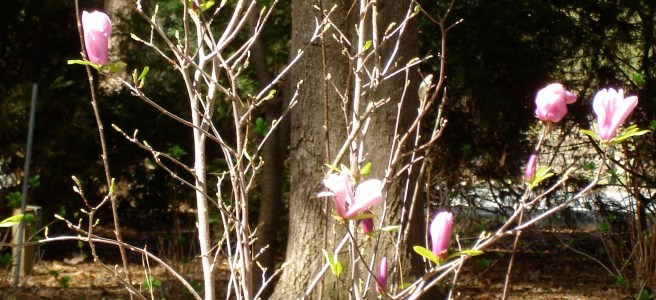
Like my father I enjoy the green and growing plants sprouting up from the earth when spring arrives. It is like a magic trick. Unobserved tree buds stretch out and spread into delicate leaves. “Nothing up my sleeve,” nature says. Each year I am a bit chagrined by how this season takes me by surprise again and again

The tender blossoms uncurl, risking damage from frenzied winds, weighty downpours of rain and drastic changes in temperatures. I watch the naïve fledgling birds as they fend for themselves, pecking for juicy larvae. An alert kitten crouches watching these vulnerable chicks. The prey and predators are hard to separate one from the other.

The older ones are at risk during this season too. With each new generation, I know my days are shortened. The dampness from the earth below my feet awakens the pain in my arthritic ankles. I am reminded that I will return to that soil one day myself. I will dissolve as the melting snow.

Lightning

When my father would hear the first rumble of thunder, he would often gather us all into the car and drive to the highest point of land where we could get the best view. If it weren’t possible to chase the storm, Dad would position himself on the covered patio on the side of our garage. He would stand there, smoking his pipe, watching and listening attentively. The display of electricity as the sparks shot down from the sky and met the ground below never disappointed him.

It was with the deepest reverence and respect that I learned to watch the bursts of light cutting through the clouds. Even today, I find myself counted the seconds off between the audible jolts of sound that precede and follow the long, jagged, tentacles of sparks. It is hot meeting cold, positive crashing against negative. It is energy and brilliance being discharged so that it can be seen and heard. All the elements of wind, rain, sky and earth are present. Atmospheric scientists explain that the push of two sea breezes, one from the east and one from the west, force air upward. This is a common cause of lightning. The pressures of wind and gravity produce an enormous electrical potential.

It feels so much safer to surround myself with other people who share my values. I search for news reports that reflect opinions I already hold. I protect myself from the explosive power of opposites.

Not too long ago, I looked out the window to see two women walking towards the front door of my house. It was a cold, rainy morning. The two women were carrying pamphlets and I had a moment of panic as the doorbell rang. Should I just pretend that there is no one home and let them leave their religious tracts by my door? They looked almost as surprised as I did when instead I opened the door wide and invited them to step inside. For a moment, I felt their surprise and indecision, as I had when I saw them come walking down my path. When I risk conflict, I can feel the pressure rise. Often, I can see it rising from the other side too.

The two women chose not to be tempted by the warmth of my home. Returning to their preset agenda, they stood outside in the drizzle and offered me a pamphlet. I declined to accept their gift. We all missed the energy of the opposite forces pushing against each other. We all missed the possibility of conflict and the potential of transformation.