
Survivor

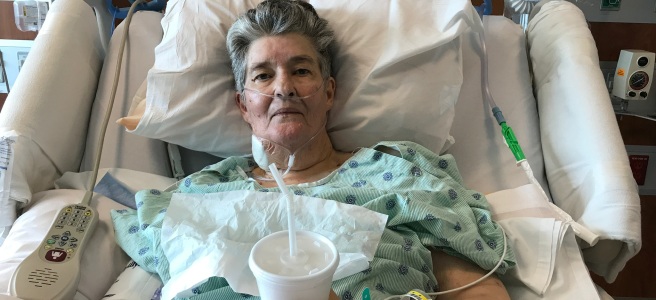
Four years ago I was reclining in an intensive care hospital bed, connected to fluids running in and draining out. High on steroids and pain killers I was ecstatic to be allowed to take a few sips of water. I prayed silently to my vital organs. “Heart, kidneys, lungs, please welcome your new partner, a liver from another body.” Silently I repeated this mantra over and over, asking that they all work as a team.

Each morning when the doctors from the transplant team made their rounds they asked “How are you today?”

I grinned and responded. “Fabulous!”

My gratitude was expansive. Thankful for the anonymous donor’s family, the team of surgeons, my treasured hematologist, my supportive family and generous friends. Most of all I was comforted by my loving spouse who was camped out, spending her days and nights in the cluttered Intensive Care room with me.

Just four months earlier I had sat in front of the sad-faced gastroenterologist. He said, “You know this was a possibility. The scan shows you have HCC, hepatocellular carcinoma.”

I did know, but suddenly I could not comprehend or focus on the doctors words. I glanced a my new-found friend who was sitting silently in the chair beside me. She was scribbling notes and staring at her lap. With immeasurable gratitude, I let go of trying to understand right now. Right now I needed to breathe deeply.

It was incredible that I had lived with Hepatitis C for more than forty years before reaching what many had predicted would be my end. It was astounding that despite my life-long bleeding disorder I had survived long enough that liver transplants were now sustainable, due to improvements in anti-rejection medications. It was amazing that even with my bleeding disorder I could not only survive a transplant, I would move up on the waiting list because of my bleeding disorder.

It was miraculous to me that the newest Hepatitis C treatment had cleared me of the virus, just a year before I was diagnosed with liver cancer. If this had not happened a transplanted liver would quickly be contaminated with the virus and the cycle of liver deterioration would begin all over again. Now a transplant would replace my cirrhotic liver, give me blood that would clot, and get rid of the spot that appeared on the MRI image that signaled alarm.

Recovering from the surgery took months of physical therapy, ongoing testing and regular check-ins with the surgical team.

Now, four years later I sit in a row with four other women awaiting a COVID-19 vaccine booster shot. We are all survivors. We have all lived longer than anticipated. We all live with compromised immune systems. We all need others to get vaccinated for COVID-19 and use recommended personal protective equipment.

Liverversary

Three years ago today, I was wheeled into surgery at 6:30 in the evening. I had been on hold in the Intensive Care Unit of Florida State University’s Hospital. During those eighteen hours, I was acutely aware that I was waiting for one person’s life to end so that my life could be saved. As I watched the clock move forward, I had time to sit with the choice I had made to have a transplant, then consider the choice some family would be making to donate the organs of a loved one. It felt like I had been given a gift I was not worthy to receive and that someone else had received a punishment they did not deserve.

I was also aware that I was not alone. Robin had slept on a day bed in the room with me the night before. More than forty friends and family members had signed up to be with me virtually through my hospitalization and recovery period. Some of those folks kept in touch with me through text messaging and well wishes online. Some of those folks lived close enough that they checked on our house while we were away. Many would help me once I returned home in more ways than I can count. I was overcome with gratitude and still am today.

When the transplant surgeon came to my room earlier that morning he asked me how I was feeling about the surgery. I said, “Excited and terrified.”

Since my blood did not clot without infusions of clotting factor, I was an unusual challenge for the surgical team. I was not the only person who was anxious. The nurse coordinator blurted out one day, “I’m sure you are almost as worried as I am.” I imagine she meant to say that the other way around. Hours of meetings, weeks of testing and re-testing were done to reassure everyone involved that this procedure could be done successfully. Still I’m pretty sure we all had our lingering doubts. Like a rollercoaster ride there was something risky and something thrilling about to take place. Something that would be written up in the medical journals no matter what the outcome.

Robin was in the waiting room that night for almost eight hours. It was 2:05 am when the doctor came out to tell her all had gone well. That wasn’t the end of the story, but it was a new beginning.

Tomorrow will be my three-year liverversary. I will never know about the person who was born with the liver that is now in my body. This is not a happy anniversary for that person’s family. I wish I could offer them sympathy. I will never know all of the medical specialists who read the results of tests I took or who were consulted on my unusual case. I wish I could say thank you to all of them. I don’t remember the faces of all the nurses or names of the respiratory therapists who assisted me when I needed them. I will always be grateful for their compassion. They taught me about the way kindness ripples out further than any one of us may ever realize.

Support

Recently in a friend’s home, I sat down at her dining room table on a chair with arms. Much to my surprise the chair was on casters and when I plopped into the cushiony seat the chair rolled backwards over the hardwood floor, perilously close to her antique china cabinet.

Over my lifetime, several bleeds into my joints have deteriorated the cartilage and left beads of calcium along the bone. My ankles haven’t been able to flex for many years and my knees are weak. When I sit down I collapse, rather than lowering myself slowly. When I stand up from a chair, I need support. If I have a choice, I pick a chair with firm arms so I can push myself up with my hands to a standing position. It makes me look as if I am at least twenty years older than I am. Considering that as a child my life expectancy was estimated at ten years of age, vanity seems like a small price to pay for living past sixty.

Sitting in the rolling chair, I began to think about how I was going to stand up. Where could I find support so that I wouldn’t send the chair or myself flying out of control? I considered my options carefully as I sipped my tea. My friend was unaware of what was scrolling through my brain. I could use the table to lean on, my core muscles could help, the soles on my shoes would grip well on the slippery floor. I practiced these things in my mind before it was time for me to stand up. No glass was broken and I got up safely.

Support is something I need to keep my balance in life. Sometimes it is physical support, medical support, or emotional support. I depend on friends and family to help me through difficult times and to celebrate the joys.

I have come to appreciate that there are different types of support I need for balance. There are times when what I need is empathy, a hug or a “I’m so sorry you are going through this.” I am very grateful for friends and family who can provide that kind of support.

There are also times when I need guidance, challenge and advice. These are times when “good job!” doesn’t mean much unless the person who says it really understands the work from personal experience. That’s why for guidance and advice about living with a bleeding disorder I lean on women with a bleeding disorder and they lean on me. Together we provide mutual support.

Guinea Pig

Merlin the Peruvian Guinea Pig shuffled over to his cage to greet me. His long fur parted in the middle of his back covered his eyes and toes. It was hard to tell which way he was facing until he moved. Merlin and I were simpatico. I knew what it was like to be a human Guinea pig.

Hospitalized frequently during my childhood, I tested the first oral polio vaccine in the 1950‘s. It satisfied a need I had to be useful. I also believed I owed a debt to the medical researchers who were trying to discover new treatments.

In 1967, my doctor asked if I would test a new anticoagulant. The new medication had only been used as a last resort on soldiers, serving in the war in Vietnam, who had suffered deep tissue burns. I was 18 years old and for the first time I was going into the hospital for a planned procedure, to have my four wisdom teeth extracted. I casually agreed to be a guinea pig again.

A nurse started the IV line in my right arm before the doctor arrived. A technician made a tiny cut in my left arm. She explained that it was 10 mm long and 1 mm deep. Every 30 seconds she used absorbent paper to draw off the blood. Normally the bleeding would stop before 9 minutes. I watched as the blood bubbled up one drop at a time, knowing that with no fibrinogen it would take a lot longer than 9 minutes to stop. Without fibrinogen the blood would not clot.

I watched the doctor place the bottle of medication on the IV pole and connect the tubing. He stopped the saline solution and started the medication. I turned my head to look at my left arm and the little drops of blood had stopped surfacing. Amazed, I looked back at the face of the doctor and noticed that his lips were moving but I couldn’t hear any words being spoken. A second later everything went black and I remember my last thought was, “I’m dying.”

When I opened my eyes I was startled to see at least ten people by the bedside. Where did all these people come from and why were they looking so worried? There was a cart that had not been there before and I heard one of the doctors say the word, “anaphylaxis” and then “the adrenaline worked, thank God.”

From deep in my belly I started to laugh. It was like a magic trick I had popped back to life before their very eyes. The audience of doctors and nurses looked more concerned at my laughter, so I stopped, but I just could not wipe the grin off my face.

A Belated Valentine to My Body

Dear Body,

In our 63 years, I have often forgotten to thank you or to say how much I love you. I do love you and I have come to admire so many of your features. While others of my generation look in the mirror and frown at the wrinkles on their face, the imperfections in their skin tone, thinning hair, and flabby chins I laugh. These superficial things mean little to me.

I remember when you and I were young and I saw you for the first time in a mirror. You were quite a charmer then. I smiled to see
the blonde baby curls that transformed over the years to brown with golden strands and I smile today when I see that gold has turned to silver.

You have done many hard and complex tasks for me over the years. You have endured my anger and my frustration at the things you cannot do and repaid me with a gentleness. Perhaps the thing I admire the most about you is your ability to heal and to learn new and different ways of responding when you have been assaulted.

Without fibrinogen you have faced many challenges that most other bodies have not confronted. You have adapted to blood that will not clot and made me trust you when others told me you would be unfaithful. When the doctors judged you as being weak you proved them wrong. They said you would desert me in less than 10 years and when you did not they said you would leave before we had spent 20 years together. So now after 63 years, I love you even more. I am so grateful for the gifts you continue to give me.

I’m sorry that I ever doubted you. I am sorry that I have wasted so much of our time together worrying about you.

You have never lied to me even though I have often ignored your warnings. Yes, I have even come to value the pain and fatigue you give me. You tell me when to slow down, get some rest, and when to call for medical assistance. I apologize for the times I have not paid attention to your needs, the weight I have gained, the times I have delayed treating an injury, and my stubborn streak that has overruled you.

Last week when I sat in the doctor’s office filling out the five-page medical history, I checked off the list that is your resume: bleeding disorder, stroke, arthritis, seizure, high blood pressure, and cataracts. What great life experience you have had, I thought to myself. So, with confidence I check off the box that says “good,” beside overall health.

Then I smile.