Beginning of Life Decisions

My maternal grandmother gave birth to one child every two years until she had five sons and five daughters. It was said that Grandmother was appalled that any woman would have a child more frequently than that. Grandmother expressed her scorn by saying, “She must not know how to use a thimble.” That meant they didn’t practice appropriate birth control. Her children, including my mother, saw the irony in where she drew her moral line.

Of my grandmother’s ten children, six did not have any biological children. My mother had several miscarriages prior to conceiving me. In what she believed to be a last attempt, Mom opted to take a prescribed medication that was thought to prevent unwanted miscarriages. Later it was determined that the medication was not only ineffective, but that it created serious health problems. I was her first and last-born child.

When I was still a youth myself, my doctor told me that I would never be able to withstand a pregnancy, because of my particular type of bleeding disorder. This was true. I’ve watched in my lifetime as many women now carry a child with the help of medical technology that did not exist ten or twenty years ago. Women who have past their fertile years, women who are not in sexual relationships with a man, or women who love a man who is unable to provide the Y-chromosomes for the child they want may all give birth to children now. It also seems that more and more I hear of newborns who survive only because of medical interventions that would not have been possible a few years ago. Some people question how this moral line has stretched.

This expanded potential for childbearing with the help of technology is mirrored by the way in which it has become medically safer for potential parents to make decisions about when and how often to give birth. It seems that many question this capacity for increased human decision-making on when a life begins. During my grandmother’s, and my mother’s and my own lifetimes, we all knew some women who chose to use birth control and made decisions to terminate a pregnancy. We also knew of women who, against their will, had a pregnancy aborted by the brutality of the child‘s father.

We each draw the moral line for this pregnancy and against that one where we are able. Others may see irony or even sinfulness in our decisions. Yet, it seems to me, that they are the best decisions people can make under the circumstances of their lives at that moment in that era.
Communion

Sunday was chilly and the rain clouds were moving in as I set my pot of vegetarian chili onto the grill at the Church potluck. Even though my mother died two years ago, when I cook, I still cook with her guiding my hands.

When I was a child, every Sunday evening in the cold weather, we had waffles and ice cream for supper. Friends and neighbors would drop by our house on Sunday evenings even when the winter snow was falling fast and thick. Moreover, despite the weather outdoors, they would all arrive in enough time to join in the tradition my parents had created. However, it wasn’t just the waffles and the ice cream that brought them to our back door. Mom’s homemade canned peaches created the magic. At the end of every summer, my mother took bushel baskets of fresh peaches, peeled and pitted them, cooked them in sugar syrup and stored the sealed jars in our basement. There were enough jars of canned peaches to put on top of the ice cream covered waffles for each Sunday during the chilly days of late autumn and winter.

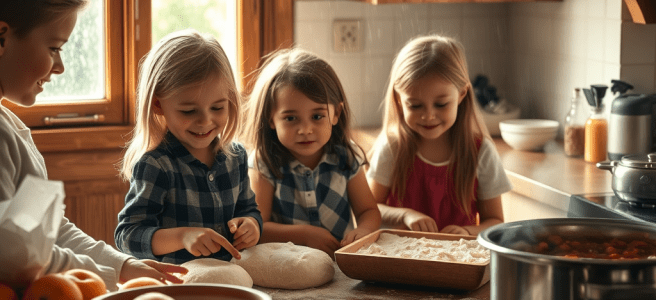
When the weather turns cold and dampness works it’s way into my aging bones, as it did today, I still think about cooking with my mother. I started “helping” her cook when I was so young I wasn’t tall enough to reach the counter top in our kitchen. My childhood friends and I learned how to measure and sift ingredients following my mother’s instructions. We kneaded bread dough and tasted cake batter by licking out the large wooden spoons we had used to stir it all together.

There was more than food processed in my mother’s kitchen. The conversations that happened as we prepared food and ate together were part of the plentiful feast, part of the communion.

One of my most vivid childhood memories is of the day that my friend Sherry was tossing the bread dough in the air and it went so high that it stuck to the kitchen ceiling. Slowly, as everyone in the room held their inhaled breath, the gooey and slightly gray colored substance oozed back down into my friend’s waiting hands. Sherry had an abusive alcoholic father. None of us was aware of the secrets she held inside herself then. Reshaping the sticky, soiled mess back into form, Sherry said with a satisfied tone, “That’s ok; I’ll bake this loaf for my Dad.” There was something about the way she said it that sounded important. No one, even my mother, questioned her decision. Sherry carefully carved “Dad” onto her loaf and baked it in the oven with the rest.

Grandma’s Hands

Older white woman siting in a chair, knitting out doors under a tree

By the time I was born, only my maternal grandmother, Ruby was still living. From children’s books and the experience of some of my friends, I had an idealistic picture of what a grandmother was like. Unlike my grandmother, she usually lived nearby and came to visit often.

My grandmother lived in a country farmhouse, far away from where I was raised as a child. She had given birth to one child every two years until she had five sons and five daughters. About seven years after the last of her ten babies was born, Ruby’s husband, my grandfather, died. The year was 1927. If the genealogy records are accurate, she was 52 years old by that time.

The household was already organized with economy, precision and determination. A few of the eldest sons had gone off to earn money that could then be sent back home. The eldest daughters had long been taking care of the very youngest children and the ones in-between were used to tending to the farm chores and household duties.

Ruby’s children reaped the health benefits of her ability to prevent the spread of disease by meticulous attention to hygiene. She learned her native nursing-care skills from her mother. Grandma’s attentive watchfulness and analytical problem solving enhanced her reputation as one who could cure the sick.

My grandmother was a strong and demanding woman. Observation of my aunts, her daughters, has given me a taste of what this must have been like. She may have felt that the family’s very survival depended upon her ability to make decisions quickly and enforce them with a critical tongue. The precision cutting of her words sometimes left jagged scars that required healing over time. Yet, there was enough comfort, compassion and caring for the mending of wounds within the family and beyond. Those who were ill, or in need, could count on my grandmother for comfort and aid.

Despite the Great Depression and outward poverty of the little farmhouse, there was enough healthy food to eat and enough to generously share with others in my Grandma’s house. Guests were always welcome, whether they were friends or strangers. And, when the workday ended, there was music, books to read, lively conversation, jokes and laughter.

Even though I only got to see my Grandma in person once, each time we visited the old farmhouse its seemed that Ruby’s powerful spirit was still there. It was revealed in more than just the chipped Blue Willow dinner wear in the China cabinet, or the rocking chair by the kitchen window. It could be observed in the qualities of her children, my aunts and uncles. It emanated whenever a guest, whether child or adult, entered the back door. And, it is still reflected in the values and actions of her grandchildren.

When I curl a loop of yarn around my fingers to knit I think of my Grandma’s hands knitting warm socks and mittens. When I cook, I imagine Grandma’s hands kneading the many loaves of bread, baking the pies and churning the butter. When I help care for someone who is sick or in pain, I reflect on Grandma’s care that lives on long past her lifetime.

Perhaps the ideal Grandma that I imagined as a child visits me more now than she did when I was a child.

Uncle Byron

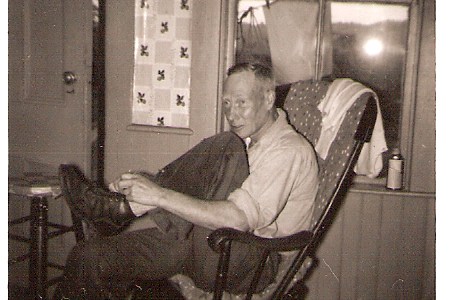
Older man with sunburn face sitting on a rocking chair inform of a window, tying one shoe

Uncle Byron sat in his rocking chair watching the sun set. The supper dishes were removed from the big dining table that in his childhood was used to spread out the meals for his nine siblings and whatever guests happened to come for a visit at mealtime. I piled the dishes in the sink and heated the water over the wood stove to wash and rinse them clean again, I watched as Byron gazed out over the front pasture that sloped down to the road. The road had not yet been paved and an occasional automobile passing by would raise a sandy dust as it rumbled over the gravel. The kitchen window faced the maple sugar camp that Byron had operated since he was a young man. But, Byron did not look in that direction; instead his eyes were fixed on the display of color in the sky from the setting sun

Slowly, Byron pulled out a cigarette paper and his pouch of tobacco. With the mindfulness of a Buddhist monk, he curved the paper with his fingers and filled the ridge with a small portion of dried tobacco. Then with care and gracefulness, that revealed how often he had practiced this ritual in the past, Uncle Byron rolled the paper around, licking it on the edge to hold the two ends together. The match he struck against the wood stove and as he exhaled he filled the room with the aroma of smoke.

He sat and rocked and watched the setting sun, seemingly unaware of the clatter of pots and pans. The women who were washing, drying and putting away seemed equally absorbed in their task. Byron had spent all of his life in that house, with the exception of his tour of duty in WWII. He had cared for his mother until her death and tended to the farm chores by himself when his five sisters and four brothers moved away one at time. He seemed during these times very comfortable in his solitude.

However, on the evenings when family and friends were in the house, Byron’s face displayed contentment. When the day was coming to a close, after each platter and plate, cup and saucer was set back in it’s spot in the china cabinet, people drifted back to the dinning room table. The deck of cards was shuffled and dealt to each player. The stories of neighbors and family were told and re-told. There was usually at least one joke about Byron’s elder sister whose Baptist faith scorned card playing as much as alcohol consumption. What would she think if she could see them shuffling and dealing for hours on end, or if she new that her own husband made beer in the basement?

Even Byron’s humor was tempered with compassion. He was a quiet man and when he spoke his words often revealed his empathy for those who were small or weak or ill. The night his youngest sister was killed in an automobile accident, it was Byron who received the telephone call. He sat by himself until dawn, not conveying the news to other family members. When asked, he said he did not want to upset their sleep.

When we arrived at the farmhouse for a visit or left to return home, Uncle Byron gave a hug that was so tight it seemed he did not want to let go. Had he suffered enough loss in his life already that his heart could bear no more?

Cooking with Dad

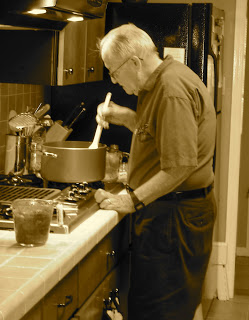
As my father-in-law and I prepare supper together, I joke that we should have our own television cooking program. He is an avid fan of Rachel Ray, the speed queen of cooking, and Paula Dean, the maven of butter and sugar. As he chops the celery, he asks, “What should we call our show?” I say, “Cooking with Dad.” He smiles. I can tell that he gets satisfaction from helping to cook. Even more than that, he likes being called “Dad.”

After he was 70 years old and had retired as a mechanical engineer, my father-in-law worked at a fast food restaurant. For more than 10 years, he would get up each morning at 4:00 a.m. to open the restaurant and prepare the grills for the breakfast crowd. The franchised restaurant chain hired all part-time employees, with the exception of the store manager. Most of these employees were teenagers struggling with the adjustment of becoming adults. They relied on this grandfatherly person for his advice and his good humor. And, they called him “Dad.”

It has been difficult for me to call my father-in-law “Dad.” It somehow does not feel fair to my biological father. My Dad established a relationship with me even before I was born, and continues that bond even after his death.

My father-in-law is now in his late 80’s and I feel the increasing weight of becoming responsible for his well-being. He can walk only a few yards before he becomes short of breath. He insists this is from allergy, not the heart disease the doctor mentioned. As he pitches his body forward in an unbalanced stride, I find myself playing a more “Mother Hen” role than acting like a daughter to him. “Don’t forget your cane!” I say as we leave the house together. “Watch out for that bump on the sidewalk.” He makes a sour face because he does not want to admit he is vulnerable to broken bones. He is struggling with the adjustment to old age. He still wants to be the protective one, not the protected.

But when we cook together at the end of each day, the relationship is transformed. Mimicking my own mother’s voice, I lay out the jobs that need to be accomplished and divide the tasks between the two of us. “You chop the celery and I’ll peel the potatoes,” I say. He can enjoy re-experiencing the roll of protector. “Don’t forget to put on the oven mitts. The pan is hot, you know,” he warns. Together we work to prepare the family meal. It is not just the food that will sustain us and comfort us; it is the sharing of the care giving.

Elderly man stirring a pot of soup on the stove