
Vigilance

Squatting on the ground, my eyes stared at the hole in the sand; I watched ants slide one at a time down the slope and into the waiting grasp of the antlion. I couldn’t see the antlion and neither could the ant. As soon as the ant began to lose it’s footing, however, it seemed to know that it was in trouble. Sometimes an ant would make a brave attempt to climb back up and escape to freedom. When this happened, a sand-pebble barrage would shoot from the hole in the middle of the funnel, knocking the ant off balance and rolling it down hill once again. I routed for each ant, but very few made it out to freedom.

The antlion was hiding in the hole at the bottom of the trap it had constructed so meticulously. The sand was soft, dry, and rolled easily to the bottom. From my perspective I could see each ant tumble and become swept into the cascade of fine sand until it reached the bottom. Up would reach the jaw of the antlion; zap the ant would disappear below.
 
The unsuspecting ant had done what I have done so many times myself. It was determined to stay on the task: carrying food, returning to its safe home, or following the scent of water. It was so fixed on sticking to the job that it didn’t look up to see what obstacles might be in its way. For the ant it was a fatal mistake.
 
As a person with a bleeding disorder, I had empathy for those ants. Booby-traps seemed to be everywhere when I was a child. At a young age I learned to be vigilant about my surroundings. Even today, I watch for cracks in the pavement. I notice when I walk into a room if there are sharp corners on coffee tables or slippery area rugs. Still there are times when I forget to watch for pitfalls. If my mind is occupied with things other than what is immediately in my path, I know a carnivorous predator won’t eat me, but I could be badly bruised.
 
One day at work, I got up from the desk quickly and headed towards the filing cabinet. Tripping on an electrical chord I landed hard on my right hip. Within minutes I could feel the bruise enlarging. When I managed to stand up I no longer cared about the filing cabinet, I headed for the telephone. It took several infusions of cryoprecipitate to get the bruised hipbone to stop bleeding.
 
As anyone who meditates knows, it is hard to be attentive to just one thing. I have been practicing mindfulness for almost thirty years. The single focus I found so easy as a child is now something I need to practice. It is worth it though to be fully conscious and awake to the things that can trip me up, whether they are physical, emotional or spiritual. 
You Say Tomato

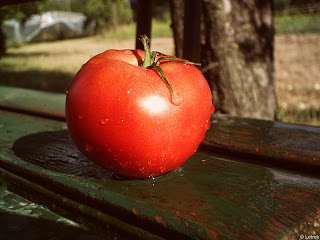
Ripe tomatoes on a outdoor table

Uncle Bill picked a ripe tomato from the garden and rinsed the dust off under the garden hose. Then he sat down at the picnic table and surveyed our backyard. From the look of satisfaction on his face, Uncle Bill was getting great enjoyment from that fresh tomato. To my surprise, he took a large bite out of it, the way I would have bitten into an apple. I shivered, thinking about the acidity.

“Do you want some salt?” I asked.

“Nope, I like it just the way it is.”

I slid into the bench across from him and watched him closely, waiting for the tomato juice to dribble down his chin. It was so hot that afternoon, neither of us felt like talking anyway. We listened to the cicadas announcing the temperature with their clicking.

Languidly Uncle Bill took a second bite of the tomato, and then he took another. His short-sleeved shirt was spotlessly clean. By the time he finished that tomato, not one drop of juice had escaped his lips or stained his clothes. It seemed like a magic trick to me.

I was sure that my mother would have preferred to be outdoors like her brother Bill and me, but instead she was brewing tea for Auntie Anne. Two bone china cups and saucers would be on the table with a sugar bowl and a pitcher of milk. Auntie Anne would be chattering away like the cicadas while my mother listened and nodded politely.

Uncle Bill and his wife, Anne, were visiting us for a week. They lived in Toronto. Auntie Anne had grown up in England. She pronounced her words differently than we did. Mom said she was a “war bride.” I didn’t know what that meant.

“I can’t imagine what he sees in Anne,” my mother said after they had left. To my mother, Anne was an annoyance. When Auntie Anne unpacked her suitcase it contained several dresses, pointy-toed shoes and a hat decorated with artificial flowers. Mother thought Anne was superficial and vain. Anne’s appearance, religious beliefs and values were different from ours. “She’s not like us,” mother would say. For her brother’s sake, my mother kept this opinion to herself.

In February of 1964, Uncle Bill went out to shovel snow after dinner and died suddenly of a heart attack. He was 52 years old.

Five months later, Anne traveled alone to our house for a visit. Anne unpacked the hats and sundresses from her suitcase as usual. After supper she asked my father to bring out a deck of cards so we could play Bridge. Anne had met Bill, playing Bridge at the USO. Mom found it hard to imagine that her brother would have enjoyed such a pastime. It seemed foreign.

We were used to card games that were less complicated. We were in the habit of laughing and joking during a card game, not keeping track of what had been dealt and played.

None of us played Bridge; Anne said that didn’t matter. Patiently she instructed us in how to rotate shuffling the deck, passing it to another person to deal. She explained how to bid, name trumps, and lay out the dummy hand. Auntie Anne took Bridge seriously and in spite of our lack of interest, she insisted that we play each night together.

After that visit on her own, she would come and stay with us once each year. Since we only played Bridge when she was visiting, we needed a refresher each time. She tolerated our lackadaisical attitudes the way my mother had kept silent about her vanity. It seemed to me that Uncle Bill still had a hand to play and hearts were trump.

The Faces of Hemophilia

I celebrated my 62nd birthday a few weeks ago. At two years old, I was diagnosed with a rare bleeding disorder, congenital afibrinogenemia or Factor I deficiency. In addition to having blood that does not clot, I have battled attitudinal barriers all of my life.
 
When I was young, and people were told of my medical disorder, it often triggered a fear response. “Does that mean you will bleed to death, if you cut yourself?” It didn’t take me long to notice that some adults were overly concerned for my safety, while others were simply afraid to be around me.
 
In the fairy tale story of the Princess and the Pea, the real princess was so sensitive she could feel a single pea on a bedstead piled with twenty feather mattresses on top of it. I always felt I had something in common with her. Not that I claimed to be a real princess, but because the smallest object could leave a painful mark on my body. The little girl in that story, however, lost a good night’s sleep and gained a Prince; I lost being allowed to participate in sports and received odd stares and nosey questions day after day.
 
“What did you do to get that bruise?” or “Why are you limping today?” people would ask. If I explained that I did not know what caused the injury, the questioner’s faces would show disbelief.  If I had no visible bruises I would hear how cute I was, or how smart. When my disorder was apparent in bruises or limping, the disability was all that most people saw when they looked at me. The other parts of me became invisible.
 
At eight years old, a doctor told my mother I would not live past ten. At twelve years of age an orthopedic surgeon told me that I did not have a bleeding disorder and he could replace my damaged ankle joints without factor replacement therapy. When I was sixteen a medical technician told me that people with severe bleeding disorders did not live longer than twenty. None of those opinions were true.
 
Those who fear me have distorted my self-image; medical judgments have threatened to contaminate my view of what I could achieve. Still I have believed in myself. I treasure the benefits of living in the moment. I am proud to be a woman with a bleeding disorder, a retired librarian, a writer of creative non-fiction and coach for other women with bleeding disorders who want to write their own stories.
 
Most of all however, I long for a day when I, and other people with bleeding disorders, are seen as people first.

Trusting My Gut Feeling

In late January of 2000 I was hospitalized for an extended period of time with a perforated large intestine. Diverticulitis had silently crept up without a warning. My internal organs were contaminated with infectious matter. Not a pretty thought. The doctor walked into my hospital room and grimly declared that the bleeding had been stopped, but without surgery to implant a temporary colostomy, the infection would not go away.

I know that given enough clotting factor for a long enough time, I can survive surgery. There was an inner voice, however, that disagreed with the gloomy predictions of my doctor.

“I’ll be fine, just let me rest.”

“No you won’t,” the doctor continued to argue.

“Look,” I said, “it’s my body.”

With that, he left with what sounded like a threat, “I’ll send the surgeon in to talk with you.”

The conversation with the surgeon didn’t persuade me to change my mind. In the coming days antibiotics, nourishment and clotting factor were all dripped into my veins. Each morning, when I awoke I would meditate; focusing on my breathing and listening to my body.

The surgeon would appear at my door. He would nod his head in acknowledgement, and I would return his greeting with a wave.

“Vulture looking for fresh carrion,” I commented to the nurse who had just come to switch my saline drip to the antibiotic.

She laughed. “He’s at the age where he needs a challenge,” she whispered. “You know most cases look routine to him. You don’t.”

“Too bad I have to disappoint him.”

My hematologist wasn’t as subtle as the surgeon. He stood at my bedside every afternoon and lectured me. It was clear that he was genuinely worried that I had made a fatal mistake. A friend called to tell me she had refused surgery at first for diverticulitis. She had several reoccurrences until she finally took her doctor’s recommendation. Since the surgery, she hadn’t had one more episode. My bravado shrank day by day and I began to doubt my decision.

Nevertheless, I continued to feel better and better. I noticed that the surgeon was looking at me with less interest each morning. I imagined that his nod was wistful.

It’s really hard for me to know now if I had in fact been so in tune with my body that I sensed something the doctors could not discern. Now more than a decade later all I know is that I recovered without the surgery and never had a relapse of the diverticulitis.

Holiday Rush Job

“Sure, just bring them over,” I heard Mom say.

It was two days before Christmas. I knew what the person on the other end had said because the same conversation happened each year before the holidays. Soon the doorbell rang and one of the city jewelers handed my mother a package bulging with several manila folders of pearls.

“I’ll be back to pick them up tomorrow,” he said and then he hurried off to his car.
During other weeks of the year, Mom took the bus downtown, filling her purse with the cultured pearls she picked up. She did this at least once each week. Each envelope also contained the selected clasp of silver or gold, and the specifications for the necklace. Each packet had a date indicating when the customer could pick up the completed necklace. Most were promised in a week and rush jobs cost the customer extra. Mom kept a tally sheet describing each job and the price she charged the jewelry store for her work. At the end of each month she would write out an invoice and drop it off for payment.

Before the holidays, and especially two days before Christmas, “rush jobs” were predictable. Mom would return from her trip to downtown and within a few hours the telephone would ring asking if she had the time to do just a few more.

Before I was born, my mother had worked in department stores. She still made fun of the desperate husbands who would come into the store on the afternoon of December 24th with no idea of what to purchase for their wife or lover.

Working from home, my Mom didn’t see the faces of the customers anymore. She would unload the satchel delivered to our door and begin work immediately at the jewelry table. The table faced one of the windows in my parents’ room. My father had constructed it of plywood to meet my mother’s specifications. There was a rim along each of the four sides to protect beads from rolling off and onto the floor. One at a time she would empty a packet, placing the beads in a row on the grooved hardwood sorting-board she used to organize the beads before stringing them. My Mom’s fingers and thumb would glide the thin wire-needle deftly through the hole in each pearl. Between each cultured gem, she formed a knot in the thread and slid it into place tightly. If the necklace broke no pearls would roll free and be lost.

Most days before Christmas, my mother sat at the jewelry table for five to seven hours each day. She would often be there when I got up in the morning and I would hear her return after she had tucked me into bed at night.

The jeweler would be back early the next morning, probably before his store would open for the day. Mom would hand him the pearls strung to the specified lengths and adorned with bejeweled clasps. He would graciously wish her a Merry Christmas and hand her a bottle of liqueur decorated with a bow.

It was Christmas Eve and too late for any more jobs except to bake cookies for Santa.