Ruby Geneva Harnish

Ruby Geneva Harnish

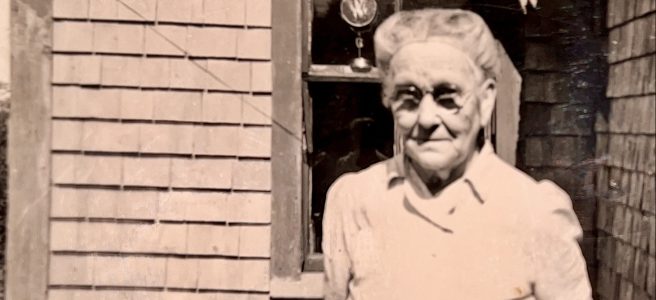
Gramma Ruby was born in 1875 in Annapolis Royal, Nova Scotia, Canada. At the age of twenty-four, she married my maternal grandfather, Samuel Harnish and moved into the two-story farmhouse he helped to build. He was a logger, which meant that he spent his days destroying trees in the Mi’kmaq heartland. Of course, that wasn’t how people thought about logging in those days.

Beginning in 1900, Ruby gave birth to ten children, five girls and five boys each one approximately two years apart. When a neighbor gave birth to two children in less than two years, Gramma would scoff that perhaps they did not know how to use a thimble. This story stuck for me because I have no idea how a thimble could be used as an effective form of birth control. It was, however, only one of the stories I heard of how judgmental she could be.

All her children lived to be healthy strong adults, even the one who contracted lock jaw from stepping on a rusty nail in the barn. Surviving tetanus was unheard of in those times, but Gramma dribbled bone broth between his lips until he could once again move his jaw.

Ruby assigned all of her children jobs. Whether it was knitting mittens and hats for winter or bringing in the firewood, everyone had at least one task to do. The boys did most of the outside chores. The girls separated the cream from the milk, stitched clothing, mended socks and did countless other things to keep everyone fed and clothed.

My grandfather Samuel died in 1927 at the age of fifty-two. His corpse was transported from the Halifax hospital back to the farmhouse where the Annapolis Royal Baptist pastor, performed the funeral. I imagine the viewing and ceremony took place in the front parlor. There was still a small organ in that room in 1956 when I first visited that home.

As soon as they were old enough most of Ruby’s children took jobs in town, teaching school, being housekeepers, or nannies. They all sent back the money they earned to support Gramma and their younger siblings. It was the Great Depression and everyone had to pitch in to survive, but Ruby continued to feed anyone who arrived at dinnertime. As a teetotaler, there would be no liquor in her house.

Four of Ruby’s sons and three of her daughter’s married, despite her strong objections. Why she tried to stop any of her children from marrying, no one in the family can explain.

Ruby was the only grandparent who was alive when I was born. I only met her once. I was five years old and she was eighty-one. I was disappointed that she was not as pleased to meet me as I was to meet her. She wasn’t the cuddly grandmother I had longed for. Ruby’s solution for getting me out of her way was to introduce me to a little girl,my age, who lived just down the road. It was a gift that has lasted seventy years.

Most of what I know of her is by way of observing my mother and my aunts and uncles. Many of them inherited Ruby’s critical tongue, organizational skills, and generosity to those in need. Those traits and the friend she introduced me too are my legacy from her.

Grandma’s Hands

Older white woman siting in a chair, knitting out doors under a tree

By the time I was born, only my maternal grandmother, Ruby was still living. From children’s books and the experience of some of my friends, I had an idealistic picture of what a grandmother was like. Unlike my grandmother, she usually lived nearby and came to visit often.

My grandmother lived in a country farmhouse, far away from where I was raised as a child. She had given birth to one child every two years until she had five sons and five daughters. About seven years after the last of her ten babies was born, Ruby’s husband, my grandfather, died. The year was 1927. If the genealogy records are accurate, she was 52 years old by that time.

The household was already organized with economy, precision and determination. A few of the eldest sons had gone off to earn money that could then be sent back home. The eldest daughters had long been taking care of the very youngest children and the ones in-between were used to tending to the farm chores and household duties.

Ruby’s children reaped the health benefits of her ability to prevent the spread of disease by meticulous attention to hygiene. She learned her native nursing-care skills from her mother. Grandma’s attentive watchfulness and analytical problem solving enhanced her reputation as one who could cure the sick.

My grandmother was a strong and demanding woman. Observation of my aunts, her daughters, has given me a taste of what this must have been like. She may have felt that the family’s very survival depended upon her ability to make decisions quickly and enforce them with a critical tongue. The precision cutting of her words sometimes left jagged scars that required healing over time. Yet, there was enough comfort, compassion and caring for the mending of wounds within the family and beyond. Those who were ill, or in need, could count on my grandmother for comfort and aid.

Despite the Great Depression and outward poverty of the little farmhouse, there was enough healthy food to eat and enough to generously share with others in my Grandma’s house. Guests were always welcome, whether they were friends or strangers. And, when the workday ended, there was music, books to read, lively conversation, jokes and laughter.

Even though I only got to see my Grandma in person once, each time we visited the old farmhouse its seemed that Ruby’s powerful spirit was still there. It was revealed in more than just the chipped Blue Willow dinner wear in the China cabinet, or the rocking chair by the kitchen window. It could be observed in the qualities of her children, my aunts and uncles. It emanated whenever a guest, whether child or adult, entered the back door. And, it is still reflected in the values and actions of her grandchildren.

When I curl a loop of yarn around my fingers to knit I think of my Grandma’s hands knitting warm socks and mittens. When I cook, I imagine Grandma’s hands kneading the many loaves of bread, baking the pies and churning the butter. When I help care for someone who is sick or in pain, I reflect on Grandma’s care that lives on long past her lifetime.

Perhaps the ideal Grandma that I imagined as a child visits me more now than she did when I was a child.