
Survivor

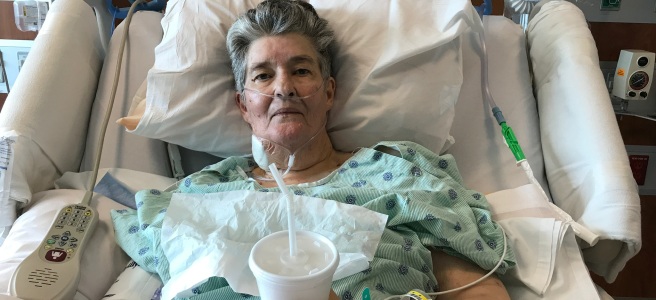
Four years ago I was reclining in an intensive care hospital bed, connected to fluids running in and draining out. High on steroids and pain killers I was ecstatic to be allowed to take a few sips of water. I prayed silently to my vital organs. “Heart, kidneys, lungs, please welcome your new partner, a liver from another body.” Silently I repeated this mantra over and over, asking that they all work as a team.

Each morning when the doctors from the transplant team made their rounds they asked “How are you today?”

I grinned and responded. “Fabulous!”

My gratitude was expansive. Thankful for the anonymous donor’s family, the team of surgeons, my treasured hematologist, my supportive family and generous friends. Most of all I was comforted by my loving spouse who was camped out, spending her days and nights in the cluttered Intensive Care room with me.

Just four months earlier I had sat in front of the sad-faced gastroenterologist. He said, “You know this was a possibility. The scan shows you have HCC, hepatocellular carcinoma.”

I did know, but suddenly I could not comprehend or focus on the doctors words. I glanced a my new-found friend who was sitting silently in the chair beside me. She was scribbling notes and staring at her lap. With immeasurable gratitude, I let go of trying to understand right now. Right now I needed to breathe deeply.

It was incredible that I had lived with Hepatitis C for more than forty years before reaching what many had predicted would be my end. It was astounding that despite my life-long bleeding disorder I had survived long enough that liver transplants were now sustainable, due to improvements in anti-rejection medications. It was amazing that even with my bleeding disorder I could not only survive a transplant, I would move up on the waiting list because of my bleeding disorder.

It was miraculous to me that the newest Hepatitis C treatment had cleared me of the virus, just a year before I was diagnosed with liver cancer. If this had not happened a transplanted liver would quickly be contaminated with the virus and the cycle of liver deterioration would begin all over again. Now a transplant would replace my cirrhotic liver, give me blood that would clot, and get rid of the spot that appeared on the MRI image that signaled alarm.

Recovering from the surgery took months of physical therapy, ongoing testing and regular check-ins with the surgical team.

Now, four years later I sit in a row with four other women awaiting a COVID-19 vaccine booster shot. We are all survivors. We have all lived longer than anticipated. We all live with compromised immune systems. We all need others to get vaccinated for COVID-19 and use recommended personal protective equipment.
Liverversary

Three years ago today, I was wheeled into surgery at 6:30 in the evening. I had been on hold in the Intensive Care Unit of Florida State University’s Hospital. During those eighteen hours, I was acutely aware that I was waiting for one person’s life to end so that my life could be saved. As I watched the clock move forward, I had time to sit with the choice I had made to have a transplant, then consider the choice some family would be making to donate the organs of a loved one. It felt like I had been given a gift I was not worthy to receive and that someone else had received a punishment they did not deserve.

I was also aware that I was not alone. Robin had slept on a day bed in the room with me the night before. More than forty friends and family members had signed up to be with me virtually through my hospitalization and recovery period. Some of those folks kept in touch with me through text messaging and well wishes online. Some of those folks lived close enough that they checked on our house while we were away. Many would help me once I returned home in more ways than I can count. I was overcome with gratitude and still am today.

When the transplant surgeon came to my room earlier that morning he asked me how I was feeling about the surgery. I said, “Excited and terrified.”

Since my blood did not clot without infusions of clotting factor, I was an unusual challenge for the surgical team. I was not the only person who was anxious. The nurse coordinator blurted out one day, “I’m sure you are almost as worried as I am.” I imagine she meant to say that the other way around. Hours of meetings, weeks of testing and re-testing were done to reassure everyone involved that this procedure could be done successfully. Still I’m pretty sure we all had our lingering doubts. Like a rollercoaster ride there was something risky and something thrilling about to take place. Something that would be written up in the medical journals no matter what the outcome.

Robin was in the waiting room that night for almost eight hours. It was 2:05 am when the doctor came out to tell her all had gone well. That wasn’t the end of the story, but it was a new beginning.

Tomorrow will be my three-year liverversary. I will never know about the person who was born with the liver that is now in my body. This is not a happy anniversary for that person’s family. I wish I could offer them sympathy. I will never know all of the medical specialists who read the results of tests I took or who were consulted on my unusual case. I wish I could say thank you to all of them. I don’t remember the faces of all the nurses or names of the respiratory therapists who assisted me when I needed them. I will always be grateful for their compassion. They taught me about the way kindness ripples out further than any one of us may ever realize.