Where Did I Go Wrong?

Statue of person holding drooping head with one hand

Tuesday morning I telephoned the doctor. I’d stayed awake most of the night wondering what I could have done that would cause my right shoulder to hurt. I certainly did not want to get an infusion of clotting factor, we had been enjoying a month at the beach and we had been there less than a week. I wasn’t actually sure I had a bleed in my shoulder joint. “It might just be arthritic pain from an old injury,” I said to the answering machine and asked the doctor to decide if I should get an infusion. The recorded message promised that a nurse would get back to me soon.

It had been years since pain in this shoulder had kept me awake. The first time I had an x-ray that showed previous injuries, joint damage, but not active bleeding. I went to a physical therapist and the pain eventually subsided although it came back whenever I didn’t keep the exercises up. I had no memory of a bleed in that shoulder, but the x-ray was proof.

The older I get the more previous injuries become painful. I feel ashamed that I can’t tell the difference each time a doctor says, “Why didn’t you call me sooner?” The implication is that I was in denial. That is probably at least partly true. However, I have also had false alarms and then the doctor’s scornful reproach implies hypochondria.

The next time I had pain in that shoulder was when we moved to Florida six years ago. That time I tried to return to the exercises but the pain got worse by the day. I had been packing and hefting books for our move to Florida. Motivated to meet the deadline for packing I suppressed my doubts until the pain became so intense I had no choice but to go to the Emergency Room and get infused. The doctor told me to rest the shoulder and wrote a prescription for a narcotic pain medication. Resting was not an option. The movers were coming in a day or two and we would be loading the car and driving south to Florida from Massachusetts whether my arm had healed or not.

We arrived in Tallahassee a few days before the moving van and settled the cat in our new house before the three of us checked into a motel. The next few days we spent shopping for essentials and delivering them to the house. We made frequent trips to the house to feed and reassure the cat. My arms loaded with supplies I missed a step and landed on the paved walkway to our new front door. Not only did I smash my glasses, bruising my face, I hit my right knee and landed on my shoulder, the same shoulder that had been injured packing books. That time it took several re-infusions of fibrinogen to subside and the doctor instructed me not to lift anything over five pounds.

So after calling the doctor’s office on Tuesday morning I waited, and waited, and waited. No return call as promised. Wednesday morning I called again and this time I was more sure of myself. The pain was worse. “Oh, I’m so sorry,” apologized the nurse. “I’ll schedule the infusion for this afternoon, can you get here by 2 pm?”

Sometimes I lie awake at night, and I ask, “Where have I gone wrong?” Then a voice says to me, “This is going to take more than one night.”

Cartoon boy extending both arms appears to be wailing

—Charles M. Schulz

A Belated Valentine to My Body

Dear Body,

In our 63 years, I have often forgotten to thank you or to say how much I love you. I do love you and I have come to admire so many of your features. While others of my generation look in the mirror and frown at the wrinkles on their face, the imperfections in their skin tone, thinning hair, and flabby chins I laugh. These superficial things mean little to me.

I remember when you and I were young and I saw you for the first time in a mirror. You were quite a charmer then. I smiled to see
the blonde baby curls that transformed over the years to brown with golden strands and I smile today when I see that gold has turned to silver.

You have done many hard and complex tasks for me over the years. You have endured my anger and my frustration at the things you cannot do and repaid me with a gentleness. Perhaps the thing I admire the most about you is your ability to heal and to learn new and different ways of responding when you have been assaulted.

Without fibrinogen you have faced many challenges that most other bodies have not confronted. You have adapted to blood that will not clot and made me trust you when others told me you would be unfaithful. When the doctors judged you as being weak you proved them wrong. They said you would desert me in less than 10 years and when you did not they said you would leave before we had spent 20 years together. So now after 63 years, I love you even more. I am so grateful for the gifts you continue to give me.

I’m sorry that I ever doubted you. I am sorry that I have wasted so much of our time together worrying about you.

You have never lied to me even though I have often ignored your warnings. Yes, I have even come to value the pain and fatigue you give me. You tell me when to slow down, get some rest, and when to call for medical assistance. I apologize for the times I have not paid attention to your needs, the weight I have gained, the times I have delayed treating an injury, and my stubborn streak that has overruled you.

Last week when I sat in the doctor’s office filling out the five-page medical history, I checked off the list that is your resume: bleeding disorder, stroke, arthritis, seizure, high blood pressure, and cataracts. What great life experience you have had, I thought to myself. So, with confidence I check off the box that says “good,” beside overall health.

Then I smile.

Baby Goes to Boston

It is standard practice for doctors and hospital staff to ask questions. From dentists to phlebotomists each new encounter brings the inquiries:
 
“How did they discover that you had a bleeding disorder?”
 
“How old were you when your bleeding disorder was diagnosed?”
 
“Were you born with the bleeding disorder?”
 
The questions rarely vary and neither do the answers I give. I try not to answer mechanically, understanding that the medical professional in front of me has never seen someone with my condition. What I have is rare, a one in a million chance.
There was no evidence at my birth that I had a bleeding disorder. The family physician identified there was something wrong when I was still a baby. Each time I received an immunization shot, I developed a large bruise. At first, the doctor apologized for the bruises caused by the injections. Later, he began to recognize that my bruises indicated am underlying problem. I am sure that this was simply confirmation for what my mother already knew. The elderly doctor seemed like a physician from an earlier century. He still made house calls carrying his large black leather bag filled with stethoscope, small surgical tools and many bottles of assorted pills. His office was a room on the first floor of his home. He was wise enough to know that he could not make a diagnosis of my problems himself, but he did know who could. He recommended we go to Boston and see Dr. William Dameshek.
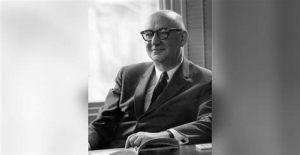
Dr. William Dameshek
My parents did not yet own a car and my father could not afford to take a day off from work. It was a half-day journey to Boston on the train. Because of the familiar nursery rhyme my father had read to me so many times, “Baby Goes to Boston,” I was happy to go on the trip. Mom had packed a lunch for us and the Raggedy Anne doll she had hand sewn. For me it was a grand adventure.
 
My parents were thirty-six years old the year I was born.  Mom and Dad had been married for ten years by then. Life was hard in those post- World War II days. My parents were renting a cold-water apartment on the second floor of a three-story tenement. The gray stucco building had an exterior staircase. Mom cleaned when she was anxious. She scrubbed the kitchen floor on her hands and knees in the chilly, walk-up apartment as she worried about how the bills would be paid. My father took the bus to work, carrying his lunch in a tin pail. He did his share of worrying too.
 
On the day we took the train to Boston, my mother carried the cash that was required to see this world famous specialist. My father’s health insurance plan covered only hospitalizations, not doctor’s appointments. The money was more than a month’s pay for my father.
 
That day there were no answers. First, Dr. Dameshek ordered some blood samples to be drawn. He interviewed my mother about our families’ medical history. Then he performed a physical examination and talked directly to me. His white lab coat was meticulously clean and crisp. From the first, I liked this man with the round face and relaxed smile.
 
A week or two later a letter arrived from Dr. Dameshek. He had determined that I had congenital afibrinogenemia. Over the next few years, Dr. Dameshek followed my progress carefully. My mother and I made routine train trips to Boston four times each year. Each time he greeted me enthusiastically, as if I was his guest, not his patient. He never missed an opportunity to teach me something. His explanations were clear and simple while remaining accurate. He beamed when, at three years old, I could say congenital afibrinogenemia. “Knowledge will save your life,” he said with pride.

Grab It and Go

As I pull out the suitcase, I see the satchel of items that I take whenever I travel. They are things I wouldn’t want to forget to pack. There is a toothbrush, toothpaste, nail clipper, comb, deodorant, a small tube of hand cream, the charger for my cell phone, my earbuds for listening and a pair of clean underwear. There is also a bag with a week’s supply of my prescription medications. If I’m flying, I will carry on this bag, so I will have the basics if my stored luggage doesn’t arrive at my destination

I’ve kept a bag prepared and ready to go at a moment’s notice since I was a child, although the contents have changed over the years. I had no need for prescriptions medications then, and cell phones hadn’t been invented yet. When I was young, it included pajama bottoms, but not the tops. The bag was what I needed for a stay in the hospital. I would be given one of those buttonless gowns to wear, the ones that tie in the back but flop wide open when you walk. Wearing the pajama bottoms satisfied my modesty.

For years, the only way I could get an infusion of clotting factor was as a hospital in-patient. These days it is rare for me to have to stay overnight in a hospital. Infusions can be done on an outpatient basis. Younger people who have bleeding disorders are often able to do their own infusions at home.

Pausing for a moment before I fill the suitcase with clothes and footwear, I feel thankful that now my “grab it and go” sack gets to be used for vacations more often than hospitalizations.