Survivor

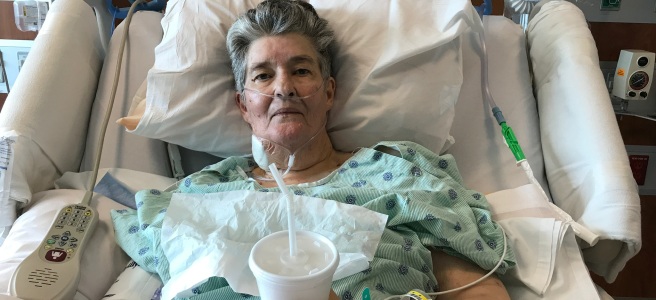
Four years ago I was reclining in an intensive care hospital bed, connected to fluids running in and draining out. High on steroids and pain killers I was ecstatic to be allowed to take a few sips of water. I prayed silently to my vital organs. “Heart, kidneys, lungs, please welcome your new partner, a liver from another body.” Silently I repeated this mantra over and over, asking that they all work as a team.

Each morning when the doctors from the transplant team made their rounds they asked “How are you today?”

I grinned and responded. “Fabulous!”

My gratitude was expansive. Thankful for the anonymous donor’s family, the team of surgeons, my treasured hematologist, my supportive family and generous friends. Most of all I was comforted by my loving spouse who was camped out, spending her days and nights in the cluttered Intensive Care room with me.

Just four months earlier I had sat in front of the sad-faced gastroenterologist. He said, “You know this was a possibility. The scan shows you have HCC, hepatocellular carcinoma.”

I did know, but suddenly I could not comprehend or focus on the doctors words. I glanced a my new-found friend who was sitting silently in the chair beside me. She was scribbling notes and staring at her lap. With immeasurable gratitude, I let go of trying to understand right now. Right now I needed to breathe deeply.

It was incredible that I had lived with Hepatitis C for more than forty years before reaching what many had predicted would be my end. It was astounding that despite my life-long bleeding disorder I had survived long enough that liver transplants were now sustainable, due to improvements in anti-rejection medications. It was amazing that even with my bleeding disorder I could not only survive a transplant, I would move up on the waiting list because of my bleeding disorder.

It was miraculous to me that the newest Hepatitis C treatment had cleared me of the virus, just a year before I was diagnosed with liver cancer. If this had not happened a transplanted liver would quickly be contaminated with the virus and the cycle of liver deterioration would begin all over again. Now a transplant would replace my cirrhotic liver, give me blood that would clot, and get rid of the spot that appeared on the MRI image that signaled alarm.

Recovering from the surgery took months of physical therapy, ongoing testing and regular check-ins with the surgical team.

Now, four years later I sit in a row with four other women awaiting a COVID-19 vaccine booster shot. We are all survivors. We have all lived longer than anticipated. We all live with compromised immune systems. We all need others to get vaccinated for COVID-19 and use recommended personal protective equipment.

I remember

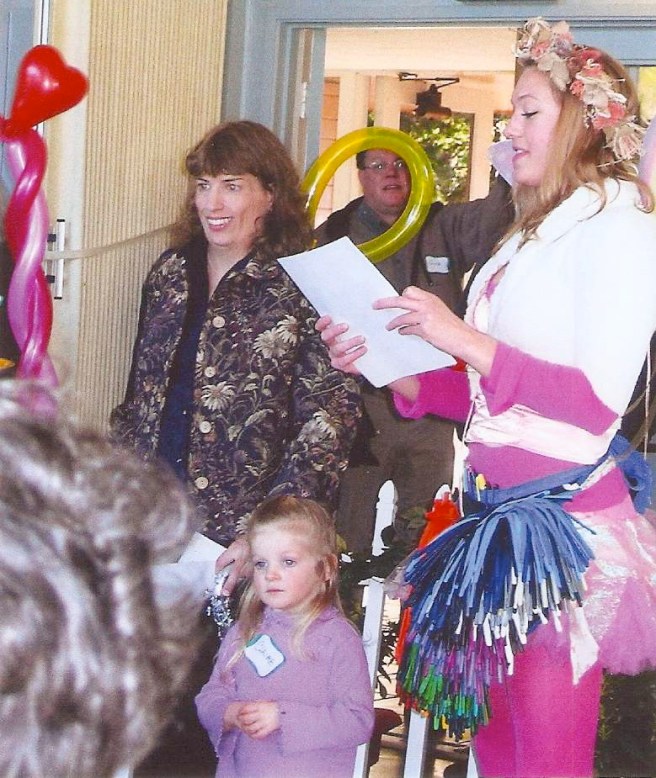
On March 14th, 2007 Cindy died of liver cancer. It had been only a few weeks since her extravaganza 40th birthday party. The celebration, which she planned herself, included costumes, food, activities for children and adults, and presents for all. Each person she invited to the party, whether they could attend or not, received a floaty pen she designed engraved with “Bloom where you are planted.” She knew as she planned that party that the liver cancer was in it’s final stages and there was nothing else that could be done to slow her death. She knew it would probably be her last birthday and she wanted it to be a grand celebration. I believe she wanted her friends to remember her with a smile

On Superbowl Sunday in 1995, I signed on to the National Hemophilia Association online. About 25 participants sat in front of our computers and introduced ourselves. That was how I met Cindy. She was in California. I was in Massachusetts. She was 28 years old and bubbling with enthusiasm. Her life story was different from my own in many ways.
 
Cindy had been diagnosed at birth with hypofibrinogenemia when her umbilical stump kept bleeding. Her fibrinogen level was abnormally low. From infusions of cryoprecipitate she had contracted HIV and Hepatitis C. She developed Transverse Myelitis, which compromised her ability to walk. None of this slowed her down much though.
 
She and I corresponded for years, we talked frequently on the telephone, but we only met once face to face.
 

She wrote to multitudes of friends, many who also had some of the same medical issues she had in her life. She actively sought out as many women as possible who had medical problems similar to her own. She wrote to the Hemophilia Treatment Centers Program Specialists requesting that they give their patients with rare bleeding disorders her contact information.  She created a website called Shemophilia and inspired a listserv for people with Fibrinogen (Factor I) Blood disorders and their close relatives.

 
Cindy traveled frequently to attend medical conferences, often as a speaker or panelist and wrote lots of articles. She published numerous articles and contributed to a book written by Bill Hayes entitled Five Quarts of Blood. In countless ways she put pressure on hemophilia organizations to include all bleeding disorders and genders. She was also very involved in HIV and disability communities. The advocacy work she accomplished in her lifetime spread across continents.
 
Her mission was to educate, inform and inspire others. It was her life’s work.
 
Today I also think of her playfulness of spirit, her love of children, her compassion and generosity. I remember her long and engaging search for the ruby red frogs, her holiday greeting cards written and decorated by her feline companions (Skipper, Grady and Cinderella) and her silly sense of humor.