
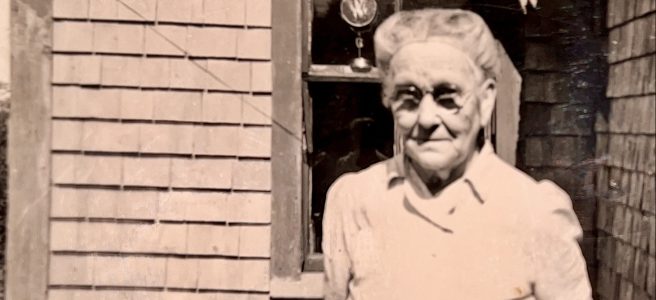
Ruby Geneva Harnish

Ruby Geneva Harnish

Gramma Ruby was born in 1875 in Annapolis Royal, Nova Scotia, Canada. At the age of twenty-four, she married my maternal grandfather, Samuel Harnish and moved into the two-story farmhouse he helped to build. He was a logger, which meant that he spent his days destroying trees in the Mi’kmaq heartland. Of course, that wasn’t how people thought about logging in those days.

Beginning in 1900, Ruby gave birth to ten children, five girls and five boys each one approximately two years apart. When a neighbor gave birth to two children in less than two years, Gramma would scoff that perhaps they did not know how to use a thimble. This story stuck for me because I have no idea how a thimble could be used as an effective form of birth control. It was, however, only one of the stories I heard of how judgmental she could be.

All her children lived to be healthy strong adults, even the one who contracted lock jaw from stepping on a rusty nail in the barn. Surviving tetanus was unheard of in those times, but Gramma dribbled bone broth between his lips until he could once again move his jaw.

Ruby assigned all of her children jobs. Whether it was knitting mittens and hats for winter or bringing in the firewood, everyone had at least one task to do. The boys did most of the outside chores. The girls separated the cream from the milk, stitched clothing, mended socks and did countless other things to keep everyone fed and clothed.

My grandfather Samuel died in 1927 at the age of fifty-two. His corpse was transported from the Halifax hospital back to the farmhouse where the Annapolis Royal Baptist pastor, performed the funeral. I imagine the viewing and ceremony took place in the front parlor. There was still a small organ in that room in 1956 when I first visited that home.

As soon as they were old enough most of Ruby’s children took jobs in town, teaching school, being housekeepers, or nannies. They all sent back the money they earned to support Gramma and their younger siblings. It was the Great Depression and everyone had to pitch in to survive, but Ruby continued to feed anyone who arrived at dinnertime. As a teetotaler, there would be no liquor in her house.

Four of Ruby’s sons and three of her daughter’s married, despite her strong objections. Why she tried to stop any of her children from marrying, no one in the family can explain.

Ruby was the only grandparent who was alive when I was born. I only met her once. I was five years old and she was eighty-one. I was disappointed that she was not as pleased to meet me as I was to meet her. She wasn’t the cuddly grandmother I had longed for. Ruby’s solution for getting me out of her way was to introduce me to a little girl,my age, who lived just down the road. It was a gift that has lasted seventy years.

Most of what I know of her is by way of observing my mother and my aunts and uncles. Many of them inherited Ruby’s critical tongue, organizational skills, and generosity to those in need. Those traits and the friend she introduced me too are my legacy from her.

Roots and Trees: A Familial Legacy in Nova Scotia

Graywood Cemetery

My grandfather and great grandfather cleared forests to build homes and establish farms in Nova Scotia, Canada. They made their living chopping down trees for timber, rolling logs down Bear River, loading them into cargo for shipment abroad. Now those ancestors are buried in ground sheltered by trees. My family roots are entangled with trees.

I have watched as my uncle split wood and fill the cast iron stove so that my mother could make breakfast. I have seen the sap drip from a maple tree into a tin bucket and smelled the smoke mingled with the sweet scent of sap boiling until it becomes syrup. I have climbed my grandmother’s apple tree and sat perched on one of its branches. Some of my fondest memories are of trees.

On my front porch there is a pile of cord wood. When the first chill of winter comes. I will strike a wooden match on the side of the stove and hear the crackle as that match catches the tinder and kindling into flame. I will feel the chill leave the air as the heat from the stove warms the dining room.

Most of all I will be grateful for the trees that remain standing. Without them on the planet we would not have clean air to breathe and fresh water to drink.

Day 24 (of 31 days of free writing)

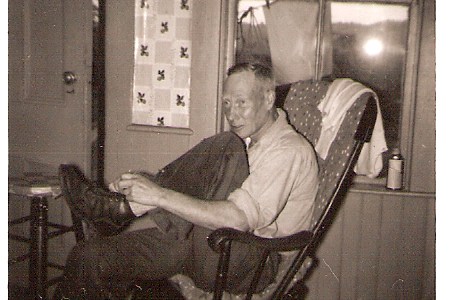
Uncle Byron

Older man with sunburn face sitting on a rocking chair inform of a window, tying one shoe

Uncle Byron sat in his rocking chair watching the sun set. The supper dishes were removed from the big dining table that in his childhood was used to spread out the meals for his nine siblings and whatever guests happened to come for a visit at mealtime. I piled the dishes in the sink and heated the water over the wood stove to wash and rinse them clean again, I watched as Byron gazed out over the front pasture that sloped down to the road. The road had not yet been paved and an occasional automobile passing by would raise a sandy dust as it rumbled over the gravel. The kitchen window faced the maple sugar camp that Byron had operated since he was a young man. But, Byron did not look in that direction; instead his eyes were fixed on the display of color in the sky from the setting sun

Slowly, Byron pulled out a cigarette paper and his pouch of tobacco. With the mindfulness of a Buddhist monk, he curved the paper with his fingers and filled the ridge with a small portion of dried tobacco. Then with care and gracefulness, that revealed how often he had practiced this ritual in the past, Uncle Byron rolled the paper around, licking it on the edge to hold the two ends together. The match he struck against the wood stove and as he exhaled he filled the room with the aroma of smoke.

He sat and rocked and watched the setting sun, seemingly unaware of the clatter of pots and pans. The women who were washing, drying and putting away seemed equally absorbed in their task. Byron had spent all of his life in that house, with the exception of his tour of duty in WWII. He had cared for his mother until her death and tended to the farm chores by himself when his five sisters and four brothers moved away one at time. He seemed during these times very comfortable in his solitude.

However, on the evenings when family and friends were in the house, Byron’s face displayed contentment. When the day was coming to a close, after each platter and plate, cup and saucer was set back in it’s spot in the china cabinet, people drifted back to the dinning room table. The deck of cards was shuffled and dealt to each player. The stories of neighbors and family were told and re-told. There was usually at least one joke about Byron’s elder sister whose Baptist faith scorned card playing as much as alcohol consumption. What would she think if she could see them shuffling and dealing for hours on end, or if she new that her own husband made beer in the basement?

Even Byron’s humor was tempered with compassion. He was a quiet man and when he spoke his words often revealed his empathy for those who were small or weak or ill. The night his youngest sister was killed in an automobile accident, it was Byron who received the telephone call. He sat by himself until dawn, not conveying the news to other family members. When asked, he said he did not want to upset their sleep.

When we arrived at the farmhouse for a visit or left to return home, Uncle Byron gave a hug that was so tight it seemed he did not want to let go. Had he suffered enough loss in his life already that his heart could bear no more?

The Rose

The only time I remember speaking with my Great Uncle Midge was when I was 14 years old and he was 91. I was in Nova Scotia with my parents to visit family and someone mentioned that Midge was in a nursing home and could use a visitor.

I didn’t want to go; in fact, the thought of meeting this aged relative for the first time frightened me a bit. I went anyway. Midge had been sent to the nursing home to recuperate after falling off his hay wagon. I was also told that during the previous winter he had gotten into a fistfight with one of his neighbors. Both of the elderly men wanted to be the one to shovel out the snow from around the house of a woman who had recently been widowed. I was somewhat shocked to hear about a man who had lived 91 years still mowing hay and fighting over a woman.

The bed Uncle Midge lay on was in the sunroom of the nursing home and his face spread out a welcoming smile when I sat down beside him. “You’re Horace’s daughter, aren’t you?” he said. Until then, I’d been told that I looked more like my mother than my father. I was surprised and very impressed that by looking at me, he could so quickly identify my place in the family. Then he said, “I’m old and probably going to die soon, but I don’t mind. I’ve lived a great life.” As I recall I could think of no response.

Then he proceeded to talk about our family. “You know,” he said, “we have a lot of ministers in our family but, it’s not our fault.” I giggled at his assessment, but he seemed quite serious and continued. One by one, he named each relative who had joined the clergy. Moreover, one by one he said, “Now he wasn’t our fault. He took after his mother, you know.” Or, for several he said, “He wasn’t our fault, because he always favored his father.” In each case, he ruled out any responsibility to our lineage. It was a large family, but to my knowledge, he didn’t miss one who had been called to the ministry. By the time he was done, he seemed quite content to have offered me proof and I was barely containing my laughter.

Now, I believe that he was trying to get the reaction from me that he did. He was trying to get his teenage grandniece to giggle. Perhaps, he was also trying to get me to let go of a few stereotypes and open my heart a bit more.

As the conversation ended, he thanked me for coming and announced that his lady friend (the woman he had won that fistfight over last winter) was about to arrive. He indicated that he wanted me to go now. As I was leaving his bedside, in walked a woman with white hair, no teeth and a big smile. She was caring a single rose.

Not Ivy

“Ivy had hands just like yours,” my mother said as I struggled to practice my piano lesson. “Her fingers didn’t reach a full octave either, but it didn’t stop her from playing the piano.”

It made me want to scream, “I am not Ivy.”

Ivy spent every weekend doing the laundry and cooking for her brother Byron and their mother. As far as anyone knew, she had made no friends in Kentville and had never been smitten by love. After her mother died in 1959, Ivy continued to spend her days off from work with Byron at the farmhouse.

On a Sunday night in late June of 1962 Ivy died in a car accident. She was driving back to her apartment in Kentville from her weekend at the farmhouse. The Royal Canadian Mounted Police (RCMP) notified Byron who sat alone in the dark until morning before calling his brother Guy. The telephone tree was started from one sibling to the next. “I can’t believe it,” my mother said as she hung up from the call she received that morning. Even though she was forty-four years old, they still considered Ivy the baby of their family. She had been the last to be born and now she was the first to die. Those who had moved out of Nova Scotia caught flights from Toronto, Montreal and Boston. They had not been together since their mother had died three years earlier.

When some of Ivy’s brothers and sisters met with the RCMP to hear the report of what had caused the accident, they learned an intoxicated driver had tried to pass her car. Ivy slowed down to let him pass. The driver saw an oncoming car and swerved to get back into the space he had just left. He didn’t notice that the car he had attempted to pass was not where it had been before. He knocked Ivy’s car off the road. Trying to do the other driver a favor, she lost her life.

As mourners came to her funeral I heard people saying, “She was so loyal to the family homestead.”

“She took care of her mother and her brother and never thought about herself.”

My mother’s grief was complicated by regret. Ivy was four years younger than my mother and Mom felt closer to her than her older sisters. However, a disagreement the last time they had seen each other had ended in angry words.

After Ivy’s death, when my mother compared me to Ivy it made me feel like spiders were crawling up my back. On my birthdays Mom began commenting, “If Ivy was still alive it would be her birthday this week too.”

On a chilly autumn night in 1993, I had left work about ten p.m.. I was tired, having worked since early that morning. I was enjoying the 45 minutes of quiet in my car. The traffic was light as compared to the usual rush hour times of day. I had traveled this route daily. The straight, well-lit highway required little thought or concentration.

The harvest moon seemed to smile down on me from a cloudless sky. When I lowered my eyes back to the road I spotted a skunk meandering across the highway in the path of my car. The slow-moving skunk seemed out for a relaxing stroll. Without thinking, I jerked the steering wheel to the left in an attempt to avoid crushing the critter. Instantly I realized my car was now heading toward the median strip, and the oncoming vehicles on the other side. I yanked the wheel of the car, this time to the right, and slammed my foot on the brake. This action sent the car out of my control. I was forty-four years old. My first thought was “I’m going to die just like Ivy.”

In a heartbeat, I hit the curb on the right. The car flipped over as I gripped the wheel in disbelief. In a few brief seconds, it was over. My car toppled upside down, and landed right side up in a strip of grass between an exit and an entrance ramp. I stared at the tree, just inches in front of my car.

I unbuckled my seat belt and stepped out to see a beautiful night sky filled with glowing planets and blinking stars. I averted my eyes from the crumpled car beside me. In minutes a State Police trouper came to investigate. A truck driver who witnessed the accident had reported it. The trouper asked, “Did you fall asleep at the wheel?”

I responded, “No, I was awake for the whole thing.” I wanted to laugh or maybe cry. Adrenalin was still making my heart pump faster than usual. I was alive and I could feel giggle bubbles rising in my chest. I wanted to shout, “I’m not dead!” The police trouper looked like a no nonsense kind of person and I decided to suppress my joy for the moment.

“We’ll get your car towed and I’ll drive you to the station where you can call someone to pick you up,” he said. I could see him watching me walk as he led me to the cruiser. I was still a little dizzy and wondered if the car had rolled over more than once. My knees were weak but I had no trouble getting into the cruiser. I babbled about the skunk and how I hadn’t wanted to hit it. He glanced at me in his rear view mirror and said, “Next time, hit the skunk.”

When we got to the State Police barracks I realized that my first call should be to my doctor. As a person with a bleeding disorder I could not believe that I had escaped with no injuries. My hematologist was on call. He listened and then said, “I want you to put the phone down and feel all over your head for any sore spots.” I looked around at the police officers behind the desk and heaved a sigh. This I thought would cause the officers to question my sanity. I did as the doctor requested. I ran my fingers across my face and massaged my scalp. “No soreness,” I said, picking up the phone again.

“Good,” he said, “but I want you to come to the hospital anyway.” Like me he was doubtful that I had escaped with no internal injury.

Next, I called my spouse, Robin. “Would you come get me?” I said, trying to keep my voice as calm as possible. “I’m at the State Police Barracks. I’m fine. I’ll tell you the story when you get here.”

After examination in the hospital it was determined that I was unhurt. Back at home as I drifted off to sleep, I thought for one last time, “I am not Ivy.”