The Evolving Nature of Truth

When I was younger I believed that truth was solid, something that was absolute. What I learned as true in my history classes I find now was a one sided view of what really happened. What science proved to be true when I was younger has now been shown to be false. Just look what happened to Pluto! Once it was a planet, then it was not, and now it is labeled a dwarf planet with one of its five moons composed of organic macromolecules that may be ingredients for the emergence of life. It seems clear to me that more research will bring new truths to light. Recently I read that there is finally some attention being paid to the placebo effect. In fact some people do have the ability to heal their own bodies based on what they believe. Others of us, myself included, lack this talent. The lesson here is not to scoff at those who are lucky enough to have this power. The research isn’t there yet, but it appears that this ability may be genetic. It’s easy for me to understand why some people don’t always believe in the same things. The possibilities for what is true is limitless and the universe is expanding.

Day 6 (of 31 days of free writing)

You Say Tomato

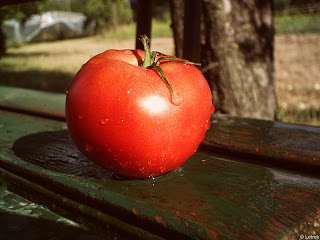
Ripe tomatoes on a outdoor table

Uncle Bill picked a ripe tomato from the garden and rinsed the dust off under the garden hose. Then he sat down at the picnic table and surveyed our backyard. From the look of satisfaction on his face, Uncle Bill was getting great enjoyment from that fresh tomato. To my surprise, he took a large bite out of it, the way I would have bitten into an apple. I shivered, thinking about the acidity.

“Do you want some salt?” I asked.

“Nope, I like it just the way it is.”

I slid into the bench across from him and watched him closely, waiting for the tomato juice to dribble down his chin. It was so hot that afternoon, neither of us felt like talking anyway. We listened to the cicadas announcing the temperature with their clicking.

Languidly Uncle Bill took a second bite of the tomato, and then he took another. His short-sleeved shirt was spotlessly clean. By the time he finished that tomato, not one drop of juice had escaped his lips or stained his clothes. It seemed like a magic trick to me.

I was sure that my mother would have preferred to be outdoors like her brother Bill and me, but instead she was brewing tea for Auntie Anne. Two bone china cups and saucers would be on the table with a sugar bowl and a pitcher of milk. Auntie Anne would be chattering away like the cicadas while my mother listened and nodded politely.

Uncle Bill and his wife, Anne, were visiting us for a week. They lived in Toronto. Auntie Anne had grown up in England. She pronounced her words differently than we did. Mom said she was a “war bride.” I didn’t know what that meant.

“I can’t imagine what he sees in Anne,” my mother said after they had left. To my mother, Anne was an annoyance. When Auntie Anne unpacked her suitcase it contained several dresses, pointy-toed shoes and a hat decorated with artificial flowers. Mother thought Anne was superficial and vain. Anne’s appearance, religious beliefs and values were different from ours. “She’s not like us,” mother would say. For her brother’s sake, my mother kept this opinion to herself.

In February of 1964, Uncle Bill went out to shovel snow after dinner and died suddenly of a heart attack. He was 52 years old.

Five months later, Anne traveled alone to our house for a visit. Anne unpacked the hats and sundresses from her suitcase as usual. After supper she asked my father to bring out a deck of cards so we could play Bridge. Anne had met Bill, playing Bridge at the USO. Mom found it hard to imagine that her brother would have enjoyed such a pastime. It seemed foreign.

We were used to card games that were less complicated. We were in the habit of laughing and joking during a card game, not keeping track of what had been dealt and played.

None of us played Bridge; Anne said that didn’t matter. Patiently she instructed us in how to rotate shuffling the deck, passing it to another person to deal. She explained how to bid, name trumps, and lay out the dummy hand. Auntie Anne took Bridge seriously and in spite of our lack of interest, she insisted that we play each night together.

After that visit on her own, she would come and stay with us once each year. Since we only played Bridge when she was visiting, we needed a refresher each time. She tolerated our lackadaisical attitudes the way my mother had kept silent about her vanity. It seemed to me that Uncle Bill still had a hand to play and hearts were trump.
Mountains from Molehills


Coffee
Originally uploaded by
lewis foa
For the past few weeks, I have been sorting through my belongings in preparation for moving later this year. Among the papers, I found a piece that my father wrote.

Note from the author: All characters in this article are imaginary. Any resemblance to any person living or dead is strictly accidental.


It has been reported in a magazine advertisement that the battle of Waterloo was lost to Napoleon because he had eaten a green peach and suffered from a stomachache at the time. Possibly, it was a plum, but it doesn’t matter too much. Fruit was cheap in those days, and the point is, it just wasn’t worth it. If this proves anything at all, it is that Napoleon was as easily influenced by trivia as the rest of us.

Back in the sixteenth century, the English used to send ships to North America to bring back sassafras bark. The survival ration of the sailors was considerably less than that for a modern astronaut, but England was short of sassafras bark so there were always plenty of volunteers. Of course, the voyage of Christopher Columbus was just as urgent. He was looking for spice. A more cautious man might have spent the money on research to develop a tin can. Columbus liked excitement. Even though he missed his goal by a hundred and eighty degrees of longitude, we must admire his spirit. He tried.
Most of us are broad minded about the right of others to have little idiosyncrasies. If someone wants to spoil a good cup of tea by adding milk to it, let them do it, as long as they drink it. We don’t mind at all, if someone insists on having sugar in their coffee. We realize that everyone can’t be a connoisseur. We value our right to disagree on matters of importance. We inherit this trait from our nation’s forefathers. Taxation without representation was discussed calmly enough. The first open act of violence in the American Revolution, quite naturally was prompted by the tax on tea.

One of our most important assets is coffee. The history of the coffee house is long and honorable. Without the aid of a single folk singer, they were doing a good business in the days of Shakespeare and [Ben] Jonson. That highly respected institution Lloyd’s of London, as anyone knows, started as a coffee house. Here, the men who underwrote marine insurance gathered to transact their business. It solved the problem of their overhead cost. It also solved the problem of the coffee break.

Sometime in the seventeenth century, we find a Londoner complaining to his diary about the difficulty of getting a good cup of coffee. He charges the coffee merchant with diluting his product with chicory. Now there is nothing wrong with chicory as a drink of course but a basic must for mixed drinks is that they be alcoholic. We all know that coffee is to be real coffee, must be pure coffee. We can expect the worst of a man who would mix chicory and coffee. It will then come as no surprise to you to hear that the chicory he bought was colored with Venetian red to make it nearer the color of coffee. The man who sold him the Venetian red was also dishonest. He was adding brick dust to his product.

One chilly fall evening in the colonial days of our country, a weary traveler stopped at a wayside inn for a night’s rest. When he was seated comfortably in front of the fireplace, his host came in to see if anything further could be done for his comfort. The traveler said, “Yes, do you have any chicory?” the landlord admitted he had. “Good,” said his guest, “would you bring it here please?” His host dutifully went to the kitchen and returned with the box in which he kept his chicory supply. “Set it there please,” said the traveler, nodding toward the table. When the landlord had done as he asked, he continued, “Now, go brew me a cup of coffee.”

It was not everyone who had the wit to get a good cup of coffee in this manner. There were those people who felt the best method was to carry a portable coffee grinder about with them and demand coffee beans. They could then grind and brew their own the more imaginative, however, felt that the legal approach was the only civilized way to handle the problem.

“No vendor of coffee may adulterate his product with any substance whatsoever unless he declare to the purchaser of said coffee the nature of the adulterating substance and the percentage of such adulteration.”

There were, of course, suitably severe penalties for any infractions. Only a person who lives close to the land of the wooden nutmeg would be cynical of the results. Sad to relate the sneer was justified. The coffee merchant kept up his trade with the seller of chicory who continued to color it with Venetian red diluted with brick dust. This mixture was then ground very fine, moistened slightly, and pressed into a mold just the shape of a coffee bean. This took care of the character who was lugging around a coffee mill. As for the legal angle he could feel quite righteous. He was not selling adulterated coffee. Coffee was the one thing he had left out.